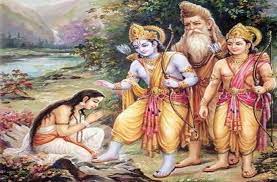
Yesterday, my seven year old daughter asked me to tell the story of Ahalya. I told the story. After that she asked me to tell another story. Her curiosity is immeasurable. However, I asked her some questions and told her to think over them. For example, I asked, Is Gautama Rishi right in cursing her? What is Ahalya’s fault? Is Indra good? By asking her questions, I got a plenty of time to do my own things, at the same time, keeping her busy pondering over them! I believe, any mythological story carries the essence of life, an art of living. It should never get interpreted literally. I tried to explain my views about Lord Ganesha’s birth, story of Dhruva, Eklavya, Jarasandha, and Ramayana. You may have your own interpretation which also is right in its own way! That’s the beauty of mythology.
Coming to the interpretation of Ahalya! Hala means plough. Ahalya means unploughed, pure, or innocent. It’s Prakriti. Indriya means “belonging to Indra“. It primarily means our sense organs. We perceive the world through our senses. In fact we become victims of our senses. We form our desires, mainly because of our senses.
Buddha says, “Desire is the root cause of all evil”. Evil acts are the result of our desires which in turn are the result of our senses. Our senses provide feedback to our brain about the the things perceived as pleasures and pains. This gives rise to desires. So Ahalya, no wonder, performs evil act under the influence of Indra!
Gautama is composed of two roots. Tama means darkness and gŐ means bright light. Gautama means dispeller of darkness. In the context of buddha (also called Siddhartha Gautama), it refers to a person who transcended desires and overcome ignorance.
Upon Gautama’s curse, Ahalya becomes a rock! Rock symbolises ignorance. It is Achetana, meaning, it lacks consciousness. We become engulfed by ignorance, means, we become rock.
It’s only when Lord Rama’s feet touch that rock, that the rock regains its consciousness. That’s when Ahalya gets reunited with Gautama. And they have a son named Shatanand, which means, eternal bliss! Now, some interpret this scene (Rama’s feet touching the rock) as a divine grace. It’s only after the Divine grace, that you regain your consciousness. However, I would also like to interpret it as a pure surrender. It’s the other way round. We bow to Rama, or bow and touch our head to His feet, meaning, we surrender unto Him. To me, the surrender comes first before the divine grace. Or, to put it in other words, surrender is a sign of having received the divine grace. Or, surrender makes us realize His omnipresent, and ever flowing Grace.
Gautama curses Indra and his body gets covered in a thousand vulvae (desires). After Indra conducts severe penance (meditation), the thousand vulvae turn into eyes. He becomes Sahasraksha. It means, there’s nothing which is hidden now. We, our senses, perceive the full Reality as is, in its true essence!
In summary, to earn Shatanand, to regain Gautama, to make our senses Sahasraksha, we, the rocks, must surrender, bow to His lotus feet!
I did not share this view with my daughter as I firmly believe, one fine day, with Lord Rama’s grace, like Ahalya, like all of us, she would also realize the meaning of the story in her own way.
 Reinvent The Self!
You must be logged in to post a comment.