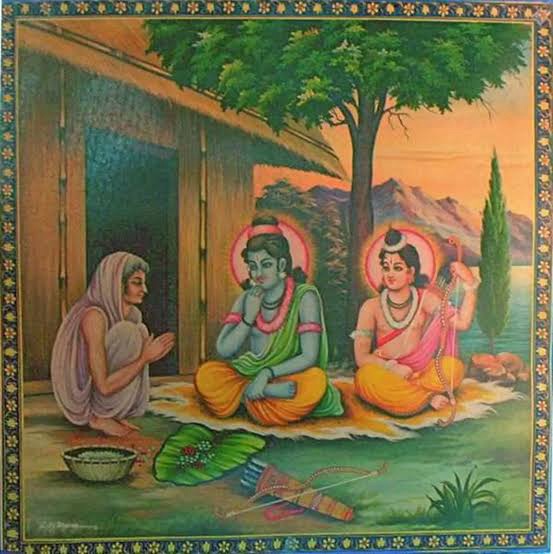
Ramayana is so fascinating that it compels me to think about my interpretations about small stories it contains. Last time we looked at Ahalya story. This time, let us take Shabari’s story.
There are a lot of angles through which we can interpret this story. For example, it is an epitome of love, devotion and gratitude. What can we offer to the Lord himself? We have nothing to offer Him that would ever match what we receive from Him. All Shabari had is the berries collected while cleaning the roads. However, she doesn’t offer Rama only the berries. Instead, she tastes each berry, makes sure it’s sweet and only then she offers it to Rama. This is why Shabari offers him a way more than what she has. Love. Gratitude.
Lakshmana, while he sees her offering half-eaten berries, gets furious at first. Rama then explains to him what is the true love looks like. Tears start flowing out from Lakshmana’s eyes after realising that there’s Shabari who is certainly a better devotee of Rama. He used to consider himself the best devotee of Rama till this time. In a way it’s a story of Lakshmana’s discomfiture.
Also, another message Shabari gives us is, when it comes to attain the love of God, nothing, like age, the caste, comes in the way. We all are equal in the eyes of the Lord.
Another way to interpret, is when I compare it with the myth of Sisyphus. Sisyphus gets a punishment. He would have to push a rock up a mountain; upon reaching the top, the rock would roll down again, leaving Sisyphus to start over. Eternally. First, to me, it has no end whatsoever. Like eternal damnation. Shabari’s story has a pleasant end. She meets Rama! Secondly, Sisyphus story connotes the nihilistic interpretation, or points at the absurdity of life where everything is irrational or meaningless. Whereas, Shabari’s story has an essence of life.
To me, thse stories have one similarity. Sisyphus, due to his defiant desire to continue, endures the punishment by trying to find the meaning in the process itself. Shabari too, due to her faith and devotion, endures her life happily.
Shabari also, for most of her life continues to collect the berries, clean the roads in Ashram, decorate them with flowers, every day, as if Rama has already come to visit her as promised by her Guru, sage Matanga.
We say in Hindi, “Ummeed par duniya kayam hai” or “Hope sustains the world”! There’s a story wherein there’s a cat who finds her locked in a room. She sees a bowl above the tall cupboard. With the hope that the bowl might contain milk, she continues to jump. Many days pass. Still, she continues to jump. One day, she is able to get on to the top of the cupboard only to find the empty bowl! That moment, the cat dies.
In Shabari’s case, it’s neither expectation, nor hope but sheer Faith that allows her to do her duty and have patience till that moment. Shraddha and Saburi, a central message in Sai Baba’s teachings.
Now faith is the substance of things hoped for, the evidence of things not seen”!
Hebrews 11.1
Faith is completely independent. It doesn’t depend even on time. Jesus conveys a very powerful truth in his message while revealing the power of Faith,
“Therefore I tell you, whatever you ask in prayer, believe that you have received it, and it will be yours.”
Mark 11:24
To elaborate more succinctly, a hope would say:
Meri Jhopdi Ke Bhag Aaj Khul Jayenge, Ram aayenge!
The doorways to my happiness will open today, Ram will come!
And Faith would say:
Bajao Dhol Swagat Mein Mere Ghar Ram Aaye Hain!
Play the drums in welcome, Ram has come to my home!
This is my version of Shabari, unquestionably amongst the greatest of His devotees, a rare combination of a karma yogini and bhakti yogini!
 Reinvent The Self!
You must be logged in to post a comment.