This essay offers a contemplative and symbolic reading of the Panchamukhi Hanuman episode found in later retellings of the Ramayana. Rather than approaching the narrative as theology or historical myth, it is interpreted here as a phenomenological map of inner discipline, describing successive stages in the regulation of desire, attention, and fear.
Drawing loosely on Yogic psychology—particularly the concept of kleshas as articulated in the Patanjali Yoga Sutras—the figures and events of the narrative are treated as representations of mental processes encountered in sustained contemplative practice. This reading does not claim textual authority or traditional exegesis; it is offered as one interpretive lens through which myth can be engaged as a reflective tool for understanding the inner life.
In some versions of Ramayana, not in Valmiki’s version, there’s a mention of Ahiravana, the king of the netherworld (Patala loka). The blog tries to explain its spiritual correspondence in its own way. Interpreted psychologically, Patala—literally “that which lies beneath”—can be read as a metaphor for latent or unexamined mental tendencies that remain inaccessible to ordinary self-regulation.
Ahiravana and Mahiravana were brothers of Ravana. In Ramayana blog, we saw that Hanuman can be read as a figure of meditative attention, Ravana as ego. Ahi means serpent and Mahi connotes the huge proportions or the great size. In mythology, serpent is a symbol of desires and temptations. Patala loka connotes the inherent hidden nature as Patala means beneath the surface. So, in short, these are the brothers of ego, signifying the hidden and often unpredictable desires.
After Indrajit (egoic aspect which controls our senses) is slain by Laxmana (power of Awareness), ego still has some of his brothers left. Spiritual aspirant, at this stage has full control over his senses. Meaning, he has kept all the six doshas /vikaras like kama (lust), krodha (anger), lobha (greed), moha (delusion), mada (pride) and matsara (envy), under the check. Having established victory over his body, the spiritual aspirant now has to work on his mental afflictions, that give rise to some of the innate, hidden or unpredictable desires. These mental afflictions are the kleshas as explained in the Patanjali Yoga Sutras. Those are Avidya (Ignorance), Asmita (ego), Raga (attachment), Dvesha (Aversion) and Abhinivesha (Fear of death, Clinging to Body).
When Ahiravan kidnaps Rama and Laxmana and take them to Patala, it’s Hanuman who needs to rescue them. Makaradhwaja is Hanuman’s son. It might mean internal conflict (as Makara is partly a fish and partly a crocodile signifying duality). It might also connote to the Abhinivesha as crocodile keeps its prey attached to the ocean (samsara), she never lets its prey go out of the waters. At the same time, fish points towards the freedom as it swims freely in the water. So in a way, what this means is, Hanuman has to confront the inherent internal conflict that lies within.
After defeating Makaradhwaja, Hanuman enters the place where Rama and Laxmana were held captive. He assumes the form of bhramara and stays behind the Mahamaya (Patal goddess) statue. Hanuman’s assumption of the bhramara (bee) form invites a contemplative association with Bhramari Pranayama, a practice in which sound and vibration are used to withdraw attention inward. While the text itself does not prescribe this connection, the parallel is suggestive when read through the lens of meditative phenomenology.
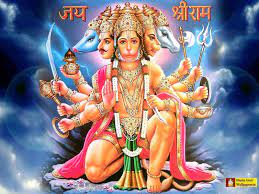
Hanuman tries to cut Ahiravana’s neck but it doesn’t work. Finally, it’s Makaradhwaja who tells Hanumana to extinguish the five lamps at once! This is because Ahiravana’s soul is in those five lamps. I think these five lamps may be read as corresponding to the five kleshas mentioned above. Even a single flame is enough to put us back in this world of suffering. That’s why and that’s when Hanuman assumes the Pachamukhi avatar thus rescuing his beloved Rama and Laxmana.
These five mukhas are Monkey (His own, meaning meditation), Narasimha, the Lion face (meaning Fearlessness), Varaha, the Boar face (prosperity and safety, remember Vishnu rescues the earth in this Avatar), Garuda, the Eagle face (speed and agility) and Hayagriva, the Horse face (knowledge and wisdom), each pointing to different directions signifying overall control! Chitta Vritti Nirodhah! The five faces of Panchamukhi Hanuman may be understood as integrated capacities of a stabilized mind—fearlessness, discernment, agility, groundedness, and knowledge—rather than as separate virtues to be cultivated independently.
Read contemplatively, the Panchamukhi Hanuman episode does not depict the acquisition of supernatural power, but the integration of attention. The extinguishing of the five lamps suggests not suppression but the quiet dissolution of the conditions that sustain mental affliction. In this sense, the narrative points toward a mature phase of practice in which control gives way to coherence.
Myth, approached in this way, functions less as belief and more as orientation—a symbolic language through which inner transformations can be named, reflected upon, and revisited.
Poet saint Goswami Tulsidas, in Hanuman Chalisa prays:
बुद्धिहीन तनु जानिके, सुमिरो पवन-कुमार ।
बल बुद्धि विद्या देहु मोहिं, हरहु कलेश विकार ।।

Considering Myself as Ignorant, I Meditate on You, O Pavan Kumar (Hanuman). Bestow on me Strength, Wisdom and Knowledge, and Remove my Afflictions and Blemishes.
Jai Shri Ram!
PS: This essay presents a personal symbolic interpretation intended for contemplative reflection rather than doctrinal or textual analysis.
 Reinvent The Self!
You must be logged in to post a comment.