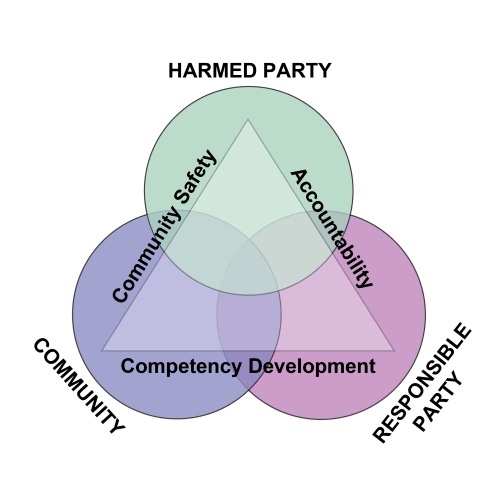
I think restorative justice is subjective and the criminal traditional justice is somewhat objective, broadly speaking.
I think that restorative justice forms a part of preventative tolerance. It’s the government’s tolerance that “allows” this restorative type of justice its place. Governement chooses to create a space for dialogue, healing, and mutual resolution before, or sometimes instead of, resorting to more traditional punitive measures by seeking broader participation from society. However, I feel this added subjectivity makes this restorative justice less effective. Complexity is added by following factors:
Proper communication and understanding: Ensuring all parties can express themselves and understand each other effectively is crucial but can be difficult.
Commitment and agreement among victims: Victims may have vastly different needs, expectations, and willingness to participate or agree on outcomes.
Unique victim experiences and requirements: Tailoring the process to each unique situation is a strength but also a logistical and emotional challenge.
Offender accountability vs. exploitation: There’s a valid concern that offenders might feign remorse or use the process to avoid stricter penalties rather than genuinely commit to making amends. This touches upon the limits of tolerance, where tolerance should not extend to enduring harm or threats to the framework itself.
Varied societal perspectives: Community involvement can bring diverse viewpoints, which can enrich the process but also complicate consensus on what constitutes “justice.”
In other words, forget the “decorative” or biased studies regarding the effectiveness of this restorative justice, I feel that this type of justice is at the best “fancy” or worse a “fantasy“. Government should not afford losing “time” which not only is a type of “cost” but also has a potential to influence the justice system itself! This restorative justice is clearly corruptible!
It seems that the word “restorative” in restorative justice is misplaced. Instead of restoring the “harmony” by repairing the “harm“, the “restoration of justice” itself is at stake! Again I would like to emphasize “Administering justice must be non-negotiable”!
Krishna in Gita says,
यदा यदा हि धर्मस्य ग्लानिर्भवति भारत |
अभ्युत्थानमधर्मस्य तदात्मानं सृजाम्यहम् || 7||
Whenever there is a decline in righteousness and an increase in unrighteousness, O Arjun, at that time I manifest Myself on earth.
The restoration of righteousness should be the outcome of justice. This hits the the root cause or the source from which the wrongdoing emanates, essentially the overall environment. Whereas the restorative justice just tries to fix the bugs or feels like a patchwork at the best, in the sense, it doesn’t fix the “process” which creates the product. Krishna delivers the broader justice, restoration of righteousness! The outcome can’t get bigger than this!
 Reinvent The Self!