We all walk through life armed with our own set of infallible arrows. Perhaps it is the power to reason, the power to restrain, or the power to concentrate. We believe these gifts make us formidable, ready to be warriors for justice. We see a world of conflict and, with the purest of intentions, we decide to participate, to side with the “weaker” side, to fix what we perceive to be wrong.
But what if our very concept of justice is flawed? What if our intervention, born of a limited ego, only leads to greater chaos? The ancient story of Barbarika, a tale I find myself returning to again and again, explores this very dilemma. It is a story about the futility of our own sense of doership and the profound liberation that comes only through absolute surrender. If you want to read more of such rare characters, here’s another blog by my Tai Deepti.
The Perfect Warrior and the Flawed Vow
Barbarika was the son of Ghatotkacha and Maurvi, and the grandson of the great Bheema. A warrior of immense skill learned from his parents, he was made nearly invincible by divine gifts. Lord Shiva granted him three magical arrows, and Agni, the god of fire, gave him a special bow that made him an unparalleled force.
When the great war of Kurukshetra was declared, Barbarika, like any great warrior, sought to join the battle. His mother made him promise that he would use his incredible power wisely, to fight only for the side that was weaker. This, to our minds, seems like the noblest of vows. It is the ego’s perfect logic: identify the oppressed and become their champion. This is our own flawed sense of justice, where we become the arbiters.
The Guru in Disguise
As Barbarika made his way to the battlefield, Lord Krishna, who knows the heart of every matter, knew of his power and his vow. He appeared before Barbarika disguised as a simple brahmin to test him. “How long,” the brahmin asked, “would it take you to end this entire war on your own?”
With the confidence of one who has mastered his abilities, Barbarika replied, “Just one minute”. He explained the function of his three arrows:
- The first arrow marks all that he wishes to destroy.
- The second marks all that he wishes to save.
- The third annihilates everything marked for destruction, after which all three arrows return to his quiver.
The God, in his disguised form, always makes us realize the futility of our long-held beliefs. Krishna challenged him to prove his power by marking every leaf on the peepal tree under which they stood. As Barbarika meditated, Krishna quietly hid one leaf under his foot. The arrow flew, marking every single leaf before hovering at Krishna’s foot, proving that it knew its target, even when hidden. The arrow, like our own deep-seated tendencies, will find its mark, whether we are conscious of it or not.
The Paradox of Doership and the Act of Surrender
Witnessing this, Krishna revealed the profound paradox in Barbareek’s vow. He asked which side Barbarika intended to join. Barbareek, true to his word, stated he would join the Pandavas, for their army was smaller and thus weaker.
Here, Krishna unveiled the trap of the ego. Whichever side Barbareek fought for would, by virtue of his power, become the stronger side. His vow would then compel him to switch to the other army, which had now become the weaker one. This oscillation would continue until every last warrior on both sides was destroyed, leaving only Barbarika standing. In our quest to be the “doer,” to enforce our brand of justice, we risk destroying everything in a cycle of our own making, forgetting the law of unintended consequences.
Barbarika, in his devotion, instantly understood his grave error. This is the rare and special moment of meeting God, when our convictions are shattered by a higher wisdom. He asked for guidance. Krishna explained that tradition demanded the sacrifice of a great warrior’s head before the battle. He then asked Barbarika for this ultimate offering.
This is the moment of true surrender. Not a defeat, but a spontaneous, devotional offering without a thought for the consequences. Barbarika, without a moment’s hesitation, severed his own head and offered it to the brahmin. The surrender of the head is the surrender of the mind, the ego, the intellect—the very source of our flawed sense of ‘I’. This is why Krishna is also called “Hari,” the one who takes away our illusions.
Barbarika had only one final wish: to be a witness to the battle.
The Witness of the Truth
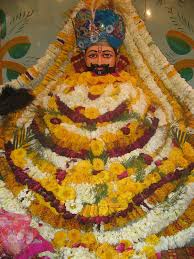
Pleased by his selfless sacrifice, Krishna placed Barbarika’s living head atop a hill overlooking the Kurukshetra field. He was blessed to be worshipped as Shyam, a form of Krishna himself, for his devotion.
Once the war was over and the Pandavas debated who was truly responsible for their victory, they sought the answer from the one who had seen it all. Barbarika’s head gave the final, irrefutable testimony. He replied that he saw no individual warriors fighting. All he witnessed was a single, brilliant chakra—Krishna’s divine discus—swiftly moving across the battlefield, eliminating the forces of adharma, while Draupadi, as the fierce Mahakali, consumed the blood of the wicked. By the way, His chakra is the symbol of cosmic order, justice itself! Rta in Sanskrit.
Only by surrendering the identity of the “doer” could he become the “seer” of the truth. It is only when our own egoic head is offered to Hari that we can stop participating in the endless conflicts of our mind and assume the role of the silent witness. And from that vantage point, all we see is His Grace, His divine justice, effortlessly re-establishing Dharma. This surrender is the only path to realize that omnipresent, all-pervading justice.
Jai Shri Krishna!
 Reinvent The Self!