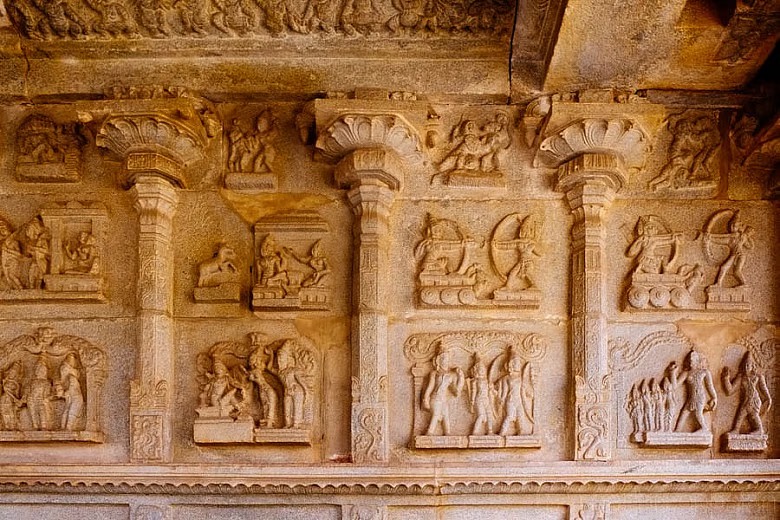
Let us venture into Kishkindha, the allegorical kingdom of our own mind. Its very name reveals its nature: “a congested place,” and at the same time, a land of boundless wonderment. It is the jungle within, where our thoughts, like restless monkeys, wander and compete. True peace lies only in going beyond this congested realm, that is, beyond thoughts!
The Duality of Thoughts from Illusion
The inhabitants of this kingdom are often born from an intoxicating source: Varuni. Her name means an intoxicating beverage, and she represents illusion, because all thoughts are, in their own way, a form of illusion.
From this intoxicating illusion, a fundamental duality arises:
- Vali (Bad Thoughts): He is born when Indra (representing the body and senses) meets with Varuni (illusion). When our senses are clouded by illusion, powerful, aggressive, and negative thought patterns are born. Vali is so strong that he can drain the strength of any who face him head-on.
- Sugriva (Good Thoughts): He is born when Surya, the Sun (representing light and higher consciousness), meets with Varuni (illusion). This shows that even our good thoughts are tinged with illusion, but they are aligned with light and have a righteous inclination.
The Birth of the Life-Force: Hanuman
Yet, Kishkindha is also home to a power of a completely different nature: Hanuman. In our allegory, Hanuman is the “Prana, Life Force, Breath, Meditation, Practice of Awareness”. He is not a mere thought, but the very mechanism to master our thoughts. His parentage reveals how this power is cultivated within us:
- Kesari (The Lion of Courage): Hanuman’s father, Kesari, was a noble and mighty vanara king. His name means “lion,” and he symbolizes earthly valor, courage, and determined effort. He is the lion-like strength and willpower required to undertake any spiritual practice.
- Anjana (The Grace of Insight): Hanuman’s mother, Anjana, was a celestial nymph cursed to live on earth. Through her purity and devotion, she was redeemed. She represents the divine grace and clarifying insight that anoints the mind, preparing it for a higher purpose.
When lion-like Effort (Kesari) unites with divine Grace and Insight (Anjana) in the kingdom of the mind, the result is the birth of Hanuman. He is also called Vayuputra (Son of the Wind God), because it is the divine breath (prana) that makes this union possible. Thus, within the restless mind, the practice of controlled breath and meditation is born.
The Power Born of Restraint: Angada
Finally, there is Angada. As the son of Tara (the faculty of Restraint), his name means an “ornament.” He symbolizes the incredible power that is born from the practice of restraining our thoughts. This power becomes our greatest strength, an ornament to be worn on our arms. It is a strength so formidable that even Ravana—the mighty Ego—cannot shake Angada’s leg, signifying that the ego is powerless against a mind fortified by restraint.
And so, we see that the mind’s inner kingdom, Kishkindha, contains not only the chaos of wandering thoughts but also the very means to transcend them: the divine life-force of Hanuman and the unshakeable power of Angada.
Jai Hanuman!
 Reinvent The Self!