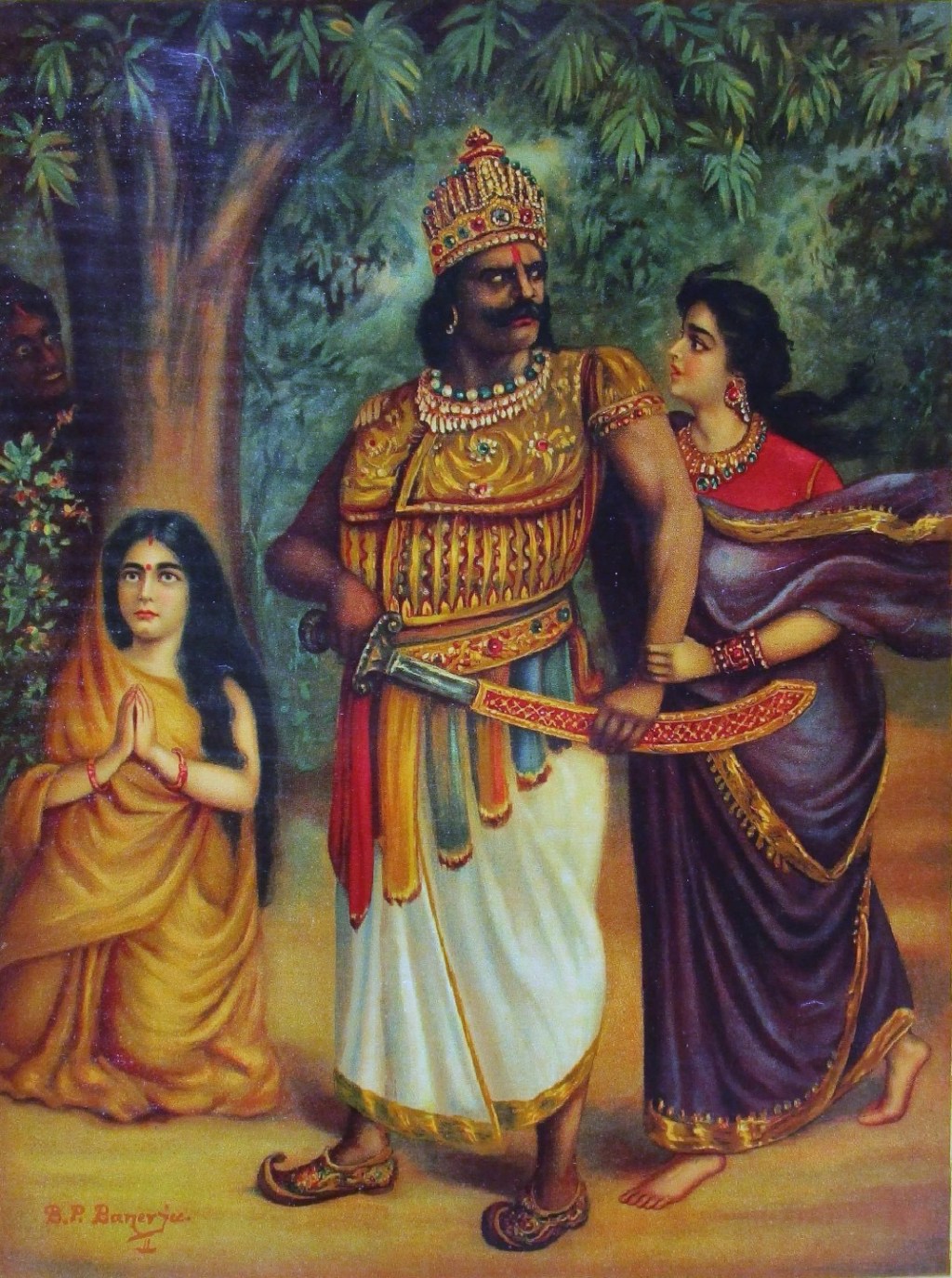
Terminology First!
Mandodari: The name is traditionally translated as “soft-bellied,” a marker of her beauty. But let’s look deeper. The root “Manda” means slow, gentle, or soft. “Udari” relates to the core, the belly. Symbolically, Mandodari is the slow, persistent, and gentle voice of wisdom that resides in our very core. She is the faculty that always remains with the mind, tirelessly sensing destruction, disaster, and moral degradation.
She is married to Ravana, and in this interpretation, this is key.
- Ravana: The Ego! He is the ten-headed monster within us, manifesting in ways we often don’t recognize. We think we have conquered one egoic tendency, but another head simply pops up.
Mandodari, our conscience, is thus inextricably bound to our Ego. She is the queen of Lanka, the delusional world of material pleasures, yet she is not of it.
The Sensitive Soul of the Frog
Legend tells us Mandodari was a frog in a past life. This isn’t just a curious tale; it’s a powerful symbol. A frog, with its permeable skin, is a bio-indicator, acutely sensitive to the pollutants in its environment. Likewise, Mandodari was acutely sensitive to the moral pollutants clouding Ravana’s judgment. She could spot the poison of his pride and desire long before it led to the burning of Lanka. Frog is Mand-uka in Sanskrit. Udar is core. The frog like element in our core. Call it sixth sense or clairvoyance!
The “Slow” Struggle with the Ego
Throughout the epic, Mandodari consistently advises Ravana. She pleads with him to return Sita, reminding him of his dharma and the curses that bind him. This is the faculty of conscience at work. It doesn’t scream; it advises. It doesn’t wage war; it warns. It is a “slow” (mand) and steady struggle against the roaring might of the Ego.
But the Ego is powerful, and the warning of Awareness is often ignored. Ravana, intoxicated with power, dismisses her counsel, just as we often dismiss our own inner voice when chasing our desires. He cannot see that she is his ultimate well-wisher, his truest protection.
The Union of Wisdom and Righteousness
After Consciousness (Rama), aided by pure thoughts (Monkeys), finally defeats the Ego (Ravana), a profound event occurs. Mandodari marries Vibhishana.
This is not a marriage of convenience; it is the restoration of divine order. Vibhishana is the embodiment of Dharma. When he is given the throne of Lanka, it signifies that righteousness now rules the material world. But for this rule to be stable and just, it must be married to Wisdom. The conscience (Mandodari) is not destroyed with the ego (Ravana). Instead, this pure faculty aligns itself with the new rule of Dharma. This is how the divine promise is kept: “Dharma sansthapanarthaya sambhavami yuge yuge!” (To establish righteousness, I will manifest in every age). That’s why Vibhishana is immortal. Chiranjeevi.
The Purity of the Panchakanya
Mandodari’s “chastity” is not of the body but of the soul. Her inclusion among the five revered women, the Panchakanya, is a testament to this fact. She lived in the heart of Lanka, the world of delusion, married to the king of Ego, yet her heart remained pure and her commitment to dharma never wavered. This is why we worship her. By revering Mandodari, we revere the incorruptible faculty of wisdom within us that remains pure no matter the external circumstances.
The key to reaching Rama (Consciousness) may be Hanuman (Meditation and Prana), but the guide who constantly illuminates the path is Mandodari, our ever-present, ever-wise conscience.
May we be blessed with the Grace to listen to the Mandodari within us.
Jai Shri Ram!
 Reinvent The Self!