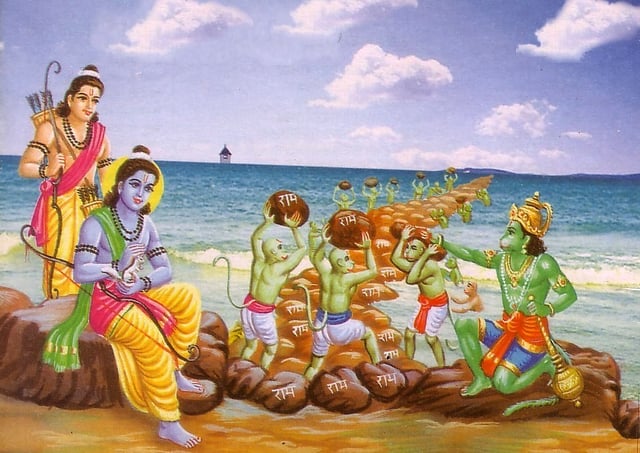
In our journey through the Ramayana of the soul, we have arrived at a pivotal shore. Consciousness (Rama) has committed to its highest purpose. It has endured exile in Dandakaranya, the land of regulations and penance , and now stands ready to reclaim the lost Mind (Sita), which languishes in Lanka, the “Delusional World full of Material pleasures”. But between Consciousness and its goal lies a vast, impossible expanse: the great ocean of Samsara.
This is the ocean of our own being—the turbulent waters of our attachments, karmic patterns, and ceaseless thoughts. How does one cross it? The ego tells us to swim, to fight, to conquer. But any effort born of ego is like a heavy stone cast into the sea; it is doomed to sink. Here, the Ramayana reveals a profound secret, not of conquest, but of connection. It teaches us to build a bridge: the Rama Setu.
The Stones of Action and the Ink of Grace
The bridge is built with stones, and these stones are our actions, our efforts, our spiritual practices (sadhana). Each prayer, each meditation, each act of service is a stone we pick up. But when we act with a sense of “I am the doer,” when we are proud of our strength and our piety, our stone is just a stone. We throw it into the bhavasagara, the ocean of worldly life, and it disappears into the depths, creating barely a ripple, or leaves a karmic print. This is the path of frustration.
The great monkey warriors, our focused and dedicated thoughts, understood this. They did not just hurl stones into the ocean. On each one, they wrote the name of Rama. This singular act of inscription is the key. It is the conscious application of:
- Faith (Shraddha): It is the unwavering conviction that our actions have no power of their own, but become buoyant when offered to a higher reality.
- Surrender (Sharanagati): It is the dissolution of the egoic “I.” By writing His name, the monkeys declared, “This is not my effort, but Thine. This is for Thee.”
- Divine Grace (Kripa): The name itself is not a mere word; it is the embodiment of the Divine. It is Grace itself that defies the law of gravity, the law of karma, the law of a sinking world. It is the loving grace of Rama that makes the impossible possible, allowing our efforts to float and form a path where none existed.
Without this grace, reclaiming the enlightened state is impossible. The bridge is not built by the strength of the monkeys but by the power of the Name they invoke.
The Universe’s Unseen Help
As the great vanaras heaved boulders, we are told a small squirrel scurried among them. It would dip itself in the water, roll in the sand, and then run to the bridge to shake the dust from its fur into the crevices between the stones. This act seems insignificant, almost laughable, next to the monumental work of the monkeys.
But in this, the Ramayana reveals a beautiful truth: we have no idea who is truly helping us build our bridge. We see our primary efforts—our hours of meditation, our conscious thoughts (the monkeys)—and we may take pride in them. But we are often blind to the squirrel.
The squirrel represents the universe helping us in invisible ways. It is the unexpected kind word that lifts our spirits, the moment of insight that arrives unbidden, the small act of kindness we receive from a stranger, or the tiny act of service we perform without expecting reward. It is every imperceptible grace note in the grand symphony of our liberation. Rama’s tender acknowledgement of the squirrel is a lesson for us all: in the eyes of the Divine, no effort offered with a pure heart is small. Every grain of dust, offered in love, helps cement the path home.
This Setu, this bridge of faith, is built from the shores of our discipline to the heart of our own delusion. It highlights the divine pact between our sincere effort and His boundless grace. We must pick up our stones, our daily actions, and have the humility to write His name upon them. We must honor the monkeys of our focused practice and cherish the squirrels of unseen help. Only then can we build that luminous path across the turbulent sea, walk into our own Lanka, and reunite with our long-lost, radiant Mind, the Mahat, ushering in the peace of Ayodhya—the city of No Conflict —within our own heart.
 Reinvent The Self!