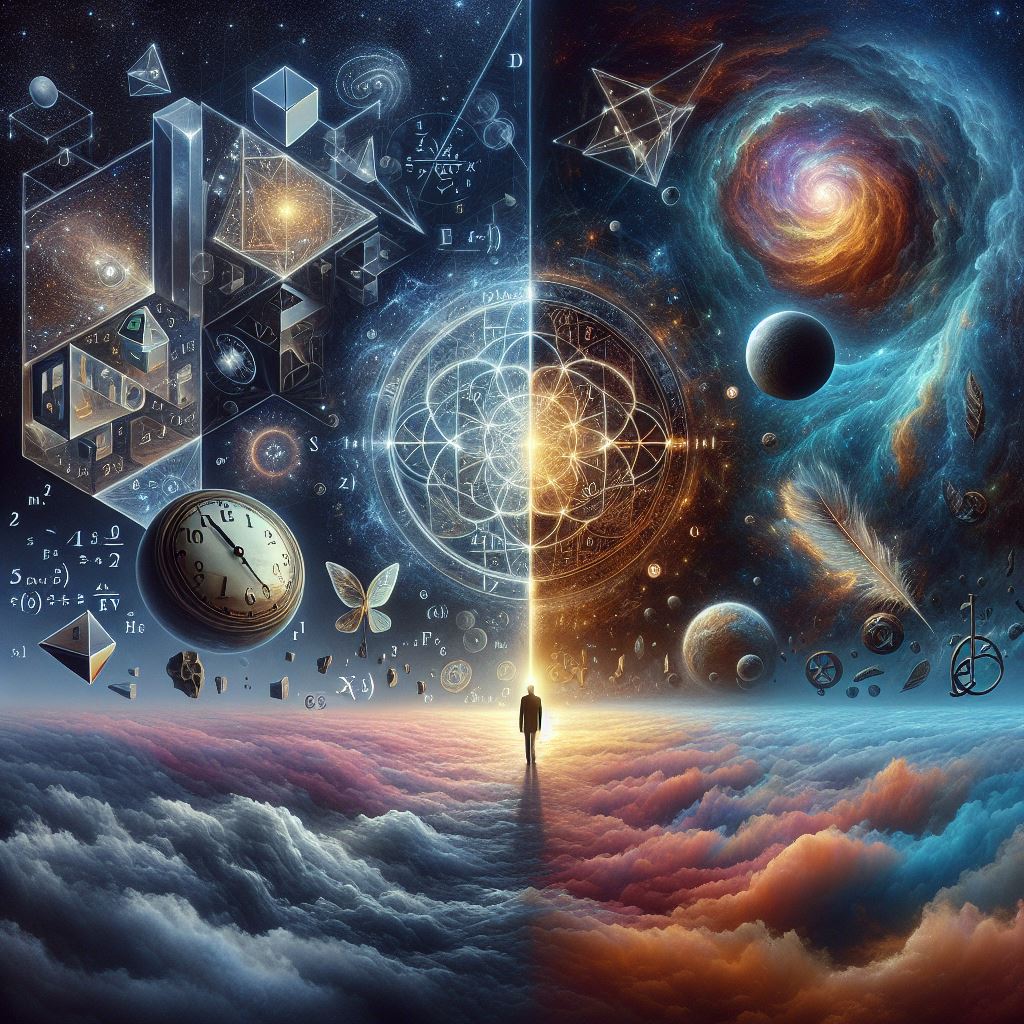
I’ve been thinking a lot lately about the purpose of knowledge. It seems to me that the grand project of epistemology—the quest for knowledge itself—is ultimately designed to falsify itself. Look at science. Our most rigorous mathematical formulations keep changing, stretching, and sometimes breaking, just to accommodate the vastness of our experience. Applied mechanics was a perfect tool, until it wasn’t. It had to make way for the strange new world of quantum mechanics. Euclidean geometry felt like absolute truth, until non-Euclidean mathematics showed us other possibilities.
These tools are incredibly useful. They help us navigate life, make better decisions, and, I hope, live more fulfilling lives. But in their very evolution, they reveal an inherent incompleteness. They show us that our grasp on objective reality is always provisional.
This led me to a thought that I can’t shake: this inherent uncertainty isn’t a bug in the system; it’s the most important feature. It is precisely because of uncertainty that we can have our own subjective views. If everything were known, if all was laid bare by objective law, then subjectivity would vanish. And with it, something precious would be lost.
I feel that uncertainty is what imparts the feeling of freedom. It’s the open space, the unwritten page, that allows us to believe we are free agents. If it weren’t for this, the world would become entirely deterministic, a fatalistic clockwork universe bound by unbreakable laws. Because we don’t know the exact outcome, we feel free.
But here’s the paradox. While uncertainty gives us the feeling of freedom, it’s objective knowledge that gives us the feeling of responsibility. The fact that there are observable laws of cause and effect makes us accountable for our actions. When we understand the consequences, we feel the weight of our choices. This pairing is what makes us feel powerful: the freedom to act and the responsibility for that action.
I used to think that gaining more knowledge and thus more responsibility was a “burden.” But I’ve changed my mind. A person truly burdened has very few choices. Deeper knowledge doesn’t limit our choices; it illuminates them. It makes us more ethically accountable, not more constrained.
So here we are, living in this beautiful, tense space. The quest for objective knowledge makes us more responsible. At the same time, a boundless, asymptotic uncertainty preserves our sense of freedom. It’s like a cosmic game of “catch me if you can.” Objective knowledge, like statistics, tries to put bounds on uncertainty. It tries to shrink the margins of error, to enhance predictability, to give us the illusion of control.
But uncertainty has an ally: Time. Through the simple fact of impermanence, time constantly deceives our static models. In machine learning, we call this “data drift” or “model drift“—the moment a perfect model starts failing because the world has changed. Uncertainty is always playing its game, and Time is always on its side, ensuring the game never ends.
This leaves us with a fundamental question. We are driven to know more, to become more responsible. Yet we are defined by the boundless uncertainty that grants us our freedom. How do we live in this state of permanent tension? Is the goal to finally conquer uncertainty, or is there another way entirely?
A tree, bent by a lifetime of wind and weather, tells its story in arches and scars—it’s not flawed, it’s fashioned. A spider’s web, fine‑threaded yet fragile, is less fragile than breathtaking in its design.
So too with us: we hunger for completeness—approval, permanence, wholeness. But what if our flaws are not failures, but signatures?
 Reinvent The Self!