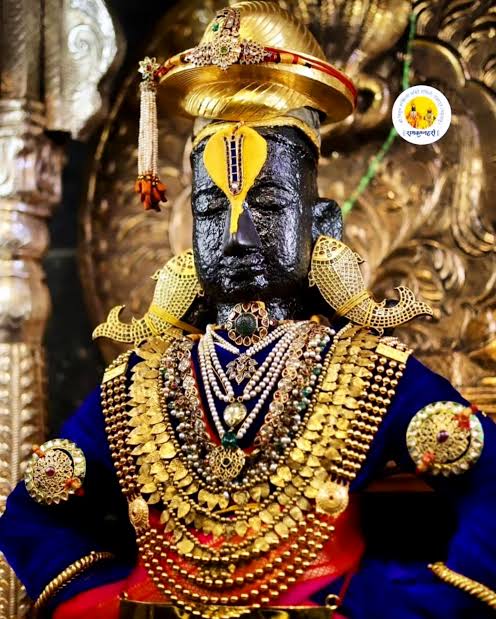
We have seen Vitthala in his stillness and in his compassionate flow. But the final layer of this reality is his all-encompassing unity. His form is a grand synthesis, a space where distinctions dissolve. He is the answer to the prayer that seeks to find the One in the many. Here, in this final exploration, we see how Vitthala is simultaneously Vishnu, Shiva, and even Buddha.
Vitthala as Vishnu: The Lord of Love and Forgiveness
At his core, Vitthala is a form of Vishnu, the preserver. This is the path of bhakti.
- The Srivatsa: The triangular mark on his chest is the mark of his consort, Lakshmi. It is also, profoundly, a mark of forgiveness. The story of the sage Bhrigu kicking Vishnu’s chest in anger, only to have the Lord receive it as a permanent adornment, is a symbol of his unlimited capacity to absorb the ego and anger of the world.
- Lord of the Varkaris: As the head of the Bhakti Marga, he is the ultimate object of love and devotion, the cosmic lover who inspires an endless river of song and pilgrimage.
Vitthala as Shiva: The Lord of Non-Duality
In a powerful act of non-dual expression, Vitthala incorporates the very essence of Shiva.
- The Shiva Linga: He wears a Shiva Linga upon his head, a clear and undeniable statement that He and Shiva are one and the same. He is the source beyond the trimurti of creation (Brahma) and sustenance (Vishnu).
- The Ascetic’s Posture: His stance as the eternal witness (Sakshi Bhava) and his mastery over the senses are core attributes of Shiva the Mahayogi. He embodies the stillness and dispassion of the supreme ascetic.
Vitthala as Buddha: The Path of Equanimity
The principles embodied by Vitthala and the Varkari tradition resonate deeply with the teachings of the Buddha.
- The Middle Path: The path of the Varkari is accessible to all, irrespective of caste, wealth, or knowledge. It is a middle path of devotion, avoiding the extremes of harsh asceticism and worldly indulgence.
- Compassion and Equality: The core message of universal love, the breaking of social barriers, and the focus on relieving suffering aligns perfectly with the Buddhist ethos.
- Witness Consciousness: The emphasis on being a detached observer of the mind’s fluctuations (Sakshi Bhava) is a central practice in Buddhist meditation.
Ultimately, the form of Vitthala is not a sectarian statement, but a universal one. He is a divine synthesis that shows that whether one seeks through the path of love (Vishnu), the path of knowledge and stillness (Shiva), or the path of compassion and mindfulness (Buddha), the destination is the same. He stands on his brick in Pandharpur as a testament that all paths, when followed with sincerity, lead to the feet of the one, all-encompassing Reality.
And here, in the very name whispered by saints, lies another layer of this grand synthesis. He is celebrated as Kānaḍā Vitthalu, a name that is at once a signpost on a map and a testament to the unmappable. Kānaḍā points to his beloved origins in Karnataka, grounding him in the soil of human history. Yet, it simultaneously whispers of his true nature as that which is “incomprehensible” and “difficult to understand”—the Absolute that eludes the grasp of the intellect. The great saint Jnaneshwar, in a moment of sublime poetic genius, captured this paradox in the single phrase, “Kānaḍā ho Viṭṭhalu Karnāṭaku.” On the surface, Karnāṭaku confirms the geographical link. But within it, Jnaneshwar hides a deeper secret, splitting the word into Kar-Nāṭaku: “the Doer of the Play.” In this masterstroke, the incomprehensible Lord from a known land is revealed as the supreme actor, the playful director of the cosmic Lila. His very name becomes a teaching: the Divine is both rooted in our world and eternally playing beyond it, an incomprehensible reality that can only be loved, never fully known.
Disclaimer: This blog post is a synthesis of various popular spiritual interpretations available and aims to present a holistic view of the symbolism associated with Lord Vitthala.
 Reinvent The Self!