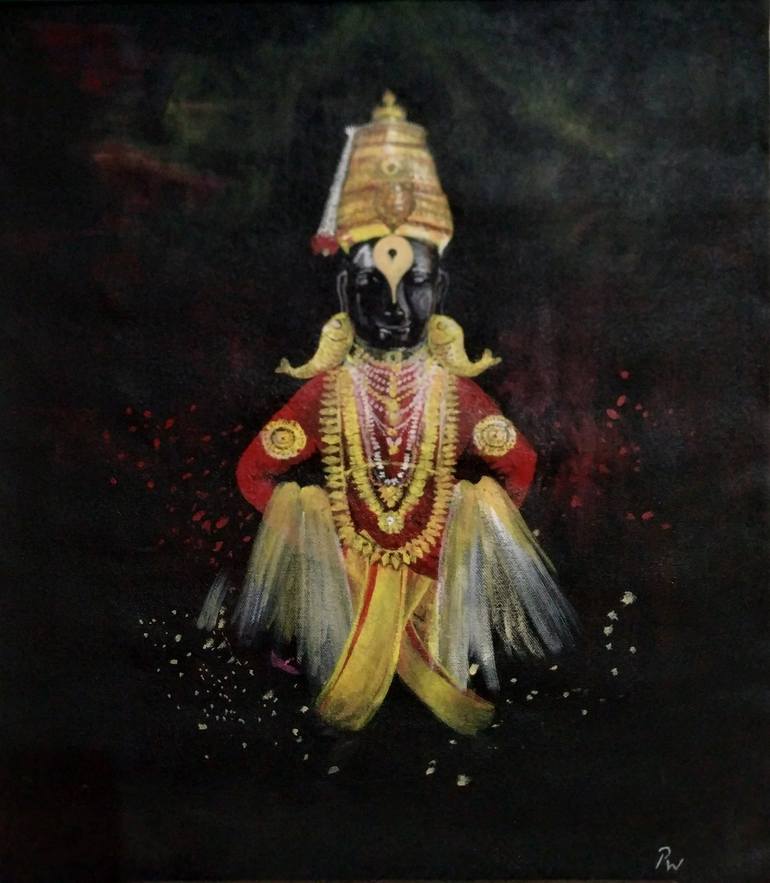
In our last exploration, we stood with Vitthala in his stillness. But that is only half of the truth. The stillness of Vithoba is not empty; it is pregnant with a rhythm of overwhelming compassion. This is an exploration of that dynamic grace, a journey into the dark-skinned Lord who is the source of all light.
The Divine Oxymoron: The Dark Lord of the White City
Vitthala is dark-skinned (sāvaḷā), yet he lives in Pandharpur, the “White City” (Pandhari) and is known as Panduranga, “the White One.” This is the central mystery of his compassionate nature.
- The Universal Attractor: His dark form is like a cosmic black hole. It is the color of the unmanifest Absolute, into which all forms, all colors, and all sins of his devotees are absorbed. He draws everything into Himself out of infinite love, cleansing the soul.
- The Inner Light: He is Panduranga, the White One, because from within this all-absorbing darkness shines the pure, illuminating light of consciousness. As the great saint Jnaneshwar prayed for a light that is both brilliant and blissfully cool, like a “moon without a spot” and a “sun without its burning heat”, Vitthala embodies this. He absorbs our darkness and blesses us with His light.
- The Rain Cloud of Grace: His dark complexion is that of a Megha-Shyam, a dense monsoon cloud, heavy with the life-giving rain of grace. This rain falls indiscriminately, quenching the thirst of the saint and the sinner alike, cooling the fires of worldly suffering (samsara).
The Ornaments of Love: A Path for the Heart
His adornments are not symbols of power, but of love and the path to its realization.
- Makara Kundala: His earrings, shaped like the mythical part-fish, part-crocodile makara, signify the mastery over duality. The crocodile is the binding attachment to the world (samsara), while the fish is the freedom of the liberated soul. Vitthala is the master of both.
- Kaustubha Mani: On his chest, over his heart, he wears the “treasure of the ocean.” This represents Cosmic Love, the most valuable jewel in existence.
- Tulsi Garland: The garland of Tulsi beads is a mark of supreme purity. It signifies that the heart of a devotee, purified through penance and love (sadhana), becomes the Lord’s most cherished ornament.
- The Anahata Chakra: Vitthala is the lord of the heart chakra (Anahata), the seat of unconditional love. The path of saints like Jnaneshwar, who practiced a form of Anahata Laya Yoga, was to find Vitthala not in a temple of stone, but within the “unstruck sound” of their own awakened hearts.
To see Vithoba is to see a God whose very being is an act of compassion. He stands still, yet pours ceaselessly. He is dark, yet he is the source of all light. He is the ultimate reality, who chooses to make his home in the heart of the devotee.
Disclaimer: This blog post is a synthesis of various popular spiritual interpretations available and aims to present a holistic view of the symbolism associated with Lord Vitthala.
 Reinvent The Self!