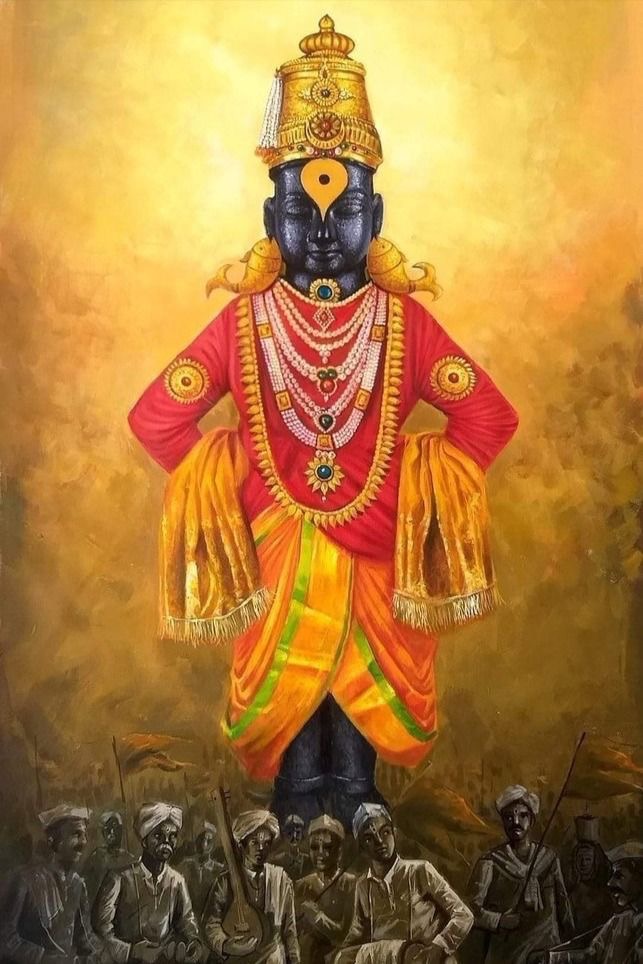
First and foremost, the blog would like to humbly confess that no one can truly capture the essence of Vitthala quite like his devoted followers—poet saint Jnaneshwar, saint Tukaram, Saint Namdeo, Saint Eknath, to name just a few from this magnificent lineage. The list is indeed extensive and filled with the voices of deep reverence! The blog really wishes to share some of the beautiful verses His devotees have created out of their sheer love, sometime later. In this blog, we aspire to unveil the profound symbols that embody the very spirit of Vitthala, inviting you to delve into the depths of his significance.
Let us start with a paradox. How can the Lord of Bhakti—a path of ecstatic love, movement, and song—be most famously depicted in a posture of absolute stillness? The form of Vitthala of Pandharpur is a divine roadmap, but it begins with standing still. Each symbol is not merely an ornament but a signpost, guiding the seeker from the whirlwind of the world to the unwavering calm of the Absolute. This is an exploration of that silent form, a journey into the patient heart of the Divine.
The Foundation: A Simple Brick
Vitthala’s feet do not rest upon a golden lotus or a celestial throne. He stands upon a humble brick (Viṭ). This is the very bedrock of his reality. The story of his devotee Pundalik, who, in his unwavering service to his parents, tossed a brick for the Lord to stand upon and wait, is central. The brick is therefore a symbol of:
- The Power of Dharma: The Lord himself gives precedence to a devotee’s righteous duty. Before any temple ritual or lofty prayer, there is dharma.
- Divine Patience: He stands in eternal patience, waiting for every single soul to complete their duties, to turn towards him. His stillness is an act of infinite compassion.
- The Victory of Bhakti: It is a testament that pure-hearted devotion can make the Supreme Being wait. The devotee’s love becomes the Lord’s pedestal.
The Posture: The Witness on the Hips
Vitthala’s hands are not raised in blessing or wielding a weapon. They rest firmly on his hips, a pose known as Kativari Kar. This is the posture of the ultimate witness, the Sakshi Bhava.
- The Impartial Umpire: He is perfectly balanced, observing the cosmic play of karma without interference. He is the still point around which the universe revolves.
- Absolute Control: With his hands cinching his waist, further bound by a waistband (Mekhala), he symbolizes perfect control over the senses. The waist is the body’s fulcrum; to hold it is to master all outgoing energies.
- Ready Accessibility: The space created by his arms is an eternal invitation. He is not distant, but accessible, ready to embrace any devotee who comes to Him.
The Markings: The Threads of Reality
On his form are markings that tie the individual to the Absolute.
- The Janeu (Sacred Thread): On the God of the Varkaris, a tradition that vehemently rejects caste barriers, the Janeu is a stunning paradox. He wears it not to signify ritual purity, but to transcend it. He shows that He is the source of all scriptures and rituals, the very embodiment of Brahman, and that the only true sacred thread is the thread of love (bhakti) that connects all beings to Him, rendering external markers meaningless.
- The Waistband (Mekhala): This is the girdle of cosmic law (Rita). It symbolizes his unwavering commitment to Dharma. He is bound by his own righteousness, a promise to uphold the order of the universe.
The form of the silent Vitthala is not a portrait of a deity; it is a mirror reflecting our own ultimate potential. It teaches that before we can dance in divine ecstasy, we must first learn to stand still, grounded in our duty and secure in the knowledge that He is patiently waiting.
Disclaimer: This blog post is a synthesis of various popular spiritual interpretations available and aims to present a holistic view of the symbolism associated with Lord Vitthala.
 Reinvent The Self!