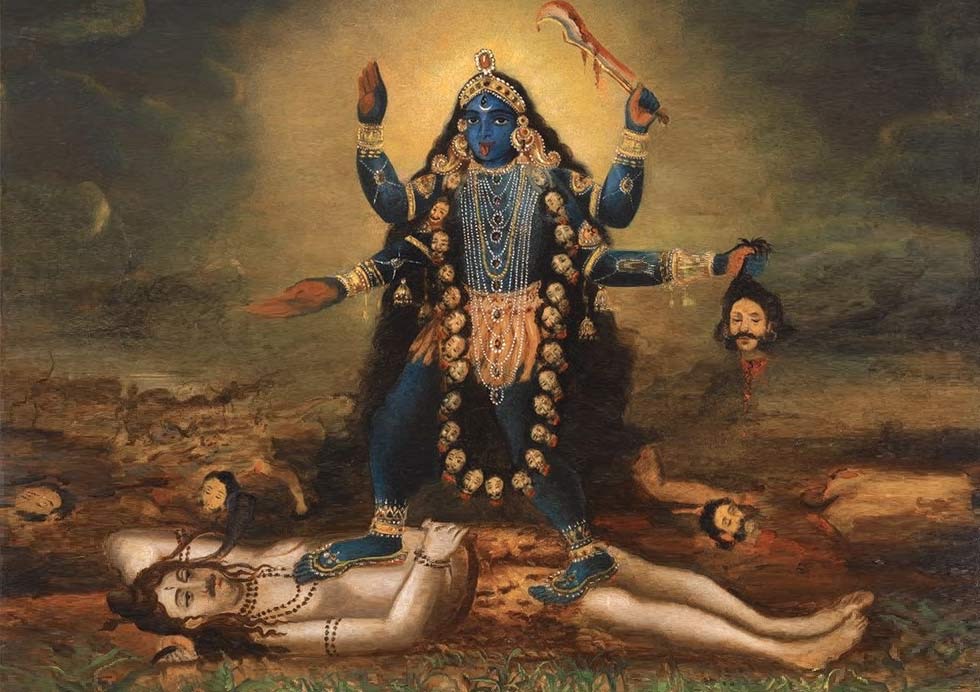
We begin, as we so often must when faced with the Divine, with a paradox. How can the most terrifying form in the cosmos—a dark, disheveled goddess, draped in skulls and dripping with blood—be the most compassionate of mothers? How can the very embodiment of destruction be the most direct path to liberation?
The journey into the heart of Kali Mata is not for the faint of heart. It is a path that asks us to look past our conditioned responses, to see the fierce love in what appears to be violence, and to understand that the void is not empty, but is, in fact, the very womb of existence. This is an exploration of that silent, dancing, all-consuming form—a journey into the tender terror of the Absolute.
The Form of the Formless: The Being Aspect
Before we can understand what Kali does, we must first sit with what she is. Her very name and form are a profound philosophy, a map of the ultimate reality.
- The Canvas of Reality: Her name, Kālī, is the feminine form of Kāla—Time itself. She is the inexorable, dynamic force that births, sustains, and devours all of creation. Yet, her name also means “The Black One.” Her dark complexion is not a color of negation, but of transcendence. Like a cosmic black hole, she is the ultimate state of Nirguna—beyond all attributes, qualities, and distinctions. Just as the color black absorbs every color of the spectrum, her being absorbs all of creation back into its formless potential. She is the dark, silent screen upon which the cosmic movie plays.
- The Gaze of Eternity: Her hair is untamed and disheveled, a powerful symbol of her absolute freedom from all conventions, constraints, and laws. She is the untamable force of nature. Her three eyes see beyond our limited perception, observing the past, present, and future as one seamless whole.
- The Adornments of Truth: Her adornments, while appearing gruesome, are a lexicon of spiritual truth. Her garland of 51 skulls is a symbol of staggering depth. It represents the 51 alphabets of the Sanskrit language, signifying her mastery over sound and language. This connects powerfully to the 51 Shakti Peethas, the sacred sites where the body parts of Sati fell, marking the geographical and spiritual body of the Divine Mother. Taking it a layer deeper, this number also corresponds to the 51 mental faculties (caitasikas) in Buddhist philosophy. This reveals her total command over the very expression of power, from the mind (mana), through speech (vacha), to the body (kaya). Her skirt of severed arms symbolizes her acceptance and dissolution of our karma. She is the one who liberates us from the fruits of our actions.
The Dance on Stillness: The Becoming Aspect
The stillness of the void is not inert. It is pregnant with a rhythm, a dance that is both creation and destruction. This is Kali’s becoming.
- The Divine Paradox: Shakti on Shiva: Kali is famously depicted dancing upon the supine body of her consort, Lord Shiva. A simplistic view sees this as the supremacy of Prakriti (Nature) over Purusha (Consciousness). But a deeper insight, one that touches the heart of Tantra, reveals a more profound truth. Shiva is not defeated; he is the Adhara, the unchanging, static base upon which Shakti can dance. He is the silent, steady-state “attractor” of chaos theory. Kali, the wild, unpredictable, chaotic system of quantum fluctuations, finds her meaning and stability only upon His eternal stillness.
- The Two-Sided Tongue: Chaos and Realization: Her lolling tongue holds a crucial duality. On one hand, it is the embodiment of her fierce, all-consuming nature—the unquenchable thirst for the blood of demons, the raw, untamed cosmic vibration of the universe. On the other hand, it is the symbol of a sudden, profound realization (pratyabhijñā). In the frenzy of her destructive dance, she steps on Shiva, and in that instant, her tongue extends not in violence, but in awe and recognition of her own source. The chaotic dance immediately ceases, halted by the awareness of the unchanging consciousness beneath her.
- The Two Paths in Her Hands: In her four arms, she holds the complete path to liberation, offering two distinct ways for the seeker to approach her.
- The Sword (Khadga) and the Severed Head (Munda) represent her active, purifying force. The sword of wisdom severs the ego, and she holds the result as a trophy.
- Her other two hands reveal the two paths of the seeker. The Abhaya Mudra, the gesture of “fear not,” is the path of the Yogi. It is for the one who seeks to become fearless through self-mastery, inner strength, and bravely confronting the terrors of the mind. The Varada Mudra, the gesture of granting boons, is the path of the Bhakta, the devotee. It is for the one who achieves liberation not by fighting, but by loving surrender, receiving the ultimate boon of Ānanda (Bliss) as an act of her divine grace.
- The Unquenchable Thirst: The myth of the demon Raktabija is a perfect allegory for our inner world. Every drop of his blood that touched the ground spawned a new demon, symbolizing how a single desire, once indulged, gives birth to thousands more. Conventional fighting is useless. Kali’s radical solution is to consume every last drop. Her extended tongue is a symbol of this fiery, all-consuming process that purifies the devotee, making them not desire-less in a negative sense, but free from the tyranny of desire.
The Ultimate Synthesis: The Liberation Aspect
The interplay of Kali’s being and becoming reveals the ultimate path of the spiritual warrior.
- Passion Meets Dispassion: Kali is raw, untamed Passion (Raga). Shiva is serene, witnessing Dispassion (Vairagya). Life requires both. When passion is not repressed but is instead shaped and guided by the stillness of dispassion, what emerges is perfection in action.
- The Rightful Action: This divine synthesis is the very essence of Yogah Karmasu Kaushalam—skill in action. It is the ability to act in the world with the full force of Kali’s energy, yet with the inner detachment of Shiva, unconcerned with the fruits of the action. It is the formula for a life that is fully engaged yet utterly free.
- The Sculptor’s Love: Ultimately, Kali’s fierce form is an act of profound love. She is the Divine Sculptor who knows what must be “killed” in us so that the true devotee can come into being. The violence of her chisel is a creative force, chipping away the hard stone of our ego, our fears, and our attachments to reveal the magnificent sculpture of the true Self that has been lying dormant within.
To gaze upon Kali is to see the entire spiritual path laid bare. She is the cosmic paradox: the terror that grants fearlessness, the destruction that leads to creation, the passion that, when grounded in dispassion, becomes the highest form of love. She is the ultimate mother, who will stop at nothing to liberate her children, even if it means lovingly, terrifyingly, consuming the world of illusion we hold so dear.
Jai Maha Kali!
 Reinvent The Self!