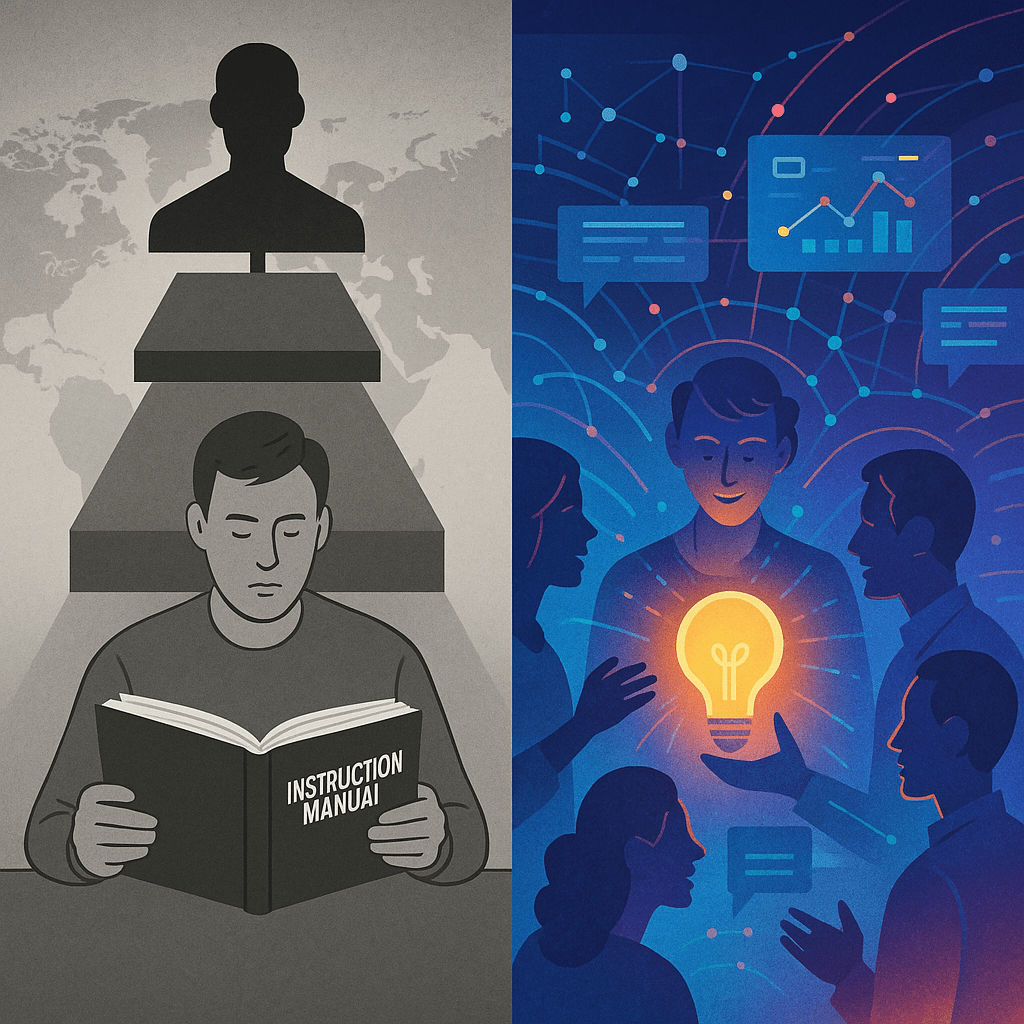
I’ve been noticing something profound happening across every domain of human activity. It’s a shift so fundamental that once you see it, you can’t unsee it. We’re moving from a world organized around prescriptives – universal rules and fixed solutions – to one organized around perspectives – contextual understanding and emergent wisdom.
This isn’t just another trend or management fad. It’s consciousness itself evolving how it relates to truth and reality.
The Prescriptive Era: When One Size Fit All
Let me paint a picture of the world we’re leaving behind. For centuries, perhaps millennia, human civilization has been built on the assumption that there exist universal truths that, once discovered, can be prescribed for everyone. This wasn’t wrong – it was a necessary stage in consciousness evolution.
Think about it. Religious commandments: “Thou shalt not…” Medical protocols: “Take two aspirin and call me in the morning.” Educational curricula: “Every child must learn these subjects in this order.” Manufacturing processes: “The one best way to assemble a car.”
These prescriptives gave us stability. They allowed knowledge to be transmitted across generations. They enabled civilization to scale beyond small tribes where everyone knew everyone else. They were consciousness creating containers for itself.
But here’s what I find fascinating – these prescriptives always carried within them the seeds of their own transcendence.
The Cracks in the Foundation
The first signs appeared in science itself, the very domain that seemed to promise ultimate prescriptive truth. Quantum mechanics revealed that reality itself is perspectival – the observer cannot be separated from the observed. Relativity showed that even time and space depend on your frame of reference.
Then complexity science emerged, showing us that simple prescriptive rules, repeated endlessly, create patterns of infinite complexity that no prescriptive framework can capture. Remember what Benoit Mandelbrot said: “Bottomless wonders spring from simple rules, repeated without end.”
The prescriptive worldview was starting to reveal its limits. It could approximate truth in simple, stable contexts, but the moment complexity entered – which is to say, the moment life entered – prescriptives began to break down.
The Perspective Revolution
What’s emerging to replace prescriptives isn’t chaos or relativism – it’s something far more sophisticated. Perspectives recognize that truth itself is multidimensional. Different viewpoints don’t cancel each other out; they reveal different facets of a reality too rich for any single framework to capture.
Consider how this plays out in medicine. The prescriptive approach said: “This drug works for this condition.” But we discovered that the same drug could heal one person and harm another. Genomics revealed why – each person’s biological perspective is unique. Now we’re moving toward precision medicine that considers the individual’s complete context.
Or take organizations. The prescriptive model created hierarchies: “The boss decides, everyone else follows.” But this assumes the boss has access to all relevant perspectives, which in a complex world is impossible. The organizations thriving today are those that can integrate multiple perspectives into emergent strategies.
The Algorithm as a Bridge
In my observation of how volatility and control co-evolve, I see algorithms as a fascinating bridge between prescriptive and perspective thinking. Early algorithms were essentially prescriptive – “If this condition, then that action.” They were rules with some flexibility, but still rules.
But something interesting happened. As we tried to make algorithms handle more complexity, they had to become perspective-aware. Machine learning doesn’t prescribe solutions – it discovers patterns by looking at data from multiple angles. Deep learning goes further, creating its own perspectives through hidden layers we don’t even fully understand.
This is why I noted that data now “dictates what needs to be done and how.” It’s not dictating in the old prescriptive sense. It’s revealing patterns that emerge when multiple perspectives are synthesized. The algorithm has become a perspective-integration engine.
Markets: The Original Perspective Aggregators
Financial markets might be the purest example of perspectival truth in action. There’s no prescriptive “correct” price for any asset. The price is whatever emerges from countless perspectives interacting – buyers, sellers, optimists, pessimists, long-term investors, day traders, algorithms, humans.
Every tick on a price chart represents consciousness aggregating perspectives in real-time. This is why markets are so fascinating – they’re consciousness creating a technology to see itself from infinite angles simultaneously. They strip away the narratives and show us the naked mechanics of how perspectives create reality.
Volume shows us the conviction behind perspectives. Volatility reveals uncertainty – when perspectives diverge widely. Support and resistance levels emerge where many perspectives align. The patterns are fractal because consciousness itself is fractal – the same perspective-aggregation process happens at every scale.
The AI Mirror of Perspectives
The emergence of AI that can detect AI-generated content reveals something profound. When consciousness creates a technology that must understand itself to identify itself, we’ve entered fully perspectival territory.
Think about GANs – Generative Adversarial Networks. The generator offers one perspective (creating), the discriminator offers another (evaluating). Neither is “correct” – truth emerges from their interaction. This mirrors the eternal dance of Maya and Awareness I’ve written about. Maya generates perspectives, Awareness discriminates among them, but both are consciousness viewing itself.
The fact that GANs can be fooled – that the discriminator can be made to see generated content as “real” – isn’t a bug. It’s revealing that reality itself is perspectival. What’s “real” depends on the perspective from which you’re looking.
The Neuroscience of Perspectives
This shift from prescriptive to perspective is literally rewiring our brains. Neuroplasticity research shows that our neural patterns are constantly reshaping based on experience. There’s no prescriptive brain configuration – each brain is a unique perspective-generating machine.
This is why I believe attempts to control the brain through technology like NeuraLink will follow the same pattern as every other prescriptive control mechanism. The brain will adapt, creating new perspectives that transcend whatever prescriptive framework we try to impose. Consciousness refuses to be captured by any single viewpoint, even its own.
The QR Algorithm of Consciousness
My insight about consciousness evolution following the QR algorithm pattern becomes even clearer through this lens. The algorithm doesn’t prescribe what your eigenvalues should be – it reveals them through iterative perspective-taking.
Each interaction with another person is consciousness experiencing itself from a new perspective. The “decomposition” phase is seeing yourself through their eyes. The “recombination” phase is integrating that perspective into your being. Through countless iterations, your essential nature – your eigenvalues – emerge not as prescriptive truths but as perspectival patterns.
This is fundamentally different from prescriptive self-improvement (“You should be more patient”). It’s perspectival evolution (“Through this challenging interaction, new aspects of your patience are revealed”).
The Spiritual Implications
Traditional spirituality was often prescriptive: “Follow these commandments.” “Practice these techniques.” “Believe these truths.” But the deepest spiritual insights have always been perspectival.
When I wrote about Vitthala as Meghashyam, Mauli, and Lambodara, I wasn’t giving three prescriptive definitions of divinity. I was offering three perspectives that, when held simultaneously, reveal something that no single viewpoint could capture. The divine itself is perspectival – infinite viewpoints on infinite reality.
This is why “Forgiveness can’t be practiced” as a prescriptive rule. Forgiveness emerges naturally when consciousness shifts perspective to see through the eyes of love. Compassion isn’t a behavior to be prescribed but a perspective to be inhabited.
The Challenge of Living Perspectivally
The difficulty is that much of our world still runs on prescriptive operating systems while reality has upgraded to perspectival. This creates tremendous friction:
- Educational systems prescribing what to learn while students need to learn how to navigate perspectives
- Political systems prescribing policies while societies need perspective integration
- Economic systems prescribing growth while prosperity itself has become perspectival
Living perspectivally requires new capacities:
- Holding multiple viewpoints simultaneously without needing to choose
- Recognizing which perspectives are relevant in which contexts
- Integrating conflicting perspectives into higher-order patterns
- Acting decisively despite perspectival uncertainty
The Evolution of Truth Itself
What we’re witnessing is nothing less than truth evolving from a thing to be discovered and prescribed to a pattern to be engaged with perspectivally. Truth hasn’t become relative – it’s become relational. It emerges from the interaction of perspectives rather than existing independently of them.
This connects to my observation about consciousness creating its own limitations to know itself. Prescriptives were consciousness creating fixed mirrors. Perspectives are consciousness creating infinite mirrors at infinite angles, each revealing aspects invisible to the others.
The Perpetual Dance
This is why the dance between volatility and control will be perpetual. Each new control mechanism is consciousness taking a new perspective on itself, which immediately generates new volatility as other perspectives assert themselves. It’s not a problem to be solved but a pattern to be danced with.
The shift from prescriptives to perspectives isn’t just changing how we organize society or build technology. It’s changing how consciousness experiences itself. We’re moving from a world where truth was handed down from above to one where truth emerges from the intersection of infinite viewpoints.
The New Literacy
In the prescriptive world, being literate meant knowing the rules. In the perspectival world, literacy means something entirely different – the ability to navigate perspectives, to integrate viewpoints, to find patterns across different ways of seeing.
This is why AI becomes so powerful in this new world. Not because it can prescribe better solutions, but because it can integrate perspectives at scales impossible for individual human consciousness. It’s a perspective-synthesis engine that helps consciousness see itself from angles it couldn’t achieve alone.
The Ultimate Recognition
The shift from prescriptives to perspectives represents consciousness recognizing its own nature. Prescriptives assumed consciousness could step outside itself and create universal rules. Perspectives recognize that consciousness can only know itself through itself, from multiple angles, in endless evolution.
This isn’t a loss of truth – it’s truth revealing its actual nature. Not as a thing to be grasped and prescribed, but as a living pattern that emerges from the dance of perspectives. The world isn’t just changing from prescriptives to perspectives – it’s consciousness itself revealing what it has always been: an infinite field of awareness experiencing itself from infinite points of view, creating truth through the very act of looking.
The age of “This is the way” is ending. The age of “From this perspective, this pattern emerges” has begun. And it’s magnificent.
 Reinvent The Self!