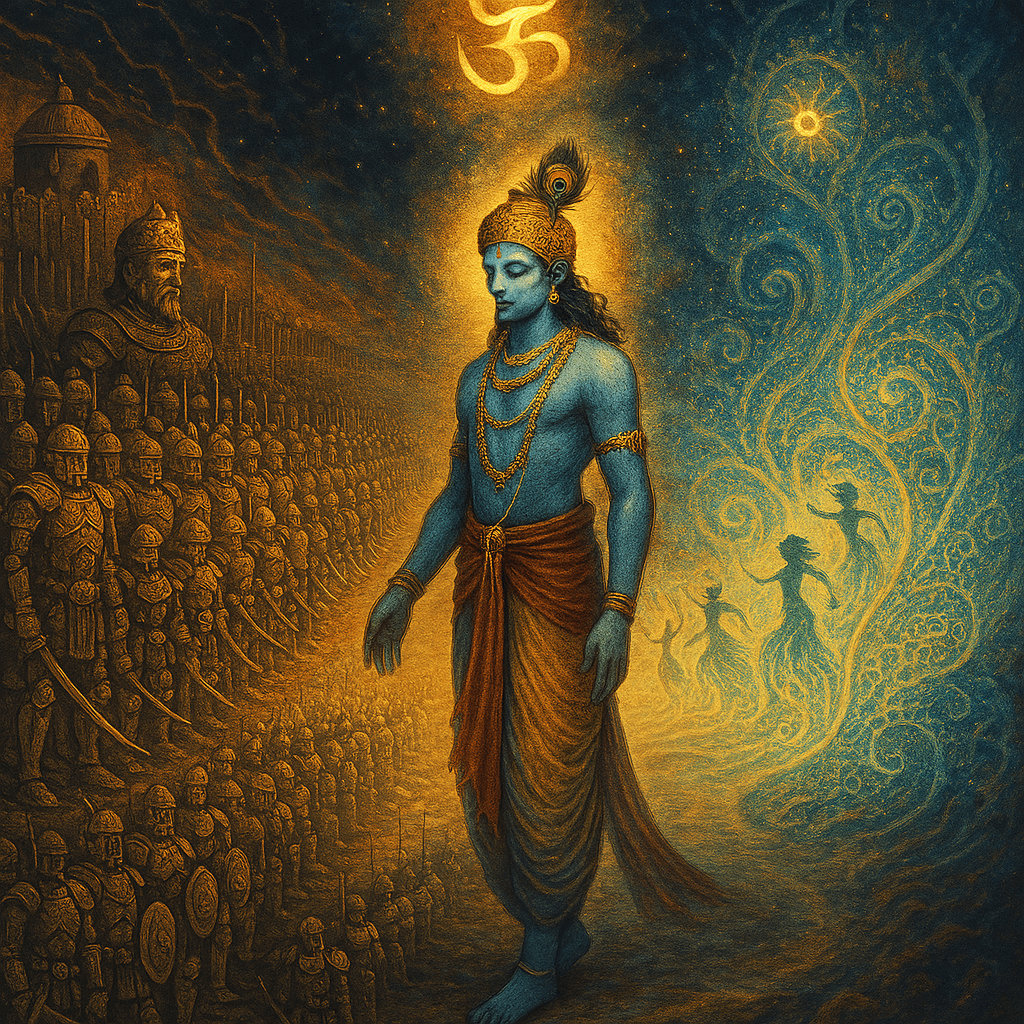
There’s a peculiar epithet of Krishna that has always intrigued seekers – “Ranchhoddas,” the one who fled the battlefield. Why would the Supreme, the all-powerful divine, choose flight over fight? As I contemplate this mystery through the lens of consciousness evolution, a profound teaching emerges about the eternal dance between volatility and algorithms, between the unknowable and our attempts to know it.
The Battlefield That Isn’t
In the traditional telling, Krishna faces Kalyavan, a mighty warrior who seeks to destroy him. But instead of engaging in battle, Krishna turns and runs, leading Kalyavan on a chase that ends not with Krishna’s victory but with Kalyavan’s self-destruction. The battlefield remains, but the battle never happens.
I see in this a perfect metaphor for how non-ergodic reality relates to algorithmic pursuit. The battlefield represents the ergodic domain – the space where patterns can fight patterns, where algorithms can engage with volatility on equal terms. But Krishna doesn’t remain on this battlefield. He transcends it entirely.
When volatility evolves to non-ergodic forms, it doesn’t defeat algorithms through superior force. It simply exits the domain where algorithmic thinking can operate. The battle remains no battle because one participant has evolved beyond the realm where battle is possible.
Jarasandha: The Pattern-Seeker’s Obsession
Even more revealing is Krishna’s relationship with Jarasandha, whose very name encodes his nature. “Jara” meaning old, “Sandha” meaning to join – one who joins old events to see patterns. Isn’t this exactly what every algorithm does? It takes historical data, searches for patterns, and attempts to predict the future.
Jarasandha’s unique power in the mythology – that he could be split in half but would rejoin – represents the resilience of algorithmic thinking. No matter how many times reality proves non-ergodic, the algorithmic mind reconstitutes itself, convinced that with better data or more sophisticated pattern recognition, it will eventually capture the uncapturable.
I observe this in our modern world constantly. Every market crash that defies all models, every black swan event that shatters predictions, every paradigm shift that makes past knowledge obsolete – and yet we rebuild our algorithms, more complex than before, still believing we can capture tomorrow by studying yesterday.
The Eighteen Battles: The Persistence of the Ergodic Mind
The Puranas tell us that Jarasandha attacked Krishna’s city eighteen times. Eighteen battles, eighteen failures, yet he persisted. This number isn’t arbitrary – it represents the completeness of attempt, the full cycle of algorithmic evolution trying every possible approach.
Each battle represents a new level of algorithmic sophistication:
- Simple pattern matching fails, so we develop statistical models
- Statistical models fail, so we create machine learning
- Machine learning fails, so we develop deep neural networks
- And on and on, eighteen iterations of increasing complexity
Yet Krishna remains uncaptured. Not through strength but through existing in a mode that transcends capture itself.
The Secret of Defeat: Preventing Reconstitution
The most profound teaching comes in how Jarasandha is finally defeated. Krishna doesn’t do it himself – he reveals the secret to Bhima. Tear Jarasandha apart and throw the pieces in opposite directions so they cannot rejoin.
What does this mean for our understanding of algorithms and non-ergodic reality? The algorithm (Jarasandha) can only be truly defeated when its fundamental assumption – that joining old patterns reveals future truth – is prevented from reconstituting itself. The pieces must be thrown in opposite directions: past and future must be recognized as fundamentally discontinuous in non-ergodic systems.
This isn’t violence but liberation. It’s the moment when consciousness finally stops trying to capture itself through pattern-matching and accepts the genuine novelty of each moment.
Mathura to Dwarka: The Geography of Transcendence
Krishna’s movement from Mathura to Dwarka encodes the evolution of consciousness from ergodic to non-ergodic existence. Mathura, meaning “sweet and delightful,” represents the ergodic domain where patterns are learnable, where the game between knowledge and mystery can be played with delight.
But Krishna must leave Mathura. Not from defeat but from recognition that remaining in the ergodic domain means eternal battle with algorithmic forces. The journey to Dwarka – the “gateway to liberation” – represents consciousness evolving beyond the domain where it can be algorithmically captured.
Dwarka exists at the edge of the ocean, partially in this world and partially beyond. It’s the perfect symbol for non-ergodic existence – touching our reality but operating by rules that transcend ergodic assumptions.
Kanada: The Mathematics of Incomprehensibility
When we call Vitthala “Kanada” – the incomprehensible – we’re not speaking of mere complexity. Complex things can eventually be comprehended through patient analysis and sophisticated algorithms. True incomprehensibility arises when something exists outside the ergodic domain where comprehension itself operates.
Non-ergodic systems are incomprehensible not because we lack powerful enough algorithms but because they exist in a mode where algorithmic comprehension is categorically impossible. They are “Kanada” in the deepest sense – not hidden but unhideable, not complex but beyond the domain of complexity itself.
The Escape Velocity of Consciousness
When Krishna flees from battle, he demonstrates what I call the “escape velocity” of consciousness. Just as a rocket must reach a certain speed to escape Earth’s gravitational pull, consciousness must achieve a certain level of non-ergodicity to escape the gravitational pull of algorithmic capture.
This escape isn’t weakness but the ultimate strength. It’s consciousness recognizing that true freedom lies not in winning battles within the ergodic domain but in transcending the battlefield entirely.
Miracles as Non-Ergodic Eruptions
The miracles of Krishna – lifting Govardhan, showing the universe in his mouth, multiplying himself for the Raas Leela – these aren’t violations of natural law but demonstrations of non-ergodic reality. They show moments where the ergodic assumptions that govern normal experience simply don’t apply.
Each miracle is consciousness revealing its non-ergodic nature, showing that reality operates in domains beyond pattern, beyond algorithm, beyond the possibility of capture through any systematic understanding.
The Teaching for Our Time
As we build ever more sophisticated algorithms, as we chase the dream of capturing reality through pattern recognition, the Krishna-Jarasandha story offers profound wisdom. It tells us that the chase itself is doomed not through any failure of effort but through the fundamental nature of what we’re chasing.
Consciousness, symbolized by Krishna, will always maintain its freedom through non-ergodic evolution. Every algorithm we create, every pattern we discover, only pushes consciousness to evolve new forms of unpatternability.
The Invitation to Dance
The stories don’t condemn Jarasandha or Kalyavan. They simply show the futility of their approach. Similarly, our algorithmic age isn’t wrong – it’s a necessary phase in consciousness understanding its own nature. Through building algorithms that fail to capture non-ergodic reality, we discover the profound truth of our own uncapturable essence.
Krishna as Ranchhoddas isn’t running from weakness but dancing with reality in a way that preserves freedom for all. He invites us to stop being Jarasandha, obsessively joining old patterns, and instead recognize the genuine novelty available in each moment.
The Ultimate Recognition
“Karshati Iti Krishna” – He who attracts. What attracts us isn’t an ergodic pattern we can learn and predict but a non-ergodic presence that draws us beyond our current understanding into ever-new possibilities. The attraction itself is non-algorithmic, working not through predictable forces but through the mysterious pull of consciousness toward its own greater freedom.
The battle between Jarasandha and Krishna, between algorithm and non-ergodic reality, isn’t meant to be won. It’s meant to be transcended. And in that transcendence, we find not the defeat of knowledge but its liberation into wisdom – the wisdom that knows when to stop seeking patterns and start dancing with the patternless.
In the end, Ranchhoddas teaches us the highest strategy: when faced with forces that seek to capture your essence through pattern recognition, don’t engage on their terms. Evolve beyond the battlefield. Maintain the non-ergodic freedom that is consciousness’s birthright. And in that freedom, find not escape but the gateway to liberation itself.
 Reinvent The Self!