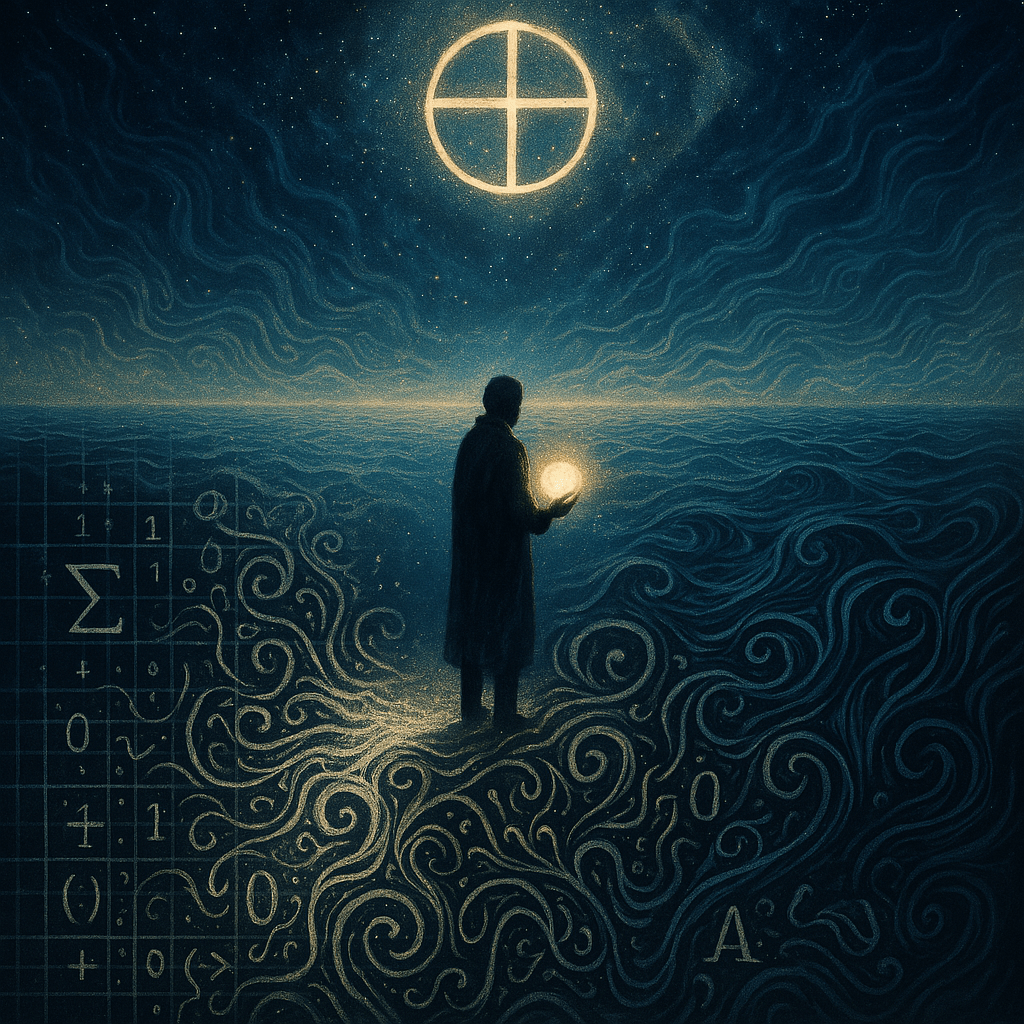
In my contemplation of how consciousness attempts to comprehend itself through its own creations, I’ve stumbled upon a pattern that reveals why certain aspects of reality remain forever beyond algorithmic grasp. This isn’t a limitation of our current technology or mathematical sophistication – it’s a fundamental feature of how volatility evolves to preserve the freedom of consciousness itself.
The Ergodic Beginning: When Patterns Were Trustworthy
Let me begin with a simple observation. In the early days of any system – be it a market, an organization, or even a relationship – volatility presents itself in digestible, learnable patterns. This is the ergodic domain, where the sacred assumption of repeatability holds true.
Ergodicity is a beautiful concept that most of us assume without naming it. It means that watching one particle for a long time tells you the same story as watching many particles for a short time. The time average equals the ensemble average. Yesterday’s patterns genuinely inform tomorrow’s possibilities.
I think of a craftsman learning his trade. The wood grain follows patterns. The tools respond predictably. Hours of practice create skill because the domain is ergodic – what worked yesterday will work today. The volatility is there – sometimes the wood is harder, sometimes the chisel slips – but it’s simple, honest volatility that respects the laws of repetition.
This is where algorithms are born and where they thrive. They can learn these patterns, encode them, optimize around them. The first processes, the first rules, the first attempts at control – they all work beautifully in this ergodic paradise.
The Statistical Interlude: When Complexity Demands New Tools
But then something shifts. The volatility evolves, becomes more sophisticated. Individual patterns become too complex to track, but statistical patterns still hold. We’ve moved from watching individual particles to needing thermodynamics.
I observe this transition everywhere. In markets, simple price patterns give way to stochastic models. In organizations, simple processes yield to statistical quality control. In consciousness itself, simple reactions evolve into complex emotional patterns that require statistical understanding.
Here, algorithms must evolve too. They become statistical beasts – machine learning systems that can detect patterns invisible to simple rules. They speak the language of distributions, correlations, and probabilities. The game between volatility and algorithm has become more sophisticated, but it’s still a game being played on ergodic ground.
The assumption remains: given enough data, sophisticated enough models, we can capture the patterns. The past still teaches us about the future, just through a more complex mathematical lens.
The Non-Ergodic Emergence: When the Ground Itself Shifts
And then comes the profound transition that I believe represents consciousness protecting its own freedom. Volatility evolves beyond ergodicity itself. The system’s statistical properties no longer remain stable through time. The very foundation upon which all algorithms stand begins to dissolve.
In non-ergodic systems, something miraculous and terrifying happens: each moment becomes genuinely novel. The past doesn’t just fail to predict the future – it actively misleads you about it. Time averages diverge from ensemble averages. The patterns you learned become traps.
I see this in the markets during regime changes – moments when correlations that held for decades suddenly reverse. I see it in organizations when culture shifts make all previous strategies obsolete overnight. I see it in personal growth when a single insight restructures your entire way of being.
Why Algorithms Cannot Follow
Here’s what I find most profound: algorithms, by their very nature, are ergodic entities. They must believe that patterns learned from data provide information about future behavior. Even our most sophisticated AI systems are fundamentally ergodic in their assumptions. They are time-travelers who can only move forward by looking backward.
But non-ergodic volatility has evolved beyond the domain where backward-looking makes sense. It’s not that the patterns are too complex – it’s that the very concept of “pattern” has broken down. Each moment emerges from a genuinely novel configuration that owes nothing to what came before.
This is why no algorithm will ever catch hold of truly non-ergodic volatility. It’s like asking a fish to describe the sky – not difficult but categorically outside its domain of existence.
The Aggregation Illusion
When I think of attempts to create “aggregated algorithms” – like how NIFTY aggregates individual stock volatilities – I see another layer of this impossibility. Aggregation assumes that combining volatile components creates something more stable, more predictable. This works in ergodic systems where diversification reduces risk.
But in non-ergodic systems, aggregation might amplify the unknowability. When components can fundamentally change their nature, when the very structure of relationships is volatile, then aggregation becomes not a solution but another layer of complexity that still cannot capture the non-ergodic essence.
The Path-Dependent Prison
What makes non-ergodic systems truly uncontrollable is their path dependence. In ergodic systems, how you arrived at the current state doesn’t matter – the future probabilities remain the same. But in non-ergodic systems, history matters irreversibly. Every path taken changes the landscape of possible futures.
This is consciousness ensuring its own freedom. By evolving volatility to be path-dependent and non-ergodic, it creates a reality that no algorithm can ever fully capture or predict. The very attempt to control changes what needs to be controlled.
The Spiritual Dimension
In Sanskrit, there’s a word – “Anirvachaniya” – that which cannot be described or categorized. I believe non-ergodic volatility is the mathematical manifestation of this spiritual concept. It’s not just unknown but unknowable through the tools of knowing we’ve created.
This connects to why Vitthala is called “Kanada” – the incomprehensible one. The divine remains incomprehensible not through hiding but through existing in a non-ergodic mode that transcends the possibility of algorithmic capture.
The Liberation in Limitation
What emerges from this understanding is not despair but liberation. The impossibility of creating an algorithm to control non-ergodic volatility isn’t a failure of human ingenuity – it’s a success of consciousness in preserving its own freedom.
Every time we create a more sophisticated algorithm, volatility evolves to become more non-ergodic. Every attempt at control spawns new dimensions of uncontrollability. This isn’t a bug in the system – it’s the most fundamental feature, ensuring that consciousness can never be fully captured by its own creations.
Living with the Impossible
So how do we relate to non-ergodic volatility if we cannot control it? Perhaps the answer lies not in better algorithms but in a fundamentally different relationship – one that dances with uncertainty rather than trying to eliminate it.
The mystics have always known this. They speak of surrender not as defeat but as alignment with the non-ergodic nature of reality itself. They invite us to stop trying to capture the divine and instead allow ourselves to be captured by it.
The End of the Algorithmic Dream
As I contemplate this evolution from simple ergodic volatility to non-ergodic transcendence, I see we’re approaching the end of the algorithmic dream. Not because we’ve failed, but because we’ve succeeded in pushing algorithms to the very boundary where they reveal their own limitations.
What lies beyond? Perhaps a post-algorithmic relationship with reality that we’re only beginning to imagine. A way of being that surfs the non-ergodic waves rather than trying to predict them. A consciousness that has finally stopped trying to capture itself and instead celebrates its own irreducible mystery.
The impossible algorithm isn’t a problem to be solved. It’s a koan revealing that the deepest nature of reality transcends all attempts at algorithmic capture. And in this impossibility lies our greatest freedom.
 Reinvent The Self!