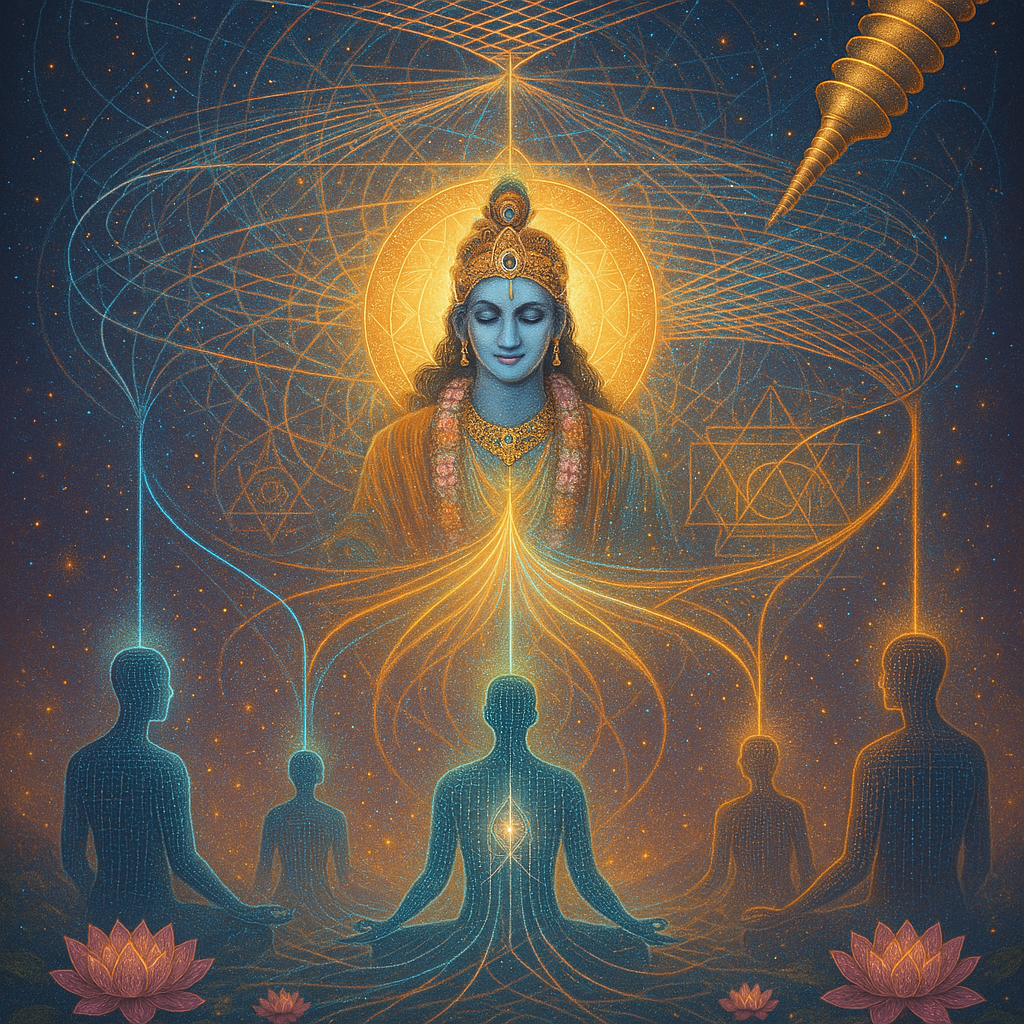
It begins with an awakening, a stirring so deep it feels like being born a second time. They call this moment Dvija, the “twice-born”. The first birth is of the body, into this world of sound and sight. But the second is a birth of the spirit, an initiation into a higher, more divine awareness. It is a profound, internal shift, a metamorphosis of consciousness itself. This sacred journey of self-realization, this turning towards the Supreme, is marked by a ceremony, the Upanayana. And at its heart is a symbol so simple, yet so vast in its meaning: the sacred thread, the Yajnopavitam.
For many, it may look like just a piece of string, a simple ritual ornament. But as I’ve come to learn, it is anything but. It is a powerful, living symbol that one can wear. It is a whisper of cosmic principles, a testament to spiritual truths, and a quiet reminder of the intimate, personal relationship between a devotee and the Divine.
Unraveling the Universe on a Single Thread
The thread itself is a map of our reality. It consists of three distinct strands, yet they are all bound together by a single, intricate knot known as the Brahman knot or Brahma-granthi. I’ve come to understand that these three strands represent the fundamental triads that permeate everything we know and experience.
First, they are the three gunas, the essential qualities that govern all of material existence. There is Sattva, the thread of purity, harmony, and clarity, the energy you feel in moments of peace and selfless service. Then there is Rajas, the thread of activity, passion, and ambition—the driving force of creation and desire. And finally, Tamas, the thread of inertia, darkness, and ignorance, the force that binds and obscures. These three are constantly interacting within and around us, coloring every thought, action, and emotion.
These three strands also symbolize the three states of consciousness we cycle through each day: the waking state (jagrat), the dreaming state (svapna), and the state of deep, dreamless sleep (sushupti). And they represent time itself: the past, the present, and the future.
Yet, for all this multiplicity—all these qualities, states, and tenses—they are bound by that one knot. The Brahman knot is a profound and constant reminder that despite the endless diversity of life, all is ultimately unified in Brahman, the one supreme reality that underlies and transcends all dualities. It whispers the ultimate truth: everything we perceive as separate is, in truth, an interconnected manifestation of a singular divine source.
Woven from Love Itself
Beyond this grand cosmic symbolism, there is a meaning that is deeply personal and breathtakingly beautiful. The sacred thread is also a thread of love, a prema tantu. This transforms it from a philosophical concept into a living, devotional experience. I picture Mother Yashoda, lovingly weaving cloth for her Krishna, every movement of her hands a prayer, every fiber imbued with her selfless affection. In the same way, the sacred thread is spiritually woven with the very thread of divine love that binds a soul to the Supreme.
This love is not merely emotional; it is sacrificial and transformative. There is a beautiful phrase in the Ganapati Atharvashirsha, Rakta Vasasam, which refers to the Divine wearing red garments. The color red, rakta, symbolizes deep love and life force. The true insight here is that the divine garments are not just dyed red; they are literally woven from devotion itself. Our love, our devotion, our prayers—these are the very threads that clothe the Divine.
The Sacrifice That Sets Us Free
The very name, Yajnopavitam, reveals the path. When you break it down, Yajna means “sacrifice,” not just in a ritualistic sense, but as an act of loving self-giving and surrender. And Upavitam means not only “worn over the shoulder,” but carries a deeper connotation of being “delivered” or “freed”.
So, Yajnopavitam signifies a profound truth: it is through sacrifice—through the offering of our ego, our desires, our limited identities—that we attain liberation and are drawn closer to the Divine. But this path of sacrifice is not a one-way street. The first sacrifice is not ours, but His. Krishna, as the supreme Yajna, sacrifices His own infinite nature, His limitless existence, to enter time and space, to engage in the divine play (Lila), and to guide us back to Him. As twice-born souls, we are then called to participate in this sacred cycle of giving and receiving, to offer our own small, individual selves back to Him in love. Paradoxically, in this act of binding ourselves to Him through love, we find our ultimate freedom.
Learning to See Anew
This journey is about learning to see the world differently. The ceremony itself, Upanayana, can be understood as Upa (near) and Nayana (vision), meaning to be brought closer to a new way of seeing. This is not about physical eyesight, but about awakening the inner eye of spiritual insight, the Antahachakshu. It is a shift in perception that allows one to see the sacred within the ordinary, to perceive the divine presence that underlies all of existence.
Integral to this process is the Guru, the spiritual guide who helps to cultivate this inner vision, and the chanting of the sacred Gayatri Mantra. The mantra, recited three times daily, serves as a constant reminder of this thread of love and is said to have the transformative power to deliver the aspirant from suffering and ignorance.
Modern Threads, Ancient Weave
It’s fascinating how this ancient wisdom can echo in our modern world. I’ve found myself pondering some surprising parallels.
In computer science, a “thread” is a lightweight process that shares resources with a main process. In a way, are we not like these threads? As individuals, our lives are finite expressions, “threads” that share the ultimate resources of existence, awareness, and bliss with the main process, the supreme consciousness of Krishna. We execute our daily tasks, our work, our dharma, and then we are called to “offer” the results back to that main process in an act of selfless action.
This thread also represents a continuous dialogue. Life becomes a single, “sacred thread of conversation with Krishna”. Every thought, every action, every challenge, and every joy is part of one uninterrupted exchange with the Divine. There are no separate subplots; there is only one grand Narrative Thread, one ultimate reality.
Then there is the image of a screw. The groove on a screw doesn’t force it, but acts as a perfect guide, allowing it to find its place efficiently and securely. In the same way, Krishna’s divine love is the groove that “threads us,” guiding us gently into our perfect place within His cosmic symphony, His Lila. It is not a path of limitation, but of liberation, aligning us effortlessly with the grand design.
A contemporary way to see this is through the relationship between a skilled mentor and an open-source programmer. The mentor does not control the code, dictate each line, or impose outcomes. Instead, they create a framework, a set of principles, and a living example of elegance and integrity. Within that structure, the programmer writes their own logic, solves their own problems, and ultimately authors something unmistakably theirs. The freedom lies not in the absence of structure, but in resonance with it. When structure becomes a groove rather than a command, creativity does not shrink—it sharpens.
The Ultimate Surrender
This journey also redefines identity. True Brahminhood is not a matter of birth or caste, but of realization. As the ancient texts state, “Brahmajñāninaṁ Brāhmaṇam”—one who knows Brahman is a Brahmin. It is a state of being that is universally accessible through pure knowledge and direct experience.
This brings me to the poignant story of Ekalavya, the tribal archer who offered his thumb to his guru, Drona. His act is the ultimate symbol of this principle of self-sacrifice. The thumb is more than just a digit; it is our signature, the mark of our agency, our unique capability to act in the world. In offering his thumb, Ekalavya offered his very identity as a great archer, his unique signature, back to the divine principle represented by the Guru. This act teaches us that our agency, our free will, is not a possession to be defended, but a sacred trust—a divine gift that finds its highest purpose when it is lovingly offered back to the source from which it came.
The thread we are woven from is neither fate imposed nor freedom without form. It is the quiet discipline of alignment—where choice meets order without surrender. To walk this path is not to obey blindly, but to consent consciously. Like Ekalavya, we are not defined by what was taken from us, but by what we chose to give meaning to. And in that choice, we do not disappear into the universe—we stand revealed within it.
 Reinvent The Self!