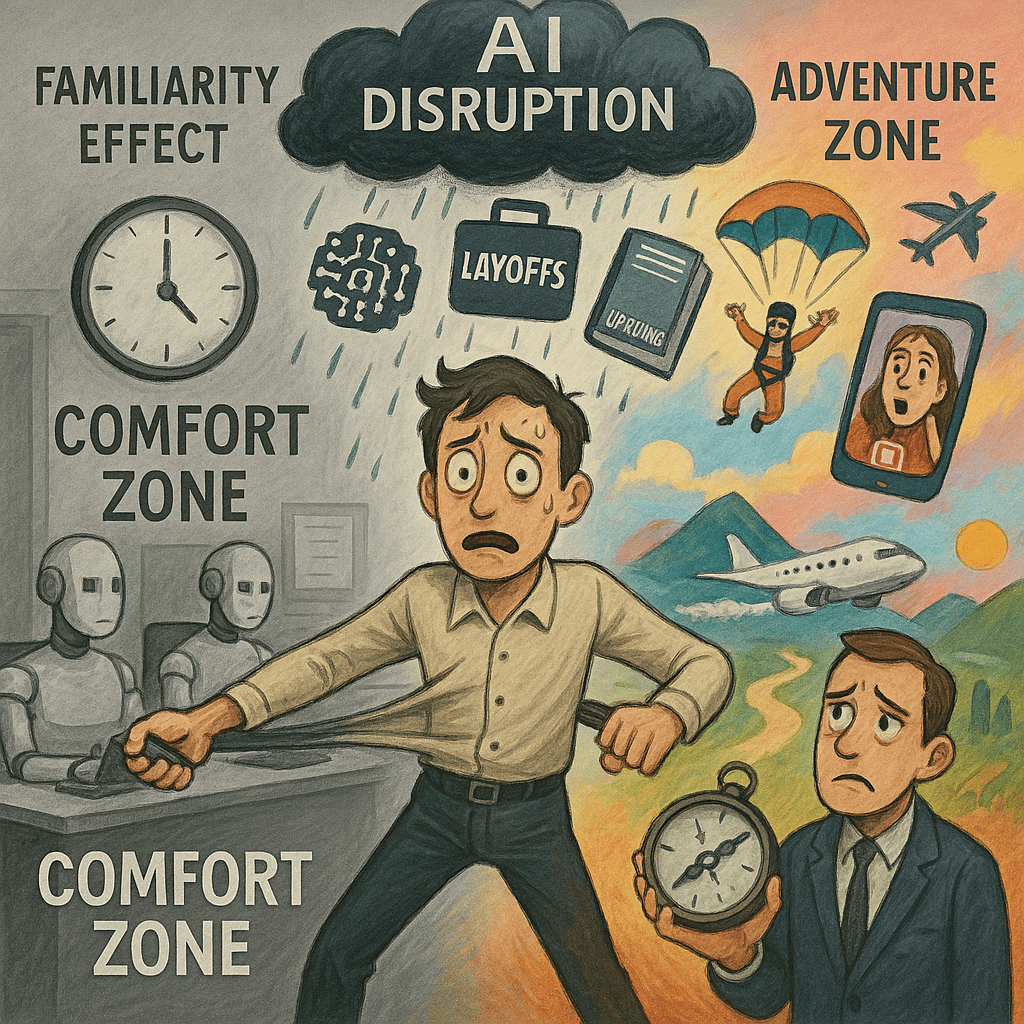
I’ve been thinking about something strange happening to us. We humans have this peculiar relationship with the familiar and the novel. Most of us, maybe 70% of our time, we want to stay in our comfort zones. The morning coffee ritual. The same route to work. The predictable rhythms of a workday. There’s something deeply comforting about knowing what comes next.
But then there’s that other 30% – usually crammed into our weekends – where we suddenly crave adventure. New restaurants. Road trips. That hiking trail we’ve been meaning to try. It’s like we’re two different people, split between the one who finds peace in routine and the one who needs to feel alive through novelty.
Here’s where it gets interesting, though. When you compress all your need for adventure into those precious 48 hours of weekend, something odd happens. The familiarity of the work week doesn’t just make you want adventure – it pushes you toward it. Hard. Sometimes too hard.
Have you noticed how weekend activities have gotten more extreme? How social media fills up with increasingly wild stunts every Saturday? Those viral reels of people doing things that make you wonder “what were they thinking?” The friend who suddenly decides to try parkour at 35. The colleague who comes back Monday with a story about nearly getting lost on a mountain they had no business climbing.
These aren’t really adventures anymore. They’re misadventures. It’s like we’re trying to squeeze a week’s worth of living into two days, and in that compression, something warps. The need for novelty becomes desperate rather than joyful.
But wait. Here’s where the plot thickens.
That comfortable, predictable job that was supposed to be our stability anchor? It’s not so stable anymore. AI has entered the chat, as they say, and suddenly the most familiar part of our lives – our work – has become a source of constant, unwanted change.
Everyone’s scrambling to learn new tools. New platforms. New ways of working. Skills that took years to master become obsolete seemingly overnight. That Python script you were proud of? There’s an AI that writes it better. That analysis you used to spend days on? Done in minutes now. The ground keeps shifting under our feet.
And our managers? They’re not faring much better. I’ve watched managers who used to make confident decisions now second-guessing themselves, wondering if an algorithm would make a better choice. How can an insecure manager provide security to their team? They can’t. The cascade of uncertainty flows downward.
This isn’t the kind of novelty we signed up for. When we seek adventure on weekends, we’re choosing it. We’re in control. But this workplace upheaval? It feels more like punishment than progress. There’s a restlessness that comes with forced change, a particular kind of exhaustion from constantly adapting to things you never asked to adapt to.
So here we are, this new generation of workers, caught in the strangest paradox. We’re desperate for the familiarity that work used to provide – that steady paycheck, that predictable routine, that sense of knowing our place in the world. But we’re also still craving real adventure, the kind we choose, the kind that makes us feel alive rather than anxious.
We’re searching for both at the same time, and finding neither.
The weekends aren’t enough anymore because we’re already exhausted from all the unwanted novelty at work. But work isn’t familiar enough anymore to give us that stable base from which to adventure. We’re like tightrope walkers who’ve lost both the wire and the net.
I keep thinking about this friend who told me she spent her Saturday binge-watching comfort shows from the 90s while simultaneously planning an impulsive solo trip to Southeast Asia. “I just want something predictable,” she said, “but I also need to feel like I’m not already dead.” That’s it, isn’t it? We want the comfort of the familiar and the thrill of the unknown, but we’re getting instability at work and manufactured adventures on Instagram.
The irony is almost too perfect. We’ve built a world where the place that was supposed to be boring and stable (work) has become thrilling and terrifying, while our free time – meant for chosen adventures – gets filled with either recuperation from work chaos or increasingly desperate attempts to feel something real.
What happens to a generation caught between these two poles? When neither work nor play provides what they’re supposed to? When we’re too tired from unwanted change to enjoy chosen change, but too restless from fake stability to find real peace?
I don’t have answers. I’m living this contradiction myself, writing this on a Sunday evening, equally torn between wanting to do something wild and wanting to hide under a blanket. Maybe that’s the most human response to an inhuman situation – to be pulled in both directions at once, finding grace in neither, but somehow still getting up Monday morning and doing it all again.
Perhaps the real adventure now is learning to live with this ambiguity. To find pockets of genuine familiarity in an unstable world, and moments of chosen novelty amidst the chaos. To recognize that feeling both needs simultaneously isn’t failure – it’s just what it means to be human in this particular moment of history.
The weekend warriors and the weekday worriers? They’re the same person now. And maybe acknowledging that is the first step toward finding a new kind of balance, one that doesn’t rely on the old bargains that no longer hold.
After all, if the world won’t give us the rhythm we need, perhaps we need to create our own. Even if we’re making it up as we go along.
 Reinvent The Self!