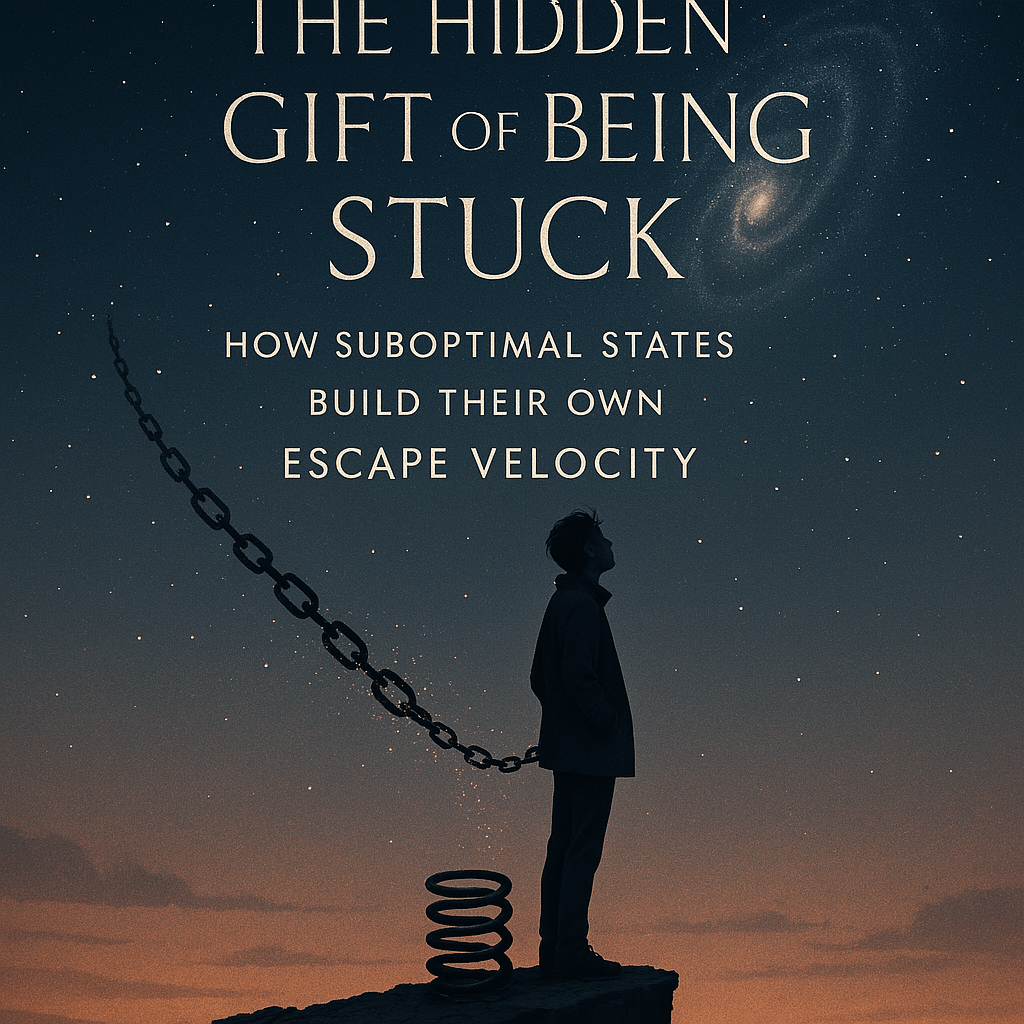
I’ve been thinking about being stuck. Not the dramatic kind of stuck – not prison bars or iron chains – but the subtle, comfortable kind. The job that’s “good enough.” The relationship that’s “fine.” The daily routine that works but doesn’t sing. We all know these states. They’re not terrible, they’re just… suboptimal.
For years, I believed that recognizing these traps was enough. I’d read about Nash equilibrium in game theory, where everyone makes their best move given what others are doing, and everyone ends up worse off. Like two companies locked in a price war, destroying profits for both. Like traffic where everyone switches lanes, making all lanes slower. I thought: “Aha! I see the trap! Now I can escape!”
How naive I was.
The Gravity of Where We Are
Here’s what I’ve come to understand: realization alone is utterly insufficient. Why? Because every state we’re in has what I call Gravity. It’s the weight of accumulated choices, the momentum of daily habits, the comfort of the known. You can stare at the stars all you want, dream of being in orbit, but that doesn’t negate the planet’s pull.
I think about Ashoka. Surely a man of his intelligence knew war was brutal before his first campaign. That intellectual understanding was there. But it was a whisper against the gravitational roar of duty, tradition, ambition. The system had its own physics, and he was bound by it.
This gravity isn’t just external pressure. It’s woven into the very fabric of how we see ourselves. When I stay in my comfortable job, it’s not just about the salary or the familiar colleagues. It’s that my identity has crystallized around it. “I am someone who does this.” To change would require not just a new action, but a new self.
The Strange Magic of Repeated Games
But here’s where it gets interesting. I used to think repeated games – doing the same suboptimal thing over and over – were the problem. Now I’m beginning to see they might be the solution. Let me explain.
Each time Ashoka went to war, he won within the game’s logic. Another territory conquered, another victory celebrated. But something else was happening. Each repetition added weight to a hidden ledger. Each iteration of the game increased not just the external cost, but an internal pressure.
The repeated game evolved. It wasn’t static. The destruction became more severe, the cognitive dissonance louder. The very success within the game’s rules was building something else – what physicists might call potential energy. Like a spring being compressed tighter and tighter.
Then came Kalinga. Not just another war, but the moment when all that accumulated pressure reached a threshold. The horror generated a force so powerful it achieved what I call escape velocity – the minimum speed needed to break free from a gravitational field permanently.
From Realization to Transformation
This is the crucial distinction. A small push, a weak realization, might lift you momentarily. You read an inspiring book, attend a workshop, have an insight. You rise a bit… then fall back. The gravity was stronger than your thrust.
But when the repeated game itself generates the energy? When the very friction of being stuck creates the heat for transformation? That’s different. That’s escape velocity building organically, inevitably, from within the trap itself.
I think about this in my own life. Every time I play my suboptimal game – staying in situations that don’t fully serve me – I tell myself I’m being practical, maintaining stability. But am I? Or am I unknowingly building the very pressure that will eventually propel me beyond what I can currently imagine?
The Hanuman Paradox
There’s a story about Hanuman that haunts me. He can assume any form, knows all scriptures, has conquered death. When offered any boon, what does he ask for? To remain alive as long as Rama’s story is told. To hear the same story, again and again, forever.
But here’s the thing – he experiences it as “all new all the time.” How?
I think this points to something profound about repetition. It’s not that the game changes – we change. Each iteration deepens something, reveals new layers. The repeated game isn’t circular; it’s a spiral. We return to the same point at a higher level.
When I find myself restless in my routines, hungry for something more, I wonder: is this greed, or is this growth? When that insatiable desire arises – to earn more, do more, be more – is it ego, or is it the natural expansion of consciousness testing the boundaries of its current container?
The Hidden Proposal
We say “man proposes, God disposes,” usually with a sigh of resignation. But lately, I’ve been wondering if we’ve got it backwards. What if our very clinging to comfort zones, our stubborn maintenance of suboptimal equilibrium, is part of a larger proposal we don’t understand?
What if the Divine writes proposals in invisible ink – ink that only becomes visible through the heat of friction, the accumulation of subtle dissatisfaction, the pressure of repeated games?
I think about my own patterns. I choose comfort, stability, the known. I think I’m being wise, avoiding risk. But all the while, something builds. A restlessness. A knowing that this isn’t quite it. A pressure that I can’t name but can’t ignore.
True love, they say, prefers to remain hidden. It doesn’t announce itself with fanfare. It works through the ordinary accumulation of days, each one adding a grain of sand to the scale until suddenly – without warning – everything tips.
Beyond Local and Global
In optimization theory, we talk about local versus global optimums. A local optimum is the best point in your neighborhood – climb any nearby hill and things get worse. A global optimum is the absolute best point in the entire landscape.
But I’m beginning to think this misses something essential. What if each of us has what I’d call a “unique optimum”? Not better or worse than others, just irreducibly ours. Like how Rama, Krishna, Buddha – they each embody completely different qualities, yet each represents a kind of perfection.
The repeated game, the building pressure, the escape velocity – maybe it’s not about reaching some universal peak. Maybe it’s about being launched into our own unique orbit, finding the particular way that consciousness wants to express itself through us.
The Mechanics of Grace
So where does this leave us? If realization isn’t enough, if comfort zones secretly build their own escape velocity, if the universe conspires through our very resistance – what do we do?
Maybe the answer is simpler than we think. Maybe we just keep playing our games, but with a different kind of attention. Not the desperate attention of trying to escape, but the curious attention of someone watching pressure build in a system.
Every day we remain in our suboptimal equilibrium, we’re not failing. We’re gathering fuel. Every repetition that seems pointless is adding to a sum we can’t yet see. Every moment of restlessness is a signal that escape velocity is building.
The trap itself becomes the engine of liberation. The gravity that holds us becomes the resistance against which we build the strength to fly. The repeated game that seems to lead nowhere is actually a spiral staircase we can only see from above.
I don’t know when my own escape velocity will be reached. I don’t know what orbit I’m being prepared for. But I’m beginning to trust the process. To see the divine kindness hidden in the very situations I’ve been trying to escape.
Perhaps that’s the ultimate realization – not that we’re stuck, but that being stuck is part of the launch sequence. Not that we need to try harder, but that we need to understand the hidden proposal written in the language of our limitations.
The spring is being compressed. The pressure is building. And somewhere, in invisible ink, love is writing a trajectory we couldn’t choose for ourselves but will recognize as perfect when we finally achieve escape velocity.
What games are you playing repeatedly? What pressure is building in your life? What if your very stuckness is gathering the energy for a transformation beyond your current imagination?
I don’t have answers. But I’m learning to love the questions. To trust the process. To see the divine conspiracy hidden in my own resistance to change.
After all, even diamonds are just carbon that stayed under pressure long enough to transform. Maybe our suboptimal equilibriums are similar – not prisons, but crucibles. Not mistakes, but methods.
The escape velocity is building. Can you feel it?
 Reinvent The Self!