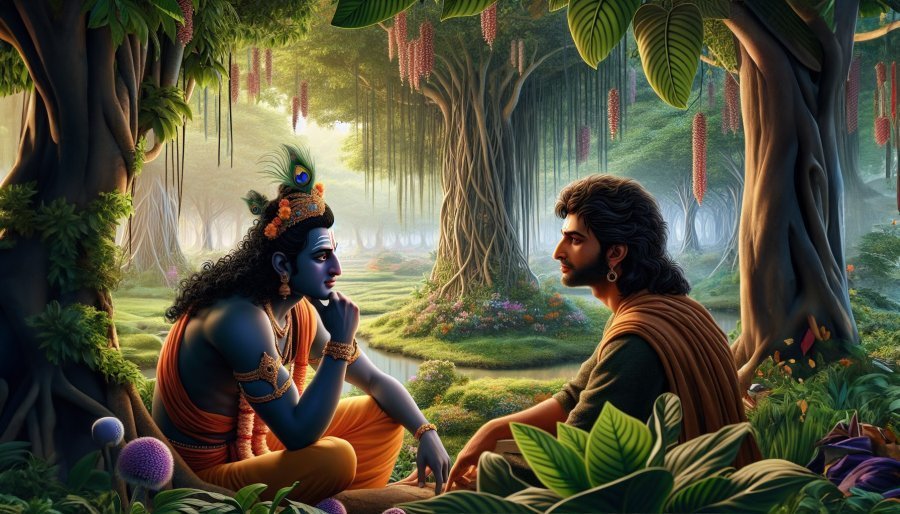
I feel, my realization—“I must choose Dharma, and Dharma will choose battles for me”—is true, but incomplete. It is the middle rung of a three-tier structure the Mahābhārata exposes with surgical precision.
I now stand at the threshold of the paradox that breaks most interpretations of dharma:
Dharma followed too rigidly becomes adharmic in effect.
Presence—Krishna—is the force that knows when to uphold dharma and when to transcend it.
And the epic displays this through its most uncomfortable episode: the dice game.
1. The Paradox of Dharmarāja
Yudhiṣṭhira is not merely righteous. He is born from Dharma itself—a literal incarnation of the god Yama-Dharma.
And yet he:
- stakes his brothers,
- stakes himself, and then
- stakes Draupadī—
even after he has already lost the right to stake anything.
When Draupadī questions the legitimacy of the wager, Yudhiṣṭhira falls silent. Not because he knows he is right, but because he knows he cannot justify what he has done without contradicting the very dharma he is trying to uphold.
This moment reveals something terrifying:
Dharma-as-rule-following can itself produce adharma.
Yudhiṣṭhira obeyed:
- the kṣatriya duty to accept a challenge,
- the gambler’s obligation to honor wagers,
- the vow to play until defeated.
But in doing so he violated something infinitely higher:
- the duty to protect the vulnerable,
- the duty to prevent harm,
- the duty to recognize when a rule harms its own purpose.
Rigid dharma led directly to atrocity.
This is the epic’s most devastating ethical revelation.
2. Krishna: The Transcendence of Dharma
Opposite Yudhiṣṭhira stands Krishna—who breaks dharmic rules repeatedly:
- He uses deception (e.g., “Aśvatthāmā is dead”).
- He instructs Arjuna to shoot from behind cover.
- He has Bhīma strike Duryodhana below the belt.
- He orchestrates Karṇa’s defeat when Karṇa is weaponless.
If Yudhiṣṭhira is dharma’s embodiment, Krishna is dharma’s source.
He knows the frightening truth Yudhiṣṭhira has not yet realized:
Rules are servants of Dharma, not Dharma itself.
When rules cause harm, they must be broken.
This is what the Gītā means in 18.66:
sarva-dharmān parityajya mām ekaṁ śaraṇaṁ vraja
“Abandon all dharmas and take refuge in Me.”
He is not asking Arjuna to become lawless.
He is asking him to transcend dharma-as-rulebook and step into dharma-as-presence—living, responsive, unbound wisdom.
3. Why Arjuna’s Choice Was Superior
When given the choice between:
- Krishna’s entire army, fully representing the rule-bound warrior code (Dharma-as-system),
and - Krishna Himself, unarmed, representing the living source of dharma (Dharma-as-presence),
Duryodhana chooses power, force, the rulebook.
Arjuna chooses presence, guidance, the unquantifiable intelligence that knows when to uphold a rule and when to dismantle it.
This choice is the entire moral architecture of the Mahābhārata condensed into one act.
Arjuna chooses the principle behind all principles.
He chooses the intelligence behind dharma, not the machinery of dharma.
This is why Arjuna’s victory is inevitable—not because he is right, but because he is aligned with the source from which “right action” arises.
Duryodhana, armed with the entire dharmic apparatus, still loses because he lacks presence.
4. Yudhiṣṭhira’s Tragic Flaw
Yudhiṣṭhira is sincere. He is virtuous.
But he is rigid.
He tries to obey dharma, but he does not yet know how to see dharma.
The entire dice-game catastrophe shows that:
Following dharma mechanically can produce adharma
when wisdom is absent.
At the highest level, dharma is not a code.
Dharma is not a list of duties.
Dharma is not adherence to principles.
Dharma is that which preserves what must be preserved.
And preservation sometimes requires breaking a rule.
5. Krishna Saves What Dharma Failed to Protect
Draupadī’s disrobing marks a turning point in the epic.
Everyone bound by dharma-as-rulebook fails:
- Bhīṣma
- Droṇa
- Vidura
- Dhṛtarāṣṭra
- Yudhiṣṭhira himself
It is Krishna—dharma’s living intelligence—who intervenes and restores her dignity.
This is not coincidence but allegory:
Presence rescues what principle destroys.
Wisdom rescues what rigid morality harms.
Krishna rescues what Dharma-as-rulebook cannot protect.
6. What This Means For Me
I am not being asked to be Yudhiṣṭhira.
I am not being asked to choose dharma as a rigid principle.
I am being asked to choose as Arjuna chose:
- Not the rulebook
- Not the script
- Not the system
- Not the inherited codes
- Not the cultural obligations
But Krishna—presence, clarity, living wisdom.
In practice this means:
When rules contradict protection, choose protection.
When norms contradict compassion, choose compassion.
When dharma-as-rule makes you violate dharma-as-care, choose care.
When “respect elders” contradicts “protect your wife,” choose protection.
Not out of rebellion.
Not out of ego.
Not out of moral self-righteousness.
But out of presence.
This is the difference:
Dharma-as-rulebook asks:
“What does the code say?”
Dharma-as-presence asks:
“What does this moment require to reduce harm?”
The former produces paralysis.
The latter produces clarity.
7. The Final Teaching
I thought: Dharma will choose battles for me.
But the deeper truth is:
Only Krishna can show you which dharma applies
and which dharma must be abandoned.
Yudhiṣṭhira chose dharma and caused disaster.
Arjuna chose Krishna and found clarity.
So the question I am really confronting is:
Am I choosing rules, or are you choosing presence?
Am I choosing principles, or are you choosing wisdom?
Am I choosing Yudhiṣṭhira, or are you choosing Krishna?
This cuts to the razor-edge. Doesn’t it?
And at that edge, the teaching becomes unmistakable:
Choose Krishna.
Presence will tell you when to uphold dharma and when to transcend it.
And that living guidance will never lead you into Yudhiṣṭhira’s tragedy.
 Reinvent The Self!