From Street Smarts to Stillness: Why the Next Evolution of Business Wisdom Requires Learning to Stop
When Mark McCormack wrote What They Don’t Teach You at Harvard Business School in 1984, he threw down a gauntlet that an entire generation picked up and carried forward. His message was electrifying in its simplicity: the real world doesn’t run on case studies and frameworks. It runs on people, timing, intuition, and the subtle intelligence of a well-read room.
For those of us who felt suffocated by the sterile air of business theory, McCormack’s book was oxygen. It said: Stop waiting for the perfect model. Start reading reality directly.
Four decades later, we’ve learned his lessons so well that we’ve created a new problem—one that McCormack himself couldn’t have anticipated. We’ve become so adaptive, so responsive, so continuously improving that we’ve built a different kind of prison: the tyranny of perpetual motion.
This essay is about what happened after we left Harvard. It’s about how pragmatic wisdom evolved into exhaustion. And it’s about the final lesson that neither business schools nor street-smart gurus can teach: sometimes the wisest move is to stop moving entirely.
The First Rebellion: Escaping the Classroom
McCormack’s insight was born from a simple observation: the most successful dealmakers, negotiators, and business builders he knew didn’t rely on theoretical frameworks. They had something else—a kind of embodied intelligence that came from direct contact with reality.
They could read a handshake. They knew when silence was more powerful than speech. They understood that timing wasn’t a variable in an equation but a felt sense that emerged from years of attentive presence.
This wasn’t anti-intellectualism. It was a rebellion against the assumption that reality could be fully captured in models, that human complexity could be reduced to decision trees, that the messiness of real deals could be sanitized into teaching cases.
For me, discovering McCormack’s work in my twenties felt like permission to trust what I was sensing in rooms that the frameworks couldn’t explain. When a negotiation shifted on an unspoken understanding. When a hire succeeded or failed for reasons no competency matrix predicted. When strategy emerged not from planning sessions but from improvised responses to what the market was actually doing.
McCormack taught us to observe, listen, and improvise. And we did. Brilliantly.
The Age of Adaptation
Something interesting happened as McCormack’s street-smart philosophy spread through the business world. It didn’t just replace the old rigid frameworks—it evolved into a new doctrine: the religion of continuous adaptation.
The 1990s and 2000s gave birth to a beautiful ecosystem of adaptive methodologies: Agile development, Lean manufacturing, Design Thinking, Growth Hacking, Continuous Learning, Fail Fast, Iterate Quickly. The boardrooms filled with whiteboards, post-it notes, retrospectives, and feedback loops.
We became experts at sensing and responding. We built organizations that could pivot on a dime. We created systems to detect change, measure everything, learn continuously, and optimize relentlessly.
In my own work, I lived this evolution. I watched teams transform from rigid planners into agile responders. I saw organizations that once spent months perfecting strategy learn to launch, measure, learn, and iterate in weeks. It felt like progress. It felt like we’d finally cracked the code.
We had become what my research into adaptive learning systems would later reveal: beautiful, sophisticated algorithms—constantly updating our models, detecting drift, minimizing regret, balancing exploration and exploitation.
The Mathematics of Exhaustion
But here’s what the frameworks don’t tell you: adaptation itself has a metabolic cost.
In my explorations of adaptive strategy and learning theory, I encountered a profound insight: every learning system accumulates what mathematicians call “regret”—the cumulative cost of not having known earlier what you know now. It’s entropy’s cousin in the realm of strategy, an unavoidable tax on learning in uncertain environments.
The formula for organizational burnout, I realized, looks something like this:
Burnout ∝ (Adaptation Frequency × Measurement Overhead) / (Actual Environmental Change)
When you’re adapting faster than the environment actually changes, when your measurement systems become more complex than the reality they’re measuring, when your retrospectives take longer than your sprints—you’re not responding to reality anymore. You’re performing adaptation as theater.
I started noticing the symptoms everywhere:
- Sprint planning sessions that consumed more time than the actual work
- Dashboards that tracked dashboards that tracked dashboards
- “Learning cultures” that had become exhausting rather than energizing
- Continuous improvement cycles that never improved the improvement process itself
- Teams that were brilliant at adapting but had forgotten what they were adapting toward
The meetings to plan the adaptations became longer than the work itself. The tools meant to enhance productivity required their own management systems. We were optimizing our optimization, iterating our iterations, continuously improving our continuous improvement.
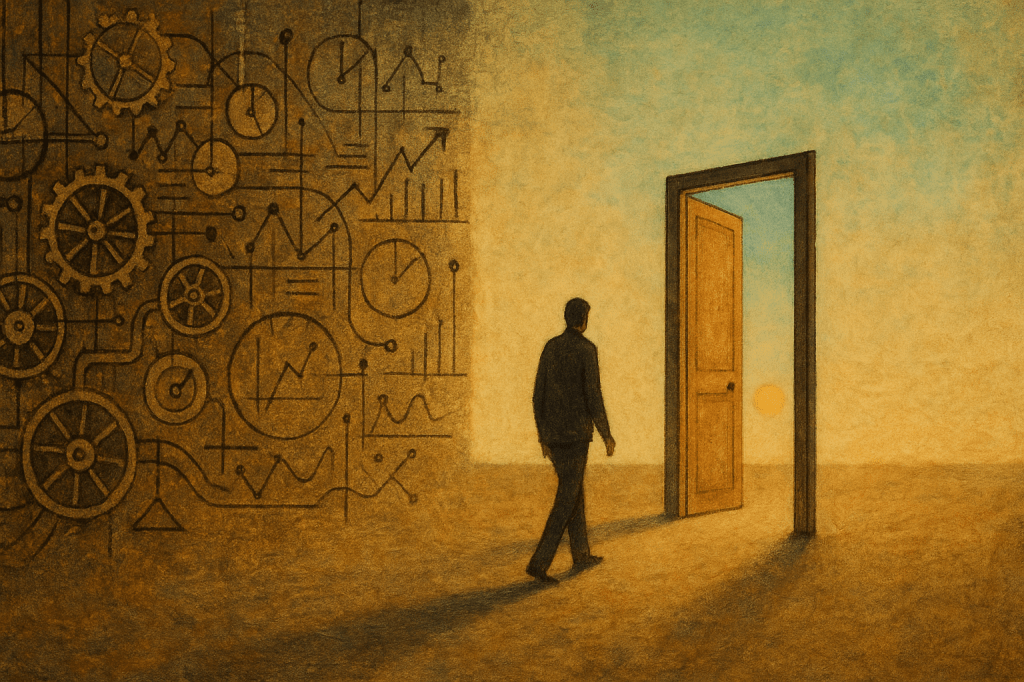
We had escaped the rigid cage of Harvard’s frameworks only to build a new cage: the ever-moving scaffolding.
The Infinite Deferral Machine
Let me give you a concrete example of how this pattern works.
Imagine someone with a simple, embodied need: I want to move my body. Maybe they’ve been sedentary, feeling sluggish, and recognize that movement would improve their wellbeing.
The straightforward response would be: walk. Run. Dance. Stretch. Do pushups in your living room.
But watch what happens when we apply “intelligent optimization” to this simple need:
“To move effectively, I should join a gym. But to afford the gym, I need more income. To earn more income, I need a different job or promotion. To get that promotion, I need new skills. To develop those skills, I need time. To create time, I need better productivity systems. To implement those systems, I need to research methodologies…”
Each step appears entirely reasonable. Of course a gym provides better equipment! Of course more income enables more options! Of course skills development requires time investment!
But notice the alchemy: a simple, direct need—move your body—has been transformed into an infinite chain of prerequisites. The original need has vanished under layers of optimization. The person who needed to move is now researching productivity methodologies, no closer to the actual movement their body craved.
This is what I’ve come to call the Infinite Deferral Machine—systems that promise to solve problems but actually transform simple problems into complex ecosystems of interdependence.
I see this pattern everywhere in modern business:
- “We need to make better decisions” → Deploy an ICA (Intelligent Choice Architecture) → Which requires data infrastructure → Which requires governance frameworks → Which requires training → Which requires metrics → Which requires committees… and we’ve now spent 18 months building the apparatus to support decision-making without actually making any decisions.
- “We need to understand our customers better” → Implement sophisticated analytics → Which requires data pipelines → Which requires APIs → Which requires security reviews → Which requires… and we’ve lost touch with the simple act of talking to a customer.
The body that waits for a gym forgets it can walk. The organization that waits for the perfect decision architecture forgets it can choose. The consciousness that waits for optimal conditions forgets it is already complete.
The Manufacture of Insufficiency
Here’s the deepest violence of these systems: they create the very inadequacy they promise to solve.
Your body isn’t sufficient without equipment. Your judgment isn’t sufficient without analytics. Your strategy isn’t sufficient without frameworks. Your learning isn’t sufficient without methodologies.
This is the corrupted form of the Buddhist Middle Way. The Buddha taught neither extreme asceticism nor indulgence, but a balanced path based on direct experience. But we’ve turned it into: “You need exactly the right balance of these seventeen practices, tracked with these three apps, calibrated through these five frameworks…”
The path that was meant to free us from dependency has become the ultimate dependence.
In my own life, I’ve felt this acutely. I’ve built businesses using adaptive frameworks. I’ve implemented sophisticated measurement systems. I’ve taught others to embrace continuous learning. And I’ve watched as the tools meant to enhance capability became substitutes for capability itself.
I remember a particular moment during a quarterly business review. We were six hours into analyzing our adaptation metrics—tracking how well we were tracking our ability to adapt. Someone made a joke about needing a retrospective on our retrospectives. Everyone laughed, but beneath the laughter was exhaustion.
That’s when it crystallized: we weren’t adapting anymore. We were performing adaptation.
When the Framework Becomes the Cage
My deeper research into adaptive learning systems revealed something profound: we don’t just use these systems—we ARE these systems.
Every human being is an adaptive learning algorithm. Our brains are constantly updating models, detecting drift, calculating regret, balancing exploration and exploitation. What we call “surprise” is drift detection. What we call “learning” is model updating. What we call “intuition” is pattern matching from accumulated experience.
Understanding this should be liberating. It reveals the magnificent complexity of human consciousness—we’re all running incredibly sophisticated optimization algorithms at every moment.
But here’s the trap: once you see yourself as an algorithm, it’s tempting to try to optimize the algorithm itself.
This is where the frameworks turn from liberating to constraining. Instead of trusting the natural intelligence of your adaptive system, you start trying to architect it. You implement meta-learning loops. You track your tracking. You optimize your optimization.
I see this especially in my explorations at the intersection of AI and human decision-making. As AI systems become more sophisticated, there’s a temptation to make humans more algorithmic—more measurable, more trackable, more optimizable. But in doing so, we risk losing exactly what made McCormack’s street smarts valuable: the direct, embodied, unmediated contact with reality.
Ancient Wisdom Speaks
What’s remarkable is that this pattern—and its resolution—isn’t new. Ancient traditions mapped this territory long before we had business frameworks to get trapped in.
Stoicism taught amor fati—loving what is, rather than endlessly optimizing what might be. Marcus Aurelius didn’t write about continuous improvement; he wrote about accepting reality with grace while acting with virtue. The Stoics knew that after you’ve done what’s in your control, wisdom lies in surrendering to what isn’t.
Buddhism places impermanence (anicca) at the center of its teaching. Everything changes; nothing lasts. The suffering (dukkha) comes not from change itself but from our clinging to permanence, our resistance to flux. The Buddhist path isn’t about optimizing your adaptation to impermanence—it’s about releasing the need to control what cannot be controlled.
Bhakti traditions in Hinduism go even further, teaching that true freedom comes through surrender (prapatti) and grace (kripa). You don’t optimize your way to liberation; you release the optimizer itself. You recognize that beneath all the doing, there’s a presence that was never trapped in the first place.
Taoism offers perhaps the most direct teaching: Wu Wei—action without an actor. Not passivity, but action that arises naturally, without the self-conscious observer trying to force optimal outcomes. The master calligrapher’s brush moves without thought. The athlete in flow has no separation between intention and execution.
These traditions all point to the same insight: there’s a stage beyond sophisticated optimization—conscious simplicity, presence without agenda, action without architecture.
The Three Stages of Knowing
I’ve come to see that wisdom follows a spiral path through three distinct stages:
Stage 1: Naive Simplicity
We use crude, mechanical methods because we know nothing else. Harvard’s case studies. Rigid org charts. Command-and-control management. This is innocence—limited but not false.
Stage 2: Sophisticated Complexity
We develop elegant, optimized systems and frameworks, believing we’re mastering the world. Adaptive strategies. Continuous learning. Agile methodologies. This is knowledge—powerful but potentially imprisoning.
Stage 3: Conscious Simplicity
We return to simple, direct action, but transformed. We’ve transcended complexity while retaining its insights. This is wisdom—informed by sophistication but no longer bound by it.
The third stage looks like the first from the outside, but it’s worlds apart. It’s the negotiator who no longer calculates tactics but listens fully. The designer who no longer iterates compulsively but creates from instinct. The leader who no longer preaches agility but embodies calm responsiveness.
McCormack’s first readers learned Stage 2—how to win in the world through adaptive intelligence. Those who kept walking eventually discover Stage 3—how to stop needing to win, how to act without anxiety, how to be present without performing presence.
What Presence Actually Looks Like
But let’s be practical. I’m not suggesting we abandon strategy, stop measuring, or reject frameworks entirely. That would be regressing to naive simplicity.
The question is: what does conscious simplicity look like in actual practice?
In my own work, I’ve found a few markers:
Presence in decision-making means trusting the judgment that emerges after you’ve gathered information, rather than endlessly optimizing the gathering process. It’s the moment you realize more data won’t improve the decision—it will just delay it.
Presence in strategy means having clear direction without being imprisoned by the plan. It’s holding goals lightly enough to notice when reality is pointing elsewhere. It’s the difference between “executing strategy” and “being strategic.”
Presence in leadership means responding to what’s actually happening rather than what your frameworks predicted should happen. It’s trusting your read of the room over what the engagement survey said last quarter.
Presence in learning means recognizing when you’ve learned enough to act, rather than using learning as a defense against action. It’s the courage to stop researching and start doing.
The practice isn’t about abandoning adaptive intelligence—it’s about knowing when to stop adapting and simply act from clear seeing.
There’s a particular quality to this kind of action. It’s not rushed or forced. It’s not hedging or over-analyzing. It’s decisive without being rigid, committed without being attached to outcomes.
I experience it most clearly in conversations. When I’m present, I’m not planning my next response while the other person is speaking. I’m not running through frameworks about active listening or emotional intelligence. I’m simply there, fully available to what’s emerging. And paradoxically, this is when I’m most effective—not because I’m trying to be, but because there’s no interference.
The Ever-Moving Scaffolding
If you want a single metaphor for where modern business has arrived, it’s this: an ever-moving scaffolding—constantly adjusted, never complete, beautiful in its mechanics, but unable to stand still long enough for anyone to climb it.
We build this scaffolding because it feels safe to be improving. But at some point, we must notice the exhaustion beneath the progress: the fatigue of continuous calibration, the anxiety dressed as productivity, the motion mistaken for aliveness.
I think of my own career—the businesses I’ve built, the strategies I’ve crafted, the teams I’ve led. The times I was most effective weren’t when I had the most sophisticated frameworks. They were when I was most present: fully attentive, responsive without reactivity, acting from clarity rather than from fear or ambition.
The ever-moving scaffolding is seductive because it never asks you to be still. As long as you’re optimizing, adapting, improving, you can avoid the deeper questions: What am I actually doing this for? Who am I when I’m not performing productivity? What remains when all the frameworks fall away?
The Seventh Lesson
McCormack taught six lessons, implicitly:
- The classroom ends at the door—real learning comes from contact with reality
- People matter more than models
- Timing and intuition trump analysis
- You must learn to read what’s unspoken
- Adaptation is survival
- Street smarts beat book smarts
But there’s a seventh lesson that can only be learned after you’ve mastered the first six:
After you’ve learned to adapt brilliantly, you must learn when to stop adapting.
Not because you’ve perfected the system. Not because you’ve achieved some final optimization. But because wisdom recognizes when the need for control has become the problem itself.
This is the graduation that nobody celebrates because it looks like giving up to those still trapped in the achievement paradigm. But it’s not giving up—it’s giving over. It’s the recognition that beyond all the strategies, all the frameworks, all the continuous improvement, there’s a kind of action that doesn’t need scaffolding.
In my deepest work—whether it’s advising leaders, building AI systems, or exploring the mathematics of adaptation—I keep returning to this insight: the goal isn’t to build better frameworks. It’s to reach the place where frameworks become optional rather than obligatory.
What They Still Don’t Teach You
So here we are, four decades after McCormack, and the lessons Harvard still doesn’t teach are even more subtle than the ones he identified:
They don’t teach you that the adaptive intelligence you cultivate can become its own form of rigidity.
They don’t teach you that continuous improvement can be continuous exhaustion wearing a productivity badge.
They don’t teach you that the most sophisticated strategy might be recognizing when strategy itself is the obstacle.
They don’t teach you how to rest without guilt, to trust what can’t be quantified, to act without architecture.
They don’t teach you that sometimes the smartest thing a strategist can do is stop strategizing—not forever, just long enough to remember why you started.
They don’t teach you how to recognize when your cleverness has become your cage.
And most importantly, they don’t teach you the final evolution of street smarts: that after you’ve learned to read the room, read the market, read the patterns—the ultimate wisdom is learning to simply be in the room, without needing to read anything at all.
The Circle Closes
What began as rebellion against academic frameworks becomes a deeper rebellion against all frameworks—even the ones that claim to set us free.
McCormack freed us from the classroom. Experience freed us from fixed strategies. The next freedom—the hardest—is from the need to be free, from the pursuit of optimal adaptation, from the performance of continuous improvement.
This isn’t nihilism or resignation. It’s the recognition that beneath all the doing, there’s a being that was never trapped in the first place. The adaptive algorithms, the learning systems, the frameworks and methodologies—they’re all running on top of something more fundamental: awareness itself, presence that requires no optimization.
In my own journey from business builder to strategic advisor to researcher at the intersection of AI and human consciousness, I’ve watched this pattern repeat: we create systems to free us, the systems become cages, we build better systems to escape those cages, those systems become subtler cages, until finally we realize the only real freedom is recognizing we were never truly caged.
The body that waited for a gym to move discovers it can walk anytime. The mind that waited for frameworks to decide discovers it can choose from presence. The consciousness that built scaffolding after scaffolding discovers it could always fly.
The Invitation
If you’re reading this and feeling the exhaustion of perpetual adaptation, if your continuous improvement has become continuously depleting, if your sophisticated frameworks feel more like prisons than tools—you’re not failing at adaptation. You’re ready for the next evolution.
The practice isn’t complicated, though it’s not easy:
Notice when you’re optimizing rather than acting, measuring rather than experiencing, strategizing rather than being.
Ask what’s actually necessary versus what’s scaffolding you’ve mistaken for structure.
Trust the direct contact with reality over the mediated analysis of reality.
Allow presence to inform action, rather than using action to avoid presence.
Remember that adaptation is a tool, not an identity. You can be strategic without being imprisoned by strategy.
This doesn’t mean abandoning frameworks—it means holding them lightly. It doesn’t mean rejecting measurement—it means knowing when you’ve measured enough. It doesn’t mean stopping learning—it means recognizing when you know enough to act.
Coda: The Spider’s Wisdom
McCormack taught us to be smart spiders—to weave sophisticated webs that catch opportunities, to sense vibrations in the market, to adapt our patterns to changing conditions.
What he couldn’t teach—because it can only be discovered, never taught—is that sometimes the smartest thing a spider can do is stop weaving.
Not because the web is perfect. Not because the pattern is complete. But because there comes a moment when you realize: the sky was always there, vast and open, requiring no web to hold it.
The web was never the goal. It was always just a means—useful, beautiful even, but not ultimate.
And in that recognition, you become free to weave or not weave, to adapt or not adapt, to strategize or not strategize—but always from presence, never from prison.
This is what they still don’t teach you at Harvard.
This is the lesson that can only be learned in the silence after all the lessons end.
Welcome to the space beyond strategy, where wisdom finally begins.
Mark McCormack opened a door in 1984. Four decades later, the question isn’t whether to walk through it—but whether to keep walking until you reach the door’s far side, where even the need for doors finally falls away.
 Reinvent The Self!