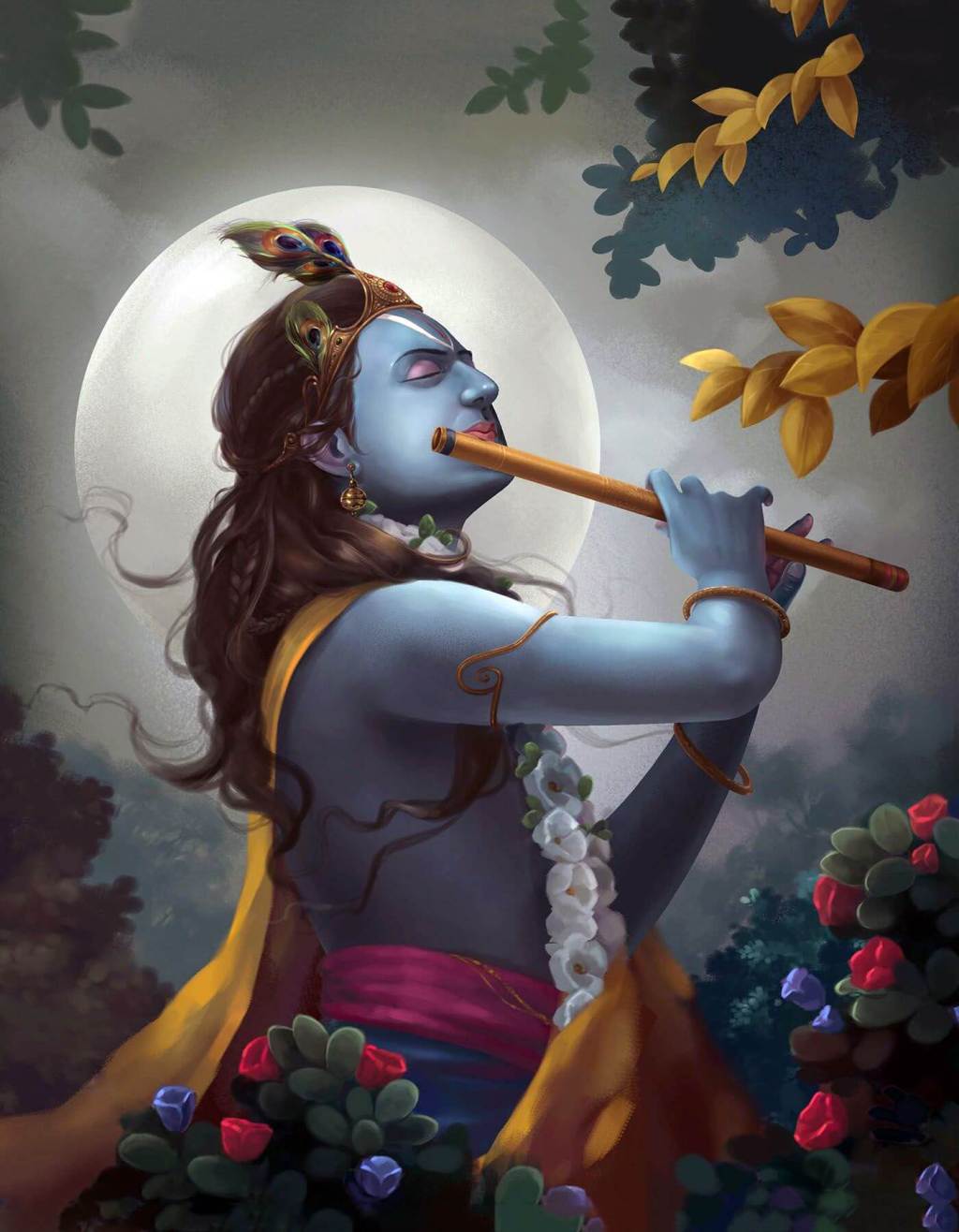
In the vibrant gallery of the divine, Lord Krishna stands unique. We know the charming face, the peacock feather, and the enchanting flute. But beneath these familiar symbols lies a profound, esoteric iconography—a spiritual grammar that decodes the very nature of our senses, our efforts, and our relationship with the divine. The names we chant and the stories we tell are not mere tales; they are sophisticated pointers to a reality that operates just beyond our perception. Let’s delve into the deeper meaning of Krishna’s symbolism, moving past the literal to uncover the divine architecture he represents.
Gopala and Govardhan: The Master of Senses and the Illusion of Effort
The term ‘Gopala’ is often simply translated as ‘cow-protector’. But the Sanskrit word ‘Go’ holds a dual, profound meaning: it signifies not only the cow but also our senses and organs.
Gopala: The Nurturer of Senses
In this deeper context, Gopala is not just a herdsman; He is the one who nurtures, sustains, and guides our senses. Our ability to see, hear, touch, and feel is a direct extension of His sustaining power. He is the consciousness that illuminates our sensory world. The cow, a sacred, calm, and life-giving animal, serves as a physical metaphor for this sustenance. Just as she provides nourishing milk, Krishna provides the divine energy that sustains our very being.
Govardhan: The Grace That Sustains
The episode of lifting the Govardhan hill is a masterclass on the illusion of human effort, or the “illusion of Karma.” When Krishna urged the villagers to worship the Govardhan hill instead of the celestial deity Indra, he was making a profound point. Worshipping Indra represents the worship of power and transactional reward—feeding the ego. Krishna redirects this worship to Govardhan, the very source that nurtures their senses and livelihood.
When Indra unleashes his fury, Krishna effortlessly lifts the entire mountain on his little finger, while the villagers believe their sticks are helping to support it. This is the ultimate metaphor. We, with our limited egos, believe our “sticks”—our jobs, our plans, our intellect—are what sustain our lives. In reality, it is the singular, effortless grace of the divine (Krishna’s little finger) that holds our entire world together. He teaches us to worship the source of our sustenance, not the transient powers we seek to appease.
Agochara and Shyama: The Incomprehensible Who Attracts All
How can the one who nurtures our senses be beyond their grasp? This paradox is central to Krishna’s nature.
Agochara: Incomprehensible to the Senses
Krishna is described as Agochara—one who is incomprehensible to the very senses He sustains. We can perceive the world through the instruments He provides, but we cannot perceive Him with those same instruments. He is the light, not the object seen by the light.
Shyama and Karshati iti Krishna: The Divine Black Hole
This is where his name and color become deeply significant. Shyama means dark or black. Like a black hole, his dark form symbolizes a divine gravity that absorbs everything into itself. You do not simply observe Krishna; you are drawn into Him. This is explained by the etymology of his name: Karshati iti Krishna—”He who attracts.” The attraction is so absolute that “you do not remain you once you are attracted to Him.” The individual ego, the sense of ‘I’, dissolves into his infinite being.
Hari and Makhan Chor: The Sacred Thief of Essence
This divine absorption is beautifully depicted in Krishna’s most playful form: the butter thief.
Hari: He Who Steals
One of Krishna’s primary names is Hari, which literally means “he who steals.”
Makhan Chor: Stealing the Essence
As Makhan Chor (the butter thief), he steals butter, which is the pure, concentrated essence of milk, obtained after a long process of churning. This is a metaphor for Viveka—the power of spiritual discrimination. The butter represents the purest part of a devotee’s love, the essence of their heart, churned through devotion and practice. Krishna doesn’t just accept any offering; He “steals” this refined essence. This theft is not a violation; it is an act of supreme love, a divine claim on the purest part of your being.
Gopalakala: The Great Equalizer of Love
What does the divine thief do with the stolen butter? He doesn’t hoard it. He distributes it among the other Gopis and Gopalas. This act symbolizes the ultimate nature of divine love: sharing and caring.
This shared meal is called Gopalakala, a mixture where everything—all the different offerings from different pots—is blended into one. In this divine feast, all separate identities are lost. There is no my butter or your butter, no my devotion or your devotion. There is only a single, shared substance of divine love. Through this simple act, Krishna establishes a community founded on grace, where individual egos dissolve and everyone partakes in the same divine essence. He steals our ego-bound love only to return it to us as a shared, universal experience.
The Architecture of Divine Paradox
Thus, the iconography of Krishna is a call to look deeper. He is not just a deity to be worshipped, but a principle to be understood—a divine force that sustains our senses, challenges our egoic efforts, and ultimately, attracts and absorbs our very being into a shared ocean of love.
Each name and story reveals a different facet of this supreme paradox:
- Gopala shows He sustains what cannot grasp Him
- Govardhan reveals our efforts are illusions masking His grace
- Agochara teaches He is beyond the very faculties He empowers
- Shyama demonstrates His nature as the divine attractor
- Hari proclaims He steals what is already His
- Makhan Chor shows He seeks only our essence, not our externals
- Gopalakala proves individual love becomes universal through Him
In understanding these deeper meanings, we move from mere devotion to divine recognition—seeing Krishna not as a historical figure to worship but as the very principle of consciousness that sustains, attracts, and ultimately absorbs all existence back into itself. The flute may call us initially, but these profound truths are what make us stay, forever lost and found in the divine play of the one who steals hearts by revealing they were never separate from His own.
 Reinvent The Self!