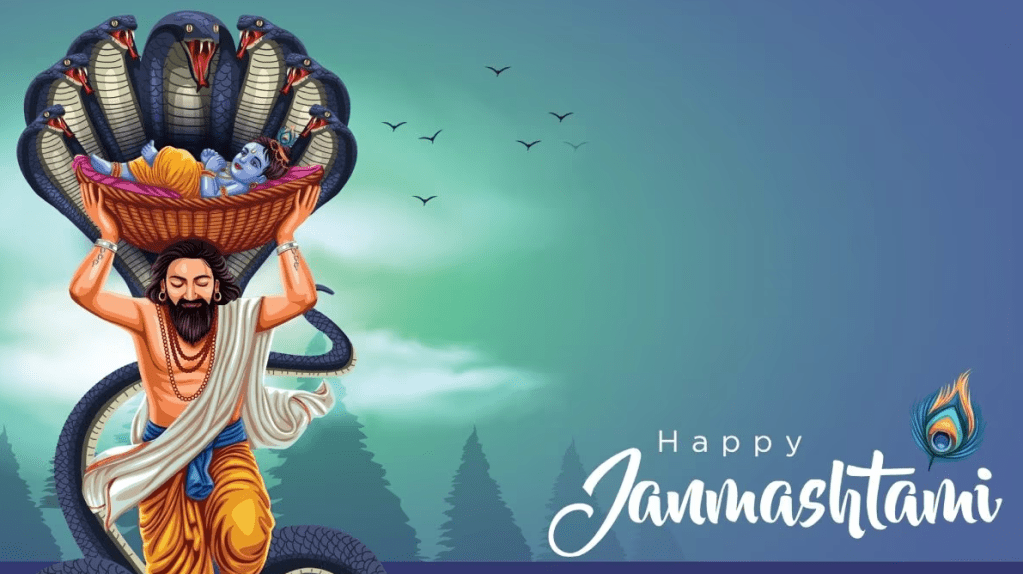
The story of Lord Krishna’s birth, celebrated as Janmashtami, is a cherished narrative of divine intervention, miraculous escapes, and the promise of salvation. Yet, beneath the surface of this beloved tale lies a profound spiritual allegory, a precise roadmap for the journey of human consciousness from bondage to liberation. When we decode the symbolism, Krishna’s birth is not an event that happened once in history, but a process that can unfold within each of us.
Ashtami: The Birth Through Inner Discipline
Krishna was born on the eighth day of the dark fortnight, known as Ashtami. This is no cosmic coincidence. The number eight is a powerful symbol in yogic philosophy, directly pointing to the eight-limbed path of Ashtanga Yoga. This framework, outlined by the sage Patanjali, is a complete system for spiritual development.
In this light, Krishna’s birth represents the dawn of divine consciousness within an individual, a state that is not a random gift but the natural culmination of dedicated spiritual practice, or sadhana. Just as the eighth day marks a point of completion in the lunar cycle, the mastery of the eight limbs of yoga brings the practitioner to a state of wholeness where the divine can manifest. One becomes Krishna only after the rigorous inner work of sadhana.
The Sweet Prison of Mathura and the Tyranny of Ego
Krishna’s birthplace, the city of Mathura, is a crucial part of the allegory. Its name means “Sweet,” yet it is a place of bondage, fear, and danger under the rule of King Kamsa. This creates a powerful paradox, mirroring the nature of the material world itself.
Deceptive Sweetness
Like the Ashok Vatika in the Ramayana—a garden meant to be without sorrow that becomes Sita’s prison—Mathura represents the alluring but ultimately impermanent sweetness of material and sensual pleasures. It is the world that the ego builds, promising happiness but delivering bondage.
Kamsa as the Ego
King Kamsa symbolizes the tyrannical Ego that rules this “caged world.” His constant fear of his own demise reflects the ego’s inherent insecurity and its desperate attempts to maintain control by eliminating any threat to its reign.
The Path of the Sadhaka: Failure Before Fruition
The story of Devaki’s first seven children represents the arduous and often frustrating path of the spiritual practitioner (sadhaka).
The Six Failed Attempts
Kamsa’s act of killing the first six children of Devaki and Vasudev signifies how the powerful, entrenched ego destroys the initial, premature efforts of a seeker. In the early stages of sadhana, our attempts to cultivate divine virtues are often weak and easily crushed by our own deep-seated egoic patterns. This illustrates the profound difficulty of escaping the caged world through sheer will alone.
The Seventh Child: The Turning Point
The seventh child, a Kanya (Yogamaya, the divine illusion), represents a critical breakthrough. She is the first to escape Kamsa’s trap, symbolizing a point in the sadhaka’s journey where spiritual energy becomes strong enough to slip past the ego’s grasp. More importantly, she issues a divine warning to Kamsa, proclaiming the inevitability of his destroyer’s arrival.
This moment signifies the dawning of unshakeable faith within the practitioner—the deep, inner knowing that the divine consciousness (Krishna) within is destined to rise and will ultimately vanquish the ego.
This progression transforms the narrative of Krishna’s birth from a single miraculous event into a phased spiritual awakening. It acknowledges the initial failures, celebrates the pivotal moment of dawning faith, and sets the stage for the final, successful birth of divine consciousness that breaks all bonds and leads the soul to the ultimate bliss of Gokul.
The Great Escape: Overcoming the Caged World
The narrative of Krishna’s escape from King Kamsa’s prison is a powerful metaphor for breaking free from the bondage of our “caged” world—the prison of the ego, worldly attachments, and karmic limitations.
Breaking the Cage
The prison, with its locked gates and sleeping guards, represents the seemingly insurmountable obstacles of our conditioned existence. Krishna’s effortless escape signifies that once divine consciousness is born within, no worldly chains can hold it.
The Sleeping Guards
The security guards, lulled into a deep slumber, symbolize our own senses and egoic patterns. Through perfected sadhana, these faculties, which normally guard the prison of our identity, are quieted and transcended, allowing for a seamless escape.
Calming the River
The fierce Yamuna river, representing the turbulent forces of nature and the fiery passions of the mind, parts with the mere touch of Krishna’s foot. This illustrates that for a realized being, even the most powerful and chaotic forces become subservient. The path clears not through struggle, but through the gentle, effortless power of divine presence.
This miraculous journey is a depiction of our own sadhana. The initial stages require effort and discipline, but the final liberation from bondage happens with an effortless grace that pacifies all opposition.
The Yamuna Crossing: Transforming Samsara
Following the birth of divine consciousness, the journey from the prison of Mathura to the bliss of Gokul involves a final, profound interaction with the world of experience, symbolized by the fiery Yamuna river.
This is not a battle, but a transformation. The raging Yamuna represents Samsara—the turbulent, often dangerous, ocean of worldly existence. A lesser force would be consumed by it. However, when Vasudeva carries the infant Krishna, the embodiment of pure consciousness, the river’s nature changes.
With just a single touch of Krishna’s toe, the Yamuna does not vanish or get destroyed. This is a crucial distinction. The spiritual path does not seek to annihilate the world of experience. Instead, the Yamuna, this very Samsara, recognizes its master. It peacefully parts, making way for consciousness to pass through unharmed and safely reach the other side.
This act reveals a sublime truth about liberation: enlightenment is not about escaping the world, but about transcending its ability to bind you. When touched by pure consciousness, the very world of challenges, attachments, and difficulties that once seemed like an insurmountable obstacle ceases to be a barrier. It becomes the very medium through which you travel to a higher state of being.
Arrival in Gokul: The Abode of Bliss and Harmony
After crossing the river, Krishna arrives in Gokul, the humble village of cowherds led by Nanda and Yashoda. This is the final stage of the allegorical journey.
Gokul, which means “a clan or community of pure beings,” represents a state of Ananda—a world filled with bliss, success, and harmonious coexistence. It is the consciousness one enters after breaking free from the prison of the ego. In Gokul, life is not a struggle for power or survival but a joyful play (Lila) in the company of other pure souls. Nanda and Yashoda symbolize the loving, nurturing environment where this newfound divine consciousness can thrive, not as a king to be feared, but as a beloved child to be cherished.
The Complete Teaching of Janmashtami
The story of Janmashtami, therefore, is our own. It teaches that through the dedicated practice of inner discipline (Ashtanga Yoga), we can give birth to divine consciousness within. This awakening provides the key to effortlessly break the chains of our caged existence and emerge into a world of pure, unadulterated bliss—the joyful, harmonious community of Gokul that awaits within us all.
Following the esoteric blueprint of Krishna’s birth, the symbolism deepens when we examine the nature of his prison, the obstacles faced, and the progressive journey of the spiritual seeker. The tale is not just of a single escape, but of a multi-stage process of overcoming the tyrannical ego.
Each element of this divine narrative serves as a milestone on the spiritual path:
- The sweetness of Mathura warns us about the deceptive nature of material pleasures
- The six failed attempts acknowledge the difficulty of spiritual transformation
- The seventh child’s escape heralds the dawn of unshakeable faith
- The sleeping guards show how consciousness can transcend its own limitations
- The parting Yamuna teaches that liberation transforms rather than destroys experience
- The arrival in Gokul promises that beyond ego lies a state of perpetual bliss
In celebrating Janmashtami, we celebrate not just a historical birth but the eternal possibility of divine consciousness awakening within each human heart. The blueprint is hidden in plain sight, waiting for those with eyes to see and hearts ready to embark on this ultimate journey from bondage to bliss.
 Reinvent The Self!