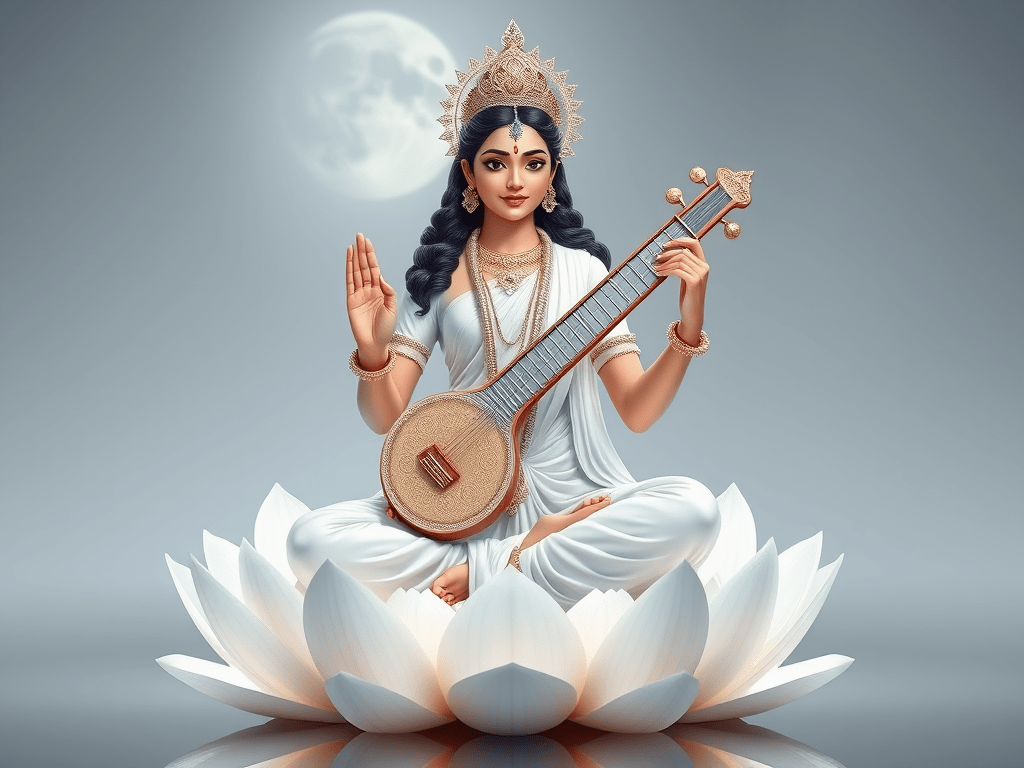
At the intersection of symbolism and science, where ancient wisdom meets quantum understanding, dwells a goddess whose very form is a mathematical equation of consciousness itself.
In the vast and vibrant pantheon of Hindu deities, Goddess Saraswati holds a place of serene distinction. She is the river of consciousness, the mother of the arts, and the source of all knowledge. But to truly understand her essence, we must look beyond mere titles and delve into the rich, symbolic language of her iconography. Each element of her depiction is a brushstroke in a masterpiece of spiritual philosophy, a note in a divine melody that resonates across the domains of mind, matter, and meaning.
The Vision in White: A Canvas of Purity and Quantum Possibility
The first thing that strikes you about Saraswati is her colour palette: a pure, radiant white. She is described in the sacred prayer Ya Kundendu Tushara Hara Dhavala as being “pure white like the jasmine flower, the moon, or a garland of snow.” Her garments are white, the lotus she sits upon is white, and her swan vehicle is white.
This whiteness operates on multiple levels of meaning, like a hologram revealing different dimensions as we shift our perspective:
The Physics of Purity
In the realm of optics, white light contains all frequencies of the visible spectrum. Similarly, Saraswati’s whiteness suggests she contains all knowledge, all possibilities, existing in a state of infinite potential—much like the quantum field before observation collapses it into specific manifestation.
The Cooling Light of Wisdom
Her luminescence is specifically compared to the moon, not the sun. This is profound. The knowledge Saraswati offers is not the scorching, unbearable heat of the sun—aggressive, dogmatic, or overwhelming. Instead, it is a cool, calming light that illuminates without burning, that reveals without destroying. In information theory terms, she represents signal without noise, clarity without distortion.
The Fragrance of Truth
The comparison to jasmine adds another dimension. Knowledge, like fragrance, has a subtle quality—it emanates naturally from its source, attracting seekers not through force but through its inherent sweetness. This mirrors how mathematical elegance draws us to correct solutions, how truth has its own aesthetic appeal.
The Four Arms: A Multi-Dimensional Interface with Reality
Saraswati’s four arms represent the four aspects of human personality in learning: manas (mind), buddhi (intellect), chitta(consciousness/alertness), and ahamkara (ego). But let’s explore this through the lens of modern cognitive science and systems thinking.
The Veena: Harmony as Algorithm
In two of her hands, she holds the veena, creating divine music. The veena is not just an instrument—it’s a sophisticated technology for exploring resonance and harmony. Consider:
- The Gourds as Amplifiers: Like resonating chambers in physics, they remind us that knowledge needs space to reverberate, to find its full expression. In machine learning, this is analogous to the hidden layers of neural networks where simple inputs transform into complex understanding.
- Strings as Dimensional Reduction: The veena’s strings, when played individually, provide discrete notes—like basis vectors in a high-dimensional space. When played together, they create chords, demonstrating how simple elements combine to create emergent complexity. This mirrors how consciousness itself might work—taking the infinite-dimensional reality and projecting it onto the manageable dimensions of human experience.
- Tuning as Calibration: The act of tuning the veena before playing mirrors the spiritual practice of aligning oneself with cosmic frequencies. In cybernetics terms, it’s a feedback loop ensuring the system remains in harmony with its environment.
The Sacred Book: Compressed Wisdom
The pustaka (book) in her hand represents not just the Vedas but the principle of knowledge compression itself. Like how DNA encodes the blueprint of life in molecular sequences, or how algorithms compress vast datasets into manageable insights, the book symbolizes the distillation of infinite wisdom into transmissible form.
The Rosary: Iteration and Recursion
The akshamala (rosary) represents the power of repetition and practice. In computational terms, it’s the iterative loops through which learning algorithms converge on truth. Each bead is a cycle of reflection, a recursive call to deeper understanding. The crystal beads specifically suggest transparency—each iteration should be clear, examined, understood.
The Sacred Vehicles: Navigating Dimensions of Consciousness
The Swan: The Ultimate Discriminator
The hamsa (swan) possesses the mythical ability of neera-ksheera viveka—separating milk from water. In our age of information overload, this symbolism is more relevant than ever. The swan represents:
- Feature Selection in ML: Like LASSO regression that zeros out irrelevant variables, the swan discriminates between signal and noise.
- Quantum Measurement: The ability to collapse superposition into definite states through conscious observation.
- Critical Thinking: The intellectual courage to separate truth from comfortable delusions.
The Peacock: Transcendent Beauty
Sometimes shown with a peacock, Saraswati embraces a creature known for its pride, transforming vanity into divine beauty. This teaches us that even ego, when surrendered to higher purpose, becomes an instrument of transcendence. The peacock’s feathers, with their fractal patterns, remind us that beauty and mathematics are intimately connected—that aesthetic appreciation might be consciousness recognizing its own patterns in nature.
The Lotus Throne: Stability in Flux
Seated on a white lotus, Saraswati demonstrates the principle of emergent purity. The lotus grows in mud yet remains unstained—a powerful metaphor for maintaining clarity while engaged with the messy complexity of existence.
In thermodynamics terms, the lotus represents a system that maintains low entropy (high order) despite existing in a high-entropy environment. It’s life creating pockets of negative entropy, consciousness creating islands of meaning in an ocean of chaos.
The Meta-Pattern: Beauty in Simplicity
As we synthesize these symbols, a profound pattern emerges—one of radical simplicity containing infinite depth. Saraswati’s iconography teaches us that:
- True knowledge cools rather than burns—it brings peace, not agitation.
- Wisdom is musical—it has rhythm, harmony, and resonance.
- Learning is iterative—each cycle deepens understanding.
- Purity emerges from engagement, not withdrawal.
- Discrimination and appreciation must dance together.
The Accommodation Principle
Perhaps most profoundly, Saraswati embodies what we might call the “accommodation principle.” Just as white light accommodates all colors, just as the veena’s resonating chamber accommodates all frequencies, she represents consciousness in its most spacious, accommodating form.
This connects to a deeper truth: knowledge acquisition is not about filling empty space but about creating space—space for new perspectives, space for others’ authenticity, space for the unknown to reveal itself. The gratitude we feel toward Saraswati is not just appreciation but recognition—we see in her the principle that allows all learning, all creativity, all expression to flourish.
Conclusion: The Eternal Symphony
Saraswati’s iconography is not mere religious symbolism but a sophisticated encoding of epistemological and ontological truths. She represents the principle by which consciousness knows itself—through art, through science, through spiritual practice, through the simple act of paying attention.
In our age of artificial intelligence and information explosion, her message is more relevant than ever: True intelligence is not about processing power but about discrimination. True creativity is not about novelty but about harmony. True knowledge is not about accumulation but about essence.
She sits eternally in her white splendor, playing the cosmic veena, reminding us that at the intersection of simplicity and complexity, of science and spirituality, of individual and universal, plays the eternal symphony of understanding. We need only tune our instruments to hear it.
Saraswati namastubhyam, varade kaamaroopini
Vidyaarambham karishyaami, siddhir bhavatu me sadaa
(Salutations to Saraswati, the giver of boons, who fulfills desires. As I begin my studies, may there always be accomplishment for me.)
 Reinvent The Self!