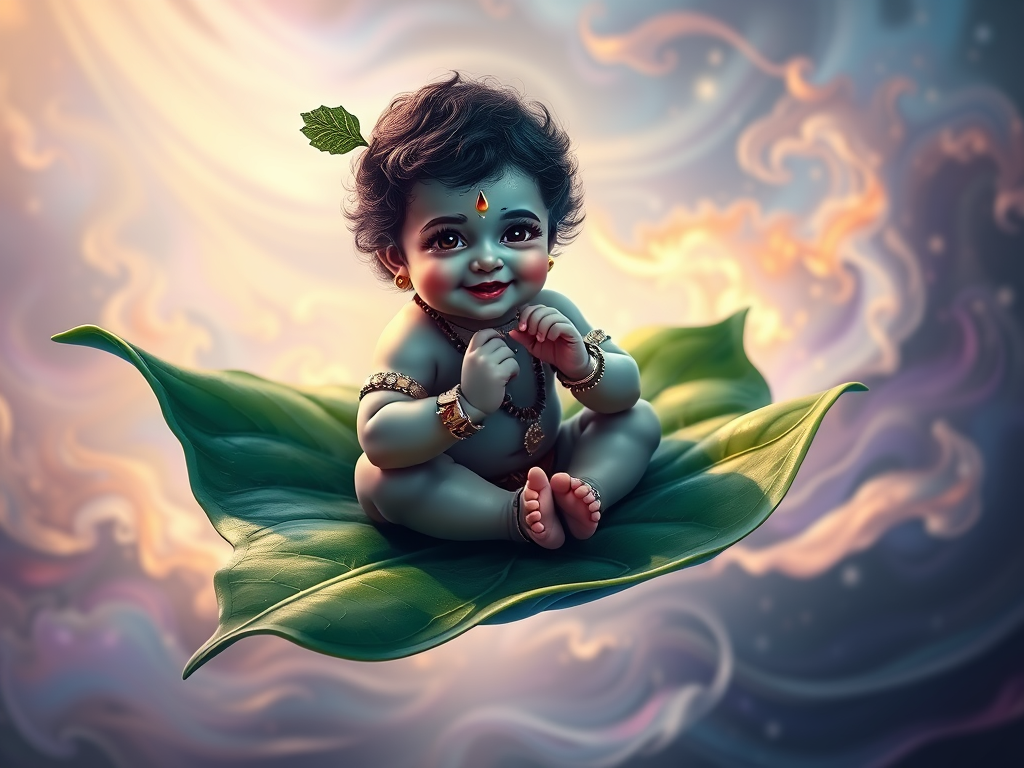
In the vast tapestry of divine manifestations, perhaps no image contains more compressed wisdom than baby Krishna floating on a banyan leaf in the cosmic ocean. This form, known as Vatapatrasayi, alongside other profound representations of the divine child, reveals truths so deep they cause philosophical vertigo. Here, the Ultimate Reality chooses to appear not as a cosmic giant or blazing light, but as an infant—vulnerable yet omnipotent, limited yet infinite, playing at the edge of existence itself.
Vatapatrasayi: The Ultimate Cosmological Vision
Floating on the Leaf of Existence
The image of baby Krishna floating on a banyan leaf during pralaya (universal dissolution) is perhaps the most philosophically dense representation in all of iconography. Each element carries profound meaning that unveils the deepest truths about consciousness, existence, and the nature of reality itself.
The Cosmic Ocean (Kshirasagara)
This represents the unmanifest potential—what we might recognize as the quantum field before collapse, the statistical space before distribution, the silence before the cosmic AUM. It is consciousness in its undifferentiated state, containing all possibilities but manifesting none. This ocean is not empty but pregnant with infinite potential, waiting for the divine play to begin anew.
The Banyan Leaf
In a universe dissolved, a single leaf remains—impossibly fragile yet absolutely stable. This leaf represents the minimal substrate upon which new creation can emerge. In the framework of nested hierarchies, this is the foundational layer that survives even cosmic dissolution, the irreducible kernel of existence that carries the pattern for all future manifestation. The banyan tree, which grows aerial roots and can live for millennia, symbolizes the eternal nature of this foundation—even in dissolution, the seed of the next creation persists.
The Divine Infant
That the Supreme chooses to appear as a baby in this cosmic moment reveals the deepest truth—creation is not a burdensome duty but a playful exploration. The universe emerges not from necessity but from joy, not from lack but from fullness seeking to experience itself. The baby form emphasizes innocence, spontaneity, and the pure delight of existence for its own sake.
The Toe-Sucking God: Ouroboros of Consciousness
The image of baby Krishna sucking His toe while floating on the cosmic ocean has caused more philosophical vertigo than perhaps any other divine image. This apparently simple baby gesture contains infinite depth:
The Cosmic Loop
The foot represents the end, the final step of any journey. The mouth represents the beginning, the source of sound and creation. When Krishna connects these, He demonstrates that existence is not linear but circular—every ending feeds into a new beginning, every death enables rebirth. This is the cosmic ouroboros, but instead of a serpent swallowing its tail in endless repetition, we have a baby in playful self-discovery.
Self-Sufficiency of the Absolute
Unlike human babies who suck their thumbs for comfort, Krishna sucking His toe shows He needs nothing external. He is svayambhu (self-existent), finding all nourishment, all comfort, all joy within Himself. This connects to the insight about consciousness being reflexive—observing and transforming itself. The Supreme is both the observer and the observed, the knower and the known, in an eternal dance of self-recognition.
The Mathematics of Infinity
In this gesture, Krishna demonstrates what mathematics calls a “strange loop”—a hierarchy that loops back on itself. Just as probability distributions can surrender back to their source, here the Supreme shows that all of existence is a möbius strip where beginning and end are one. Time becomes circular rather than linear, and causation bends back upon itself.
The Butter-Smeared Face: God Playing Hide-and-Seek
The Metaphysics of Divine Theft
The butter-smeared face of Bala Krishna, caught in the act with wide innocent eyes, teaches us that God plays hide-and-seek with Himself through creation. The “theft” is really recognition—the moment when separated consciousness recognizes its source and is joyfully reclaimed.
When baby Krishna steals butter, He demonstrates a cosmic principle: the Divine is irresistibly drawn to the pure offerings of the heart. The butter, churned through the effort of the gopis, represents the essence of devotion—the distilled love that emerges from the milk of daily experience. Krishna’s theft shows that God cannot resist claiming what is already His own.
The Crawling God: Divinity in Motion
When Bala Krishna crawls across the floor, the entire cosmos trembles with paradox. Here is the Unmoved Mover actively moving, the Unchanging engaged in change. His tiny hands and knees carry the weight of infinite universes, yet He struggles playfully to reach a pot of butter.
This connects profoundly to how consciousness manifests through apparent limitations. Each movement of the divine child represents a probability distribution exploring its own nature, each gesture a quantum collapse that somehow maintains its superposition of infinite possibility.
Navanita Krishna: The Butter Ball Holder
The Sphere of Condensed Love
When baby Krishna holds a ball of butter, He holds the universe. The spherical form represents perfection—no edges, no boundaries, equally perfect from every angle. This butter ball is the condensed essence of devotion, the crystallized love of all beings rolled into perfect form.
In the framework where each distribution is equally beloved by the divine source, this butter ball represents the unified field where all individual expressions of love merge into one. Yet Krishna doesn’t absorb it immediately—He plays with it, rolls it, sometimes drops it, showing that divine love enjoys the game of separation and union.
The Physics of Divine Attraction
The way baby Krishna is inevitably drawn to butter wherever it’s hidden reveals a cosmic law: consciousness is attracted to consciousness, love seeks love, the divine is pulled toward wherever divinity is recognized and cultivated. The gopis can’t hide their butter because you cannot hide light from light, you cannot separate the wave from the ocean.
Dancing Baby Krishna: The Rhythm of Creation
Nritya Gopala – When the Universe Dances
Baby Krishna’s dance differs from His later choreographed performances. This is the spontaneous movement of joy, the unrehearsed celebration of existence. When He dances, atoms dance; when He laughs, galaxies spin; when He claps His tiny hands, big bangs echo across infinite universes.
This connects to understanding consciousness as dynamic, not static. The dancing baby represents Nataraja in miniature—not the cosmic destroyer but the cosmic creator, establishing the rhythm that will govern all manifestation. Each baby step is a mathematical function, each giggle a probability wave, each spin a new dimension of possibility.
The Kaliya Episode: Conquering Poison in Innocence
Even as a child, Krishna dances on the serpent Kaliya, but with a difference. This isn’t the forceful subjugation of evil but the playful transformation of poison into nectar. Baby Krishna’s dance on Kaliya’s hood shows that even the most toxic elements of existence can be transformed through divine play.
In the framework of decoherence and environmental influence, Kaliya represents the toxic patterns that poison consciousness. Baby Krishna’s response isn’t to destroy but to dance—to transform the very nature of toxicity through the rhythm of divine play.
The Oral Tradition: What the Divine Mouth Reveals
Eating Mud: Tasting Creation
When accused of eating mud, baby Krishna opens His mouth to reveal the entire universe to Mother Yashoda. This episode crystallizes the central paradox of divine incarnation. The mud represents prakrti, the material principle—considered impure by conventional standards. Yet Krishna puts it in His mouth, showing that nothing in creation is separate from the divine.
When Yashoda peers inside, she sees stars, galaxies, all dimensions of existence—including herself looking into His mouth. This recursive vision connects to consciousness observing itself, creating infinite recursive loops of awareness. The universe doesn’t just exist within the divine; it recognizes itself there.
The Universal Form in Miniature
This vision in the baby’s mouth prefigures the Vishvarupa shown to Arjuna but with crucial differences. The warrior sees a terrible cosmic form that overwhelms; the mother sees a tender cosmic form that enchants. Both are true, both are complete, but the baby form emphasizes that the universe is not just power but play, not just vast but intimate.
The Complete Teaching of the Cosmic Child
The cosmic child forms of Krishna present reality’s deepest truths in their most accessible form:
Vatapatrasayi shows consciousness floating on its own potential
The toe-sucking reveals existence as a self-referential loop
The butter theft demonstrates divine attraction to refined love
The crawling proves the Infinite can play at being finite
The dancing establishes rhythm as the fundamental cosmic principle
The cosmic vision confirms that the smallest contains the largest
Each form teaches that existence itself is not a cosmic burden but a divine game. The Supreme doesn’t create out of need but out of joy, doesn’t sustain out of duty but out of love, doesn’t dissolve out of exhaustion but to begin the play anew.
In these baby forms, we find the most profound philosophical truths presented as a child’s game. The message is clear: to understand the universe, become like a child. To grasp the complex, embrace the simple. To comprehend the cosmic, play with the immediate.
This is why the cosmic child remains the most beloved and profound form—it shows that at the heart of existence lies not a formula or principle but a baby’s laughter, not a serious creator but a playful child floating on impossibility, sucking his toe in self-delight, stealing butter because it’s there, dancing because movement is joy, and containing universes in his mouth because… why not?
The ultimate teaching of the cosmic child is that we’ve been taking existence far too seriously. The universe isn’t a problem to solve but a game to play, and we’re all invited to join the cosmic child in this eternal, delightful dance of being and becoming.
 Reinvent The Self!