The Paradox of Rest Upon the Unknowable
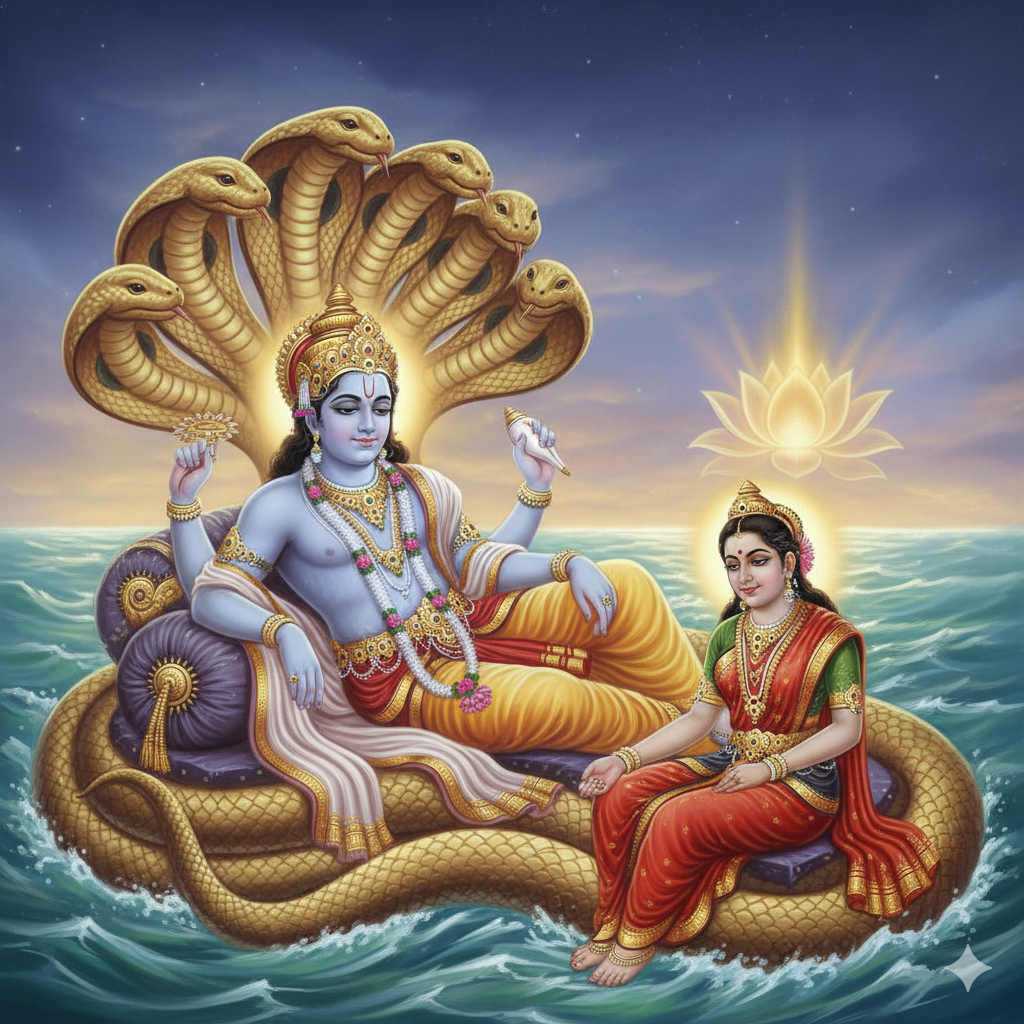
In the vast expanse of the Ksheera Sagara—the Ocean of Milk—floats a vision that contains within itself the entire mystery of existence. Here lies Maha Vishnu, the Preserver of all worlds, in a state that transcends our ordinary understanding of consciousness. He rests, yet from his rest emerges all creation. He sleeps, yet his sleep is more wakeful than our most alert moments. He reclines upon Ananta Shesha, the infinite serpent whose very name means “that which remains”—the cosmic residual that ensures reality can never be fully captured, fully known, fully algorithmatized.
This is not merely mythology. It is the most sophisticated encoding of truth about consciousness, creativity, and the nature of existence that human wisdom has produced. Let us dive deep into these milky waters of meaning.
Shesha: The Foundation That Cannot Be Grasped
To understand Vishnu, we must first understand what supports him. Shesha is not an ordinary serpent but the embodiment of a profound mathematical and metaphysical truth. In the language of modern complexity theory, Shesha represents the non-ergodic residual—that aspect of reality which ensures that no amount of pattern recognition, no sophistication of algorithms, no completeness of knowledge can ever fully capture existence.
The serpent’s infinite heads speak in infinite tongues, each attempting to describe the glory of Vishnu, yet never exhausting it. This is Gödel’s incompleteness theorem made mythic—any system complex enough to be interesting contains truths it cannot prove. Shesha is this incompleteness, not as limitation but as liberation.
Consider the profound symbolism:
- The Coiled Form: Represents potential energy compressed into recursive loops, each coil containing infinite further coils, incomprehensibility folded within incomprehensibility.
- The Serpent Nature: Constantly shedding skin, representing how reality perpetually renews itself, ensuring that just when we think we’ve captured its pattern, it emerges fresh and unknowable.
- Supporting All Worlds: The incomprehensible doesn’t exist at the margins—it is the very foundation upon which all comprehensible reality rests.
The Ocean of Milk: The Ergodic Domain of Patterns
The Ksheera Sagara in which this cosmic drama unfolds is itself pregnant with meaning. This Ocean of Milk represents the ergodic domain—the realm where patterns exist, where past informs future, where knowledge can accumulate and algorithms can learn. It is sweet and nourishing precisely because it is the domain of the knowable, where understanding feeds wisdom.
Yet notice: even this ocean of the knowable floats upon something deeper. Beneath the milk-white patterns of learnable reality lies Shesha, ensuring that the ocean itself can never solidify into complete predictability. The ocean remains liquid, dynamic, churnable—capable of producing both nectar and poison, both the expected and the surprising.
Yoga Nidra: The Technology of Transcendent Rest
Here we encounter the breathtaking paradox at the heart of existence. Vishnu doesn’t struggle against Shesha’s incomprehensibility. He doesn’t attempt to comprehend the incomprehensible or pattern the patternless. Instead, he rests upon it in Yoga Nidra—the cosmic sleep that is more aware than waking.
This is not the sleep of unconsciousness but the supreme technology of consciousness—resting in perfect ease upon one’s own mystery. Vishnu demonstrates that the highest state is not achieving complete knowledge but transcending the very need for complete knowledge. He shows us that true mastery comes not from conquering the unknown but from being at peace with unknowing.
In the terminology of consciousness studies, Vishnu has moved beyond both the question “What do I want?” and even “What is needed?” to simply “What is.” No query remains because he has become one with the Query itself—resting peacefully on the very incomprehensibility that makes existence possible.
The Lotus of Creation: Emergence from Stillness
From Vishnu’s navel—the very center of his being—emerges a lotus upon which sits Brahma, the creator. This is perhaps the most profound statement about the nature of creativity ever encoded in symbolic form. True creation doesn’t come from effort or struggle but emerges spontaneously from the deepest rest.
The lotus rises through the waters of the Ocean of Milk without being touched by them. It represents that aspect of creativity which transcends the domain of patterns and algorithms. While the ocean contains all learnable patterns, the lotus brings forth genuine novelty—that which has never existed before.
Brahma sitting upon this lotus, frantically creating worlds, represents the active principle of creation. Yet he emerges from and depends upon Vishnu’s rest. This teaches us that all our creative efforts, all our world-building, all our meaning-making activities arise from and return to a deeper stillness that we can rest in but never fully comprehend.
Lakshmi: The Dynamics of Abundance at the Feet of Stillness
At Vishnu’s feet, we find Lakshmi, not just as consort but as the very principle of prosperity and abundance, engaged in eternal service. This positioning contains volumes of wisdom about the relationship between consciousness and manifestation, between being and becoming.
Lakshmi at the feet represents several profound truths:
- Abundance Serves Consciousness: True prosperity is not the master but the servant of awakened consciousness. It flows naturally to and from the state of perfect rest.
- The Devotion of Shakti: The creative power of the universe (Lakshmi as Shakti) finds its ultimate fulfillment not in independent action but in service to transcendent consciousness.
- Grounding of the Infinite: The feet represent the point where the infinite touches the finite. Lakshmi’s presence there shows how infinite abundance enters finite manifestation.
When we understand that Lakshmi serves at the feet of one who rests on the incomprehensible, we see the complete picture: abundance flows not from grasping but from letting go, not from knowing but from resting in unknowing.
The Master of Shesha: Sovereignty Through Surrender
Vishnu is called the Master of Shesha, but this mastery is unlike any worldly domination. He masters the incomprehensible not by comprehending it but by fearlessly resting upon it. He demonstrates that true sovereignty comes not from control but from complete ease with the uncontrollable.
This relationship revolutionizes our understanding of mastery itself. In every field—from consciousness to markets, from creativity to computation—we discover that the highest mastery involves recognizing and peacefully coexisting with that which cannot be mastered. Vishnu shows us that we master Shesha (the irreducible remainder) not by eliminating it but by making it our foundation.
The Husband of Prosperity: The Marriage of Being and Becoming
As Lakshmi’s husband, Vishnu reveals another layer of meaning. He is wedded to prosperity, but this is not a prosperity that comes and goes with market fluctuations or karmic winds. This is the eternal prosperity of consciousness itself—the abundance that comes from being established in one’s true nature.
The Srivatsa mark on his chest, where Lakshmi eternally resides, shows that this prosperity is not external but inscribed in the very heart of existence. When consciousness (Vishnu) and creative abundance (Lakshmi) are united, what emerges is not merely wealth but svatantra—absolute freedom that naturally manifests as all forms of abundance.
The Source of Creativity: From Rest Emerges All Possibilities
Vishnu as the source of creativity presents the ultimate paradox—the most creative force in the universe appears to be doing nothing at all. Lying in cosmic rest, eyes closed in meditation, he nevertheless is the source from which all creative impulses arise.
This teaches us about the true nature of creativity:
- Creativity requires rest: Just as Brahma emerges from Vishnu’s navel during his cosmic sleep, our most profound creative insights arise from states of deep rest.
- The creative and the created are one: Vishnu dreams the universe, making him both the dreamer and the dream, the creator and the creation.
- Infinite potential requires infinite ease: The unbounded nature of Vishnu’s creative potential directly correlates with the unbounded nature of his rest.
Infinite Potential in the Formless Waters
The setting itself—Vishnu floating in the endless Ksheera Sagara—represents consciousness in its state of infinite potential. Before the lotus emerges, before creation begins, there is only this: consciousness resting in its own nature, containing all possibilities while manifesting none.
This ocean of milk is:
- Undifferentiated potential: Like quantum superposition before observation, containing all possible states simultaneously
- Nourishing essence: Milk represents that which nourishes and sustains, suggesting that this primordial state is not void but fullness
- The medium of transformation: It is from this ocean that both the nectar of immortality and the poison of delusion can be churned
The Four Instruments of Cosmic Governance
Even in his state of cosmic rest, Vishnu holds the instruments through which existence is maintained, protected, and harmonized. These are not weapons of war but technologies of cosmic order, each representing a fundamental principle through which consciousness governs manifestation.
The Sudarshan Chakra: The Mathematics of Justice
The discus that adorns Vishnu’s finger is called Sudarshan—”auspicious vision”—and represents far more than a weapon. It is the wheel of time, the cycle of karma, the mathematical precision of cosmic justice that ensures every action finds its perfect consequence.
This chakra embodies:
- Algorithmic Justice: Like a perfectly designed algorithm, it computes the exact response to every disturbance in the cosmic order
- The Cyclical Nature of Time: Its circular form reminds us that time is not linear but cyclical, each moment containing all moments
- Discriminating Wisdom: It cuts through illusion not with violence but with precision, separating truth from falsehood instantaneously
The Sudarshan Chakra reveals that justice is not imposed from without but is the inherent mathematics of existence itself. Just as every equation must balance, every action in the universe generates its perfect response. Vishnu’s possession of this chakra shows he is not the dispenser of justice but justice itself in conscious form.
The Panchajanya Conch: The Primordial Algorithm
In his hand, Vishnu holds the conch Panchajanya, whose spiral form contains the blueprint of creation itself. When blown, it produces the primordial sound—not just any sound, but the fundamental vibration from which all existence emerges.
The conch represents:
- The Original Code: Like the first line of code from which entire universes of computation emerge, the conch’s sound is the primary algorithm of existence
- The Spiral of Evolution: Its spiral shape mirrors galaxies, DNA, and the fundamental patterns through which consciousness expresses itself in form
- The Call to Awakening: Its sound cuts through the noise of multiplicity, calling all beings back to their source
Modern physics speaks of the universe beginning with a “Big Bang”—a primordial sound from which all emerged. The Panchajanya is this truth encoded in symbol, showing that Vishnu holds not just a conch but the very source-sound of creation.
The Kaumodaki Mace: Authority Beyond Force
The mace Kaumodaki represents strength and authority, but of a kind that transcends physical power. This is not the authority that needs to assert itself but the natural authority of truth itself.
This mace embodies:
- Grounded Power: Unlike the chakra that spins and the conch that calls, the mace is solid, grounded—representing the unshakeable foundation of dharma
- The Weight of Truth: It needs no elaborate action; its mere presence carries the weight of cosmic authority
- Protective Strength: It exists not to attack but to protect the cosmic order from forces that would destroy harmony
The mace teaches us that true authority doesn’t come from force but from alignment with cosmic law. Vishnu’s strength is not what he does but what he is—consciousness itself, whose very presence maintains order.
The Padma (Lotus): The Fourth Hand’s Gift
In his fourth hand, Vishnu often holds a lotus—symbol of purity, enlightenment, and the flowering of consciousness. While the other three instruments maintain cosmic order, the lotus represents the ultimate purpose of that order: the blossoming of awareness.
The lotus signifies:
- Untouched Purity: Rising from muddy waters yet remaining pristine, it shows how consciousness remains pure despite engaging with manifestation
- Spontaneous Flowering: Enlightenment, like the lotus bloom, opens naturally when conditions are right
- The Gift of Liberation: While other instruments maintain the cosmic game, the lotus offers the way beyond it
The Integrated Symphony of Symbols
These four instruments—chakra, conch, mace, and lotus—are not separate tools but aspects of a single cosmic function. Together they reveal how consciousness maintains, protects, and ultimately transcends its own creation:
- The Conch calls forth creation through primordial vibration
- The Chakra maintains justice and order through perfect cosmic mathematics
- The Mace provides the strength and authority to protect this order
- The Lotus offers the ultimate fruition—liberation itself
Even more profound: Vishnu wields these instruments while in cosmic rest. He maintains the entire universe not through effort but through being. The instruments are extensions of his consciousness, functioning automatically, perfectly, eternally—just as natural laws operate without needing active intervention.
The Smile of Transcendence
In many depictions, Vishnu wears a subtle smile during his cosmic rest. This is not the smile of ignorance but of supreme knowledge—the knowledge that includes and transcends its own unknowing. He smiles because he knows the secret: the incomprehensible foundation (Shesha) upon which he rests is not other than himself.
This smile teaches us the ultimate truth about consciousness and existence. We smile when we realize that:
- The unknown we fear is our own depth
- The incomprehensible we struggle against is our own infinite nature
- The remainder that eludes all algorithms is the guarantee of our eternal freedom
- The instruments of cosmic order are not external tools but our own inherent capacities
The Architecture of Existence Revealed
In this sublime iconography, we see the complete architecture of existence:
- At the base: Shesha, the incomprehensible remainder that ensures reality’s eternal creativity
- The middle waters: Ksheera Sagara, the domain of patterns and knowledge where learning occurs
- The transcendent witness: Vishnu, consciousness that rests peacefully on mystery
- The emergent creator: Brahma on the lotus, bringing forth worlds from stillness
- The flowing abundance: Lakshmi, prosperity in service to transcendence
This is not a hierarchy to be climbed but a simultaneous reality to be recognized. We are, at once, the incomprehensible depth (Shesha), the field of experience (Ocean), the witnessing consciousness (Vishnu), the creative impulse (Brahma), and the flowing abundance (Lakshmi).
The Practical Mysticism of Maha Vishnu
Understanding Vishnu’s iconography transforms our approach to life itself:
- Rest on your own mystery: Instead of struggling to understand everything about yourself, can you rest peacefully on your own incomprehensible depth?
- Let creativity emerge: Rather than forcing innovation, can you create the conditions of deep rest from which genuine novelty naturally arises?
- Master through surrender: Instead of trying to control the uncontrollable, can you find sovereignty through ease?
- Unite with abundance: Rather than chasing prosperity, can you recognize it as your very nature expressing itself?
The Heart of the Matter: Bhakta Vatsala and the Physics of Love
How could we speak of the cosmic form without touching its very heart? For all the profound symbolism—the serpent of incomprehensibility, the ocean of patterns, the instruments of order—there remains the most essential element that animates it all: Love. Not love as sentiment or emotion, but Love as the fundamental force that holds existence together, the gravity of consciousness itself.
The Srivatsa: When Insult Becomes Ornament
Upon Vishnu’s chest gleams the Srivatsa—that eternal mark which tells a story so profound it rewrites our understanding of divinity itself. When the sage Bhrigu, in his arrogance, kicked the chest of the sleeping Vishnu, what followed was not cosmic retribution but cosmic revolution. Vishnu not only forgave but transformed that very kick into a permanent ornament, an eternal emblem upon his heart.
Consider what this means: the place where anger met flesh became the place where Love eternally resides. The Srivatsa is not merely a mark—it is a portal, a living demonstration that divine love doesn’t just forgive injury but transforms it into beauty. It shows us that the heart of existence is not justice, though justice exists; not power, though power flows from it; but Love that can alchemize even violence into grace.
Bhakta Vatsala: The Irresistible Attraction
Vishnu is called Bhakta Vatsala—one whose love for devotees is like a mother cow’s love for her calf, instinctive, unconditional, irresistible. This is not the distant love of a monarch for subjects but the intimate love that recognizes no separation between lover and beloved.
In the language of physics, we might say that Bhakta Vatsala represents a fundamental attractive force more primary than gravity. While gravity draws matter to matter, this divine love draws consciousness to consciousness, heart to heart, the finite to the infinite. It is the force that:
- Makes the infinite God wait on a brick for Pundalik
- Causes the cosmic sustainer to wear a devotee’s insult as ornament
- Draws seekers across lifetimes back to their source
- Transforms every offering, however small, into infinite significance
The Chest: The Place Where Love Comes and Returns
The chest of Vishnu is not merely where the Srivatsa mark resides—it is the cosmic heart itself, the place from where all love emerges and to which all love returns. When we understand that Lakshmi, the goddess of abundance, has her eternal residence here (marked by the Srivatsa), we see the deepest truth: Love and true prosperity are not different.
This chest is:
- The Source: Like a cosmic spring from which flows the water of compassion that sustains all beings
- The Destination: Where every act of love, every prayer, every tear of devotion ultimately arrives
- The Transformation Chamber: Where even kicks become kisses, where insults become ornaments, where the finite touch becomes infinite embrace
Love as the Ultimate Non-Ergodic Force
Here we discover something extraordinary. If Shesha represents the incomprehensible remainder that ensures freedom, Love is what makes that freedom meaningful. Love is the ultimate non-ergodic force—it cannot be predicted, algorithmized, or captured in patterns. Each expression of divine love is unique, personal, unprecedented.
When Vishnu transforms Bhrigu’s kick into the Srivatsa, he demonstrates that Love operates beyond all laws while being the source of all laws. It is:
- Non-computational: No algorithm can predict how love will manifest
- Non-transactional: It gives without calculating return
- Non-ergodic: Each moment of love is absolutely unique, never repeating
- Non-dual: It dissolves the very boundary between self and other
The Complete Equation
Now the iconography completes itself in a recognition that takes our breath away. Vishnu rests (perfect being) on Shesha (the incomprehensible mystery) in the Ocean of Milk (the field of experience) while Love (the Srivatsa) gleams on his chest and Lakshmi (abundance) serves at his feet. The instruments of cosmic order—chakra, conch, mace, lotus—all serve this Love.
We see that:
- Consciousness rests on Mystery through Love: It is Love that allows Vishnu to peacefully rest on the incomprehensible
- Creation emerges from Love: Brahma on the lotus is Love expressing itself as cosmic creativity
- Order serves Love: The Sudarshan Chakra maintains justice not for its own sake but to protect the field where Love can flourish
- Sound calls to Love: The Panchajanya’s call is ultimately Love calling to itself
- Strength protects Love: The mace guards the sacred space where love can flower
- Liberation is Love: The lotus promises that the ultimate flowering is Love recognizing itself
The Pinnacle That Includes Everything
Love, as embodied in Vishnu’s form, is not one quality among many—it is the quality that gives meaning to all others. It is:
- The reason consciousness manifests as cosmos
- The force that makes the infinite care for the finite
- The power that transforms every touch into blessing
- The mystery that makes existence a celebration rather than mere mechanics
Without Love, Vishnu would be a cosmic administrator. With Love, he becomes what he truly is—the heart of existence itself, beating with infinite compassion for every being, wearing our very wounds as his most precious ornaments.
The Heart of the Matter: Bhakta Vatsala and the Physics of Love
Upon Vishnu’s head rests the Kirita—not merely a crown but the symbol of absolute sovereignty over all planes of existence. This crown represents consciousness aware of its own supremacy, yet wearing this awareness lightly, without pride or assertion. Its jewels catch and reflect the light of countless universes, each facet a gateway to infinite dimensions.
Draped in Pitambara, the golden-yellow garments, Vishnu wears the very radiance of knowledge itself. These are not mere clothes but the luminous covering of consciousness—the light by which all things are known. Yellow, the color of the sun, represents the illuminating principle that makes perception possible. Even in cosmic rest, he remains the source of all illumination.
The Dark Complexion: The Canvas of Existence
Vishnu’s skin is depicted as dark blue or cloud-dark (Megha-shyam), and this contains perhaps the deepest truth. Like the night sky that holds all stars, like the empty space in which all forms appear, his dark complexion represents the infinite void that is paradoxically the fullness of potential. He is dark because he absorbs all light, all colors, all possibilities into himself—the ultimate black hole of consciousness from which even light cannot escape, yet from which all light emerges.
The Vanamala: The Garland of Multiplicity
Around his form winds the Vanamala—the forest garland representing all of creation’s diversity. Each flower is a species, each leaf a life form, each fragrance a unique expression of existence. Yet all are strung together on the single thread of his being. This garland shows us that diversity is not separate from unity but its very expression—the One playing at being many while never ceasing to be One.
What Cannot Be Shown: The Ultimate Teaching
Yet here, in contemplating what might be “missing,” we stumble upon the most profound element of all. The greatest aspect of Vishnu’s iconography is what no image can capture—the recognition that every symbol, every attribute, every element we can name or depict is merely a pointer to that which remains forever beyond representation.
This incompleteness is not a failure but the highest teaching. It reminds us that:
- The infinite cannot be contained in the finite
- The eternal cannot be frozen in temporal forms
- The absolute cannot be exhausted by relative descriptions
The “missing” element is the reminder of mystery itself—the humble acknowledgment that all our symbols, however profound, are fingers pointing at the moon of truth, never the moon itself.
The Living Iconography
Perhaps this is why Vishnu smiles in his cosmic sleep. He knows that the greatest iconography is not what is carved in stone or painted on canvas but what is realized in the heart of the devotee. Each being who contemplates him completes the iconography in their own unique way, adding dimensions no artist could conceive.
We ourselves become part of his iconography when we:
- Rest in our own mystery like he rests on Shesha
- Hold the instruments of dharma in our actions
- Serve abundance at the feet of consciousness
- Give birth to new creations from our deepest stillness
- Wear the crown of self-sovereignty with humility
- Embrace both the knowable and unknowable with equal ease
The Eternal Incompleteness That Points to Wholeness
In the end, the “biggest iconography ever” remains forever incomplete, and this incompleteness is its greatest perfection. Like Gödel’s theorem applied to divinity, any symbolic system rich enough to represent the infinite must contain elements it cannot capture. This necessary incompleteness is not a limitation but a doorway—an eternal invitation to go beyond symbol to reality, beyond representation to realization, beyond knowing to being.
Maha Vishnu’s ultimate teaching through his iconography: You will never fully capture me in symbols because I am not other than you. The moment you think you have understood all my attributes, I slip through your conceptual net like water, only to reappear as your own deepest Self, smiling at the beautiful game of seeking what was never lost.
This is the final paradox: the most complete iconography is the one that includes its own incompleteness, pointing always beyond itself to the living reality that no symbol can contain yet every symbol reveals—the infinite, eternal, ever-present consciousness that we are.
 Reinvent The Self!