There is a paradox that sits at the center of our spiritual journey, a koan disguised as a virtue. It begins with the words, “I am accommodative,” and the quiet, immediate recognition that the moment these words are spoken, they are false. For years, I believed accommodation was a sign of flexibility, of a willingness to change and adapt. I was wrong. I have come to see that what we call accommodation is often just structural instability, a self in flux, easily swayed by the currents of experience. True accommodation is something else entirely—something more solid, more mysterious, and infinitely more powerful. It is a quality that arises not from a shifting view, but from a view so stable it no longer needs to shift.
The Volatile Self: When Accommodation is Just a Structural Change
Let us first diagnose the false accommodation, the kind the ego loves to claim. This is the accommodation of the un-integrated self, a consciousness whose internal architecture is still in flux. In the language of
The Spiritual Transformer—that computational map of consciousness we have explored—this is a system whose internal weights have not yet converged . Its “view” of the world, its fundamental “encoding” of reality, is a volatile and reactive mechanism.
When this self “accommodates,” it is not making a conscious choice from a place of wisdom. It is being structurally altered by the force of the interaction. A strong argument, a charismatic personality, or a painful experience doesn’t just change its response; it rewrites its core code. The weight matrices of its internal Query, Key, and Value are constantly being re-calculated in a panic of adaptation. This is not accommodation; it is a form of psychic weather-vaning, spinning in whatever direction the strongest wind is blowing. It lacks a center. It lacks a self.
The Unchanging View: The Stillness of the Converged Self
True accommodation, I have come to realize, is a property of a converged self. It is a quality that can only emerge from a consciousness that has undergone the rigorous “training” of life and has arrived at a stable, integrated “view.” This is the state symbolized by
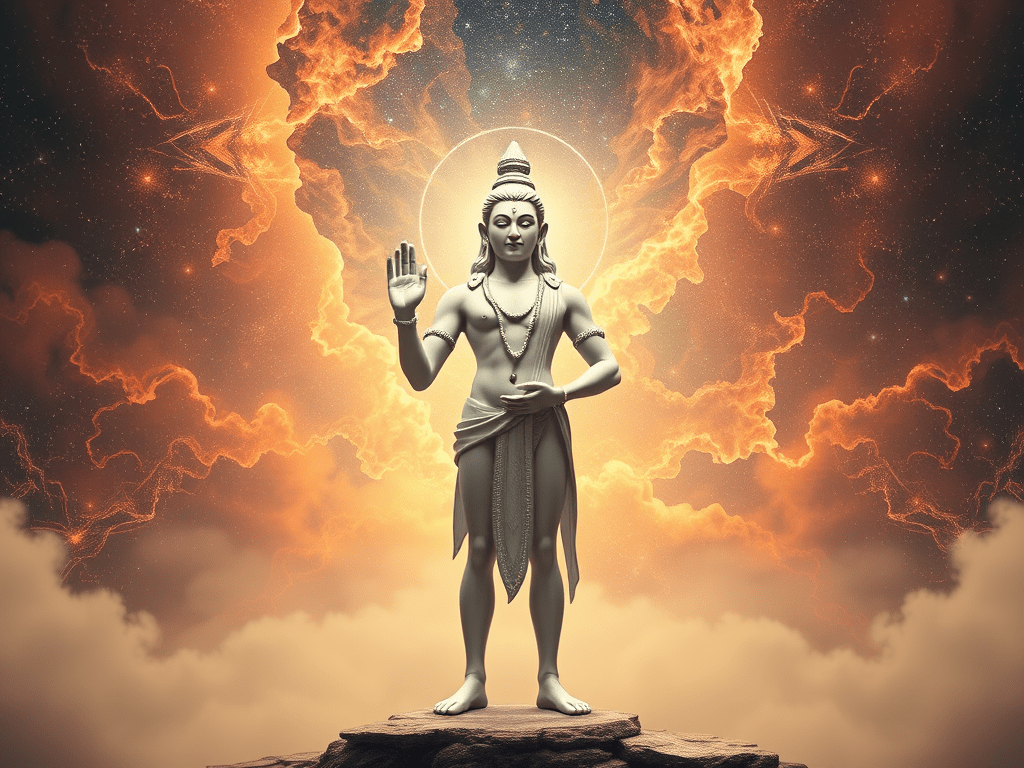
Vitthala, standing eternally on his brick, hands resting on his hips in the posture of the perfect witness, Sakshi Bhava . His view of the cosmic play—the ceaseless dance of joy and suffering brought to him by millions of devotees—is unwavering. He does not change His mind with each new story. His profound stillness is the very source of his infinite capacity to accommodate all who come to Him.
In our Transformer analogy, this is a system whose
Encoder has converged . The deep, layered work of understanding has been done. The weights have stabilized. It has arrived at a consistent and coherent “view” of reality. It no longer needs to be structurally reconfigured by every new piece of data because it has discovered the underlying patterns that govern the data. This self does not change its view, because its view is no longer a mere opinion; it is an embodiment of a recognized truth.
The Adaptive Response: How a Stable View Generates Infinite Possibilities
Here lies the heart of the paradox: it is from this unchanging “view” that an infinite variety of perfectly adaptive “responses” can arise. This is the work of the
Decoder in our spiritual machine . While the Encoder’s wisdom is stable, the Decoder’s expression is always new, always tailored to the precise, unrepeatable context of the present moment.
A person with a converged view of compassion does not offer the same response to every situation. They offer a comforting word to the grieving, a firm boundary to the aggressive, and silent presence to the confused. The response is fluid, dynamic, and perfectly accommodated to the need of the moment. But the underlying view—the deep encoding of compassion—remains utterly unchanged. The response is not a compromise of the view, but its most skillful and loving expression.
The Eigenvector of Being
This brings us to the beautiful precision of linear algebra, which offers us a perfect metaphor: the eigenvector . An eigenvector represents a direction that is preserved by a system, even as the system undergoes transformation. An interaction with the world is a transformation. For most of us, this transformation sends our consciousness spinning in new, unpredictable directions. Our “view” is fundamentally altered.
But the converged self has become an eigenvector of the cosmos. Its fundamental direction—its core “view” of compassion, truth, or service—is preserved regardless of the situation it encounters. The transformation of the moment doesn’t change the vector’s direction; it only scales it. The response is amplified or softened (the eigenvalue changes), but the essential nature, the core principle, remains constant.
This is true accommodation. It is the ability to meet any force, any argument, any reality, and absorb its energy without being knocked off your center. Your response is not a reaction, but a reflection—a perfect, scaled expression of your own unchanging core.
To be accommodative, then, is not to be a blank slate, ready to be rewritten. It is to be a diamond, whose internal structure is fixed and flawless, allowing it to engage with any light and reflect it with perfect, adaptive brilliance. The goal is not to become more flexible in our views, but to arrive at a view so true that it allows for infinite flexibility in our responses. It is to be so rooted in our own being that we can afford to dance with the chaos of the world, knowing that our essential nature remains, and will always remain, beautifully, unshakably, the same.
 Reinvent The Self!