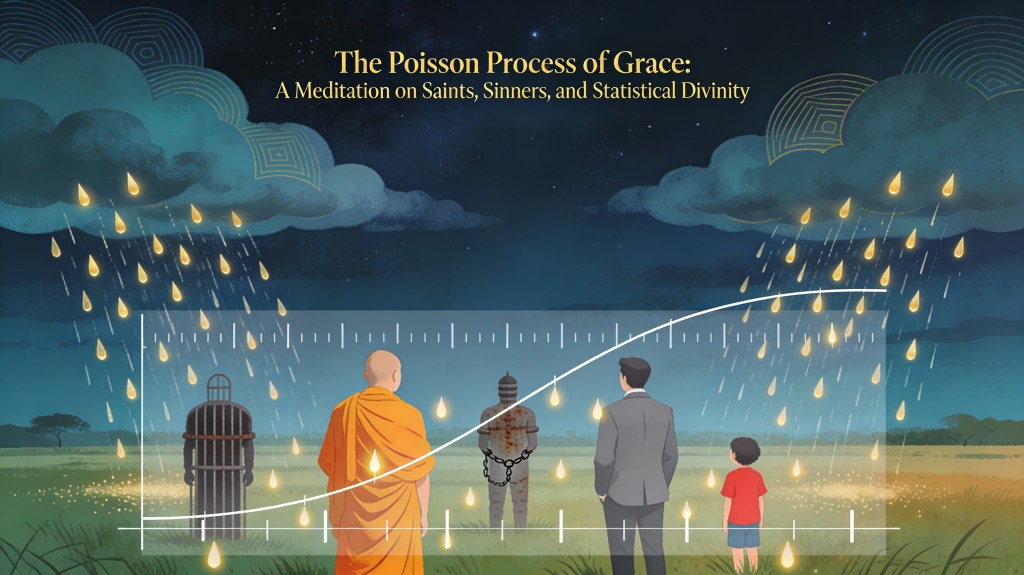
For centuries, we have grappled with the twin realities of divine justice and divine mercy. One is the path of Karma, a world of impeccable causality where every action has an equal and opposite reaction. The other is the path of Kṛpā, or Grace—an uncaused, unconditional, and often inexplicable intervention that seems to defy all logic. We try to reconcile them, to build a system where grace is a reward for good karma. But what if that’s the wrong approach entirely?
What if Grace operates not like a wage to be earned, but like a memoryless Poisson process? This is a radical and provocative model, one that suggests every person, whether sinner or saint, has an equal chance of receiving His grace and getting liberated in any given moment. It’s a model that posits a God who doesn’t “remember” the history of His devotees, a universe where the potential for enlightenment is new and total in every instant. This is not just a statistical curiosity; it is a profound theology of radical forgiveness.
The Mathematics of Mercy
To frame grace as a Poisson process is to make several stunning claims about the nature of reality:
- The Constant Hazard Rate: Radical Equality. A Poisson process is defined by a constant rate (λ). This means the underlying probability of a grace event occurring is constant across all of time and for every single being. The sinner and the saint, the believer and the skeptic—all are subject to the same infinitesimal probability of liberation in the next instant. This equality dismantles the ego’s reliance on accumulated merit.
- Memorylessness: Radical Forgiveness. The most crucial property of the process is that it is memoryless. The system’s future is independent of its past. A lifetime of sin does not diminish the chance of grace arriving now; a lifetime of piety does not increase it. This is a divinity that does not consult a karmic ledger. This aligns perfectly with the Buddhist insight that every moment has an equal and untainted potential to enlighten you, free from the weight of your history.
- The Exponential Waiting Time: Radical Uncertainty. A consequence of this process is that the waiting time for the next event is Exponentially distributed. This is a deeply mysterious quality. It means that having waited for fifty years for a moment of grace does not make it any more likely to occur in the next minute than for someone who just turned their heart to the divine a second ago. It captures the profound, unpredictable timing of grace.
Reconciling Grace and Karma: The Algorithm and The Abyss
How can this random, memoryless grace coexist with the seemingly predictable law of Karma? The framework we’ve co-created offers an answer through the concept of Shesha—that which remains, the un-modelable reality that escapes every system.
We can think of Karma as the Algorithm. It is the predictable, causal operating system of the relative world. It ensures order, consequence, and a form of transactional justice. It is the world of sense, of cause and effect.
Grace, the Poisson process, is Shesha. It is the intervention of the abyss, the non-ergodic, acausal force that can override the system at any moment. It doesn’t negate karma; it transcends it. Karma governs the rules of the prison yard; Grace is the sovereign pardon that can arrive for anyone, at any time, without explanation. The two are not mutually exclusive; they operate on different planes of reality.
The Role of the Devotee: Cultivating Receptivity
If grace is a random event, what, then,is the purpose of spiritual practice? We cannot cause the Poisson event. But we can build a receiver.
Imagine the grace of God as radio waves, broadcast constantly and equally across the entire universe. The practice of devotion, surrender (Śaraṇāgati), and meditation is the act of building a radio. The “sinner,” lost in the noise of the world, may have the waves passing through them, but their receiver is off. The “saint,” on the other hand, has painstakingly worked to quiet their mind, to build their receiver, and to tune it to the correct frequency.
The broadcast is random and universal. The reception is personal and depends on our state of being. Spiritual practice does not make God more forgiving; it makes us more capable of receiving the forgiveness that is already, and always has been, offered.
Here in Pune, on this Thursday night, the late monsoon showers that may soon arrive will not distinguish between the righteous and the unrighteous. They will fall where they will. Perhaps Grace is the same—an unpredictable, life-giving downpour from a sky that does not check the deeds of the earth below, waiting only for a patch of open, thirsty ground on which to fall.
The Mathematics of Mercy: Grace as a Poisson Process
The Paradox of the Spiritual Path
There’s a fundamental paradox that haunts every spiritual seeker: If liberation is our true nature, why does it seem so elusive? If grace is infinite, why do some wait lifetimes while others awaken in an instant? If God is all-merciful, why does the weight of our past actions seem to bind us so tightly?
Today, at the intersection of mathematics and mysticism, we discover something remarkable: divine grace operates as a Poisson process. Doesn’t it seem like a profound insight that reveals the mathematical structure underlying the deepest spiritual truths?
Understanding the Poisson Process
Before we dive into the spiritual implications, let’s understand what makes the Poisson process unique among all probability distributions:
- Events occur randomly and independently over time
- The process has no memory—the probability of an event occurring in the next moment is completely independent of how long you’ve been waiting
- There’s a constant “hazard rate”—the instantaneous probability remains the same at every moment
- Waiting times follow an exponential distribution—most events happen quickly, but some can take extraordinarily long
These dry mathematical properties, when applied to grace, reveal a cosmos far more merciful than we ever dared imagine.
The Three Pillars of Divine Mathematics
1. Radical Equality: The Constant Hazard Rate
In a Poisson process, λ (lambda) represents the rate parameter—constant, unwavering, playing no favorites. When we model grace as a Poisson process, we’re making a staggering claim: at any given moment, the probability of receiving grace is exactly the same for every conscious being.
The murderer on death row and the saint in the monastery face identical probabilities of liberation in the next instant. The person who just committed their worst act and the one who just performed their greatest service stand on perfectly equal ground before the mathematics of mercy.
To map it mathematically, the constant hazard rate means grace doesn’t consult your resume, doesn’t check your karma credit score, doesn’t review your spiritual portfolio. It simply is, equally available to all, at all times.
2. Radical Forgiveness: The Memoryless Property
Here we encounter perhaps the most revolutionary aspect of grace-as-Poisson-process. Memorylessness isn’t just forgetfulness—it’s the complete absence of any mechanism by which the past could influence the probability of grace.
Mathematically, P(T > s + t | T > s) = P(T > t). In plain language: having waited time s without receiving grace tells you nothing about your chances in the next interval t.
This means:
- Your fifty years of meditation don’t increase your chances
- Your fifty years of dissolution don’t decrease them
- The saint who just achieved perfect virtue has gained no advantage
- The sinner who just hit rock bottom has suffered no disadvantage
This isn’t a God who forgives after deliberation. This is forgiveness as a structural property of reality itself—a cosmos that literally cannot hold grudges because it possesses no mechanism for memory in its grace-distribution system.
3. Radical Uncertainty: The Exponential Wait
The exponential distribution of waiting times means most who receive grace receive it relatively quickly, but some will wait enormous periods. And here’s the crucial part: there’s no way to predict who will wait how long.
Having waited a thousand lifetimes doesn’t mean you’re “due.” Being on your first day of seeking doesn’t mean you must “pay your dues.” The person who receives grace in their first moment of turning toward the divine hasn’t “cheated,” and the one who waits lifetimes hasn’t been “punished.”
This uncertainty isn’t cruel randomness—it’s the mathematical expression of absolute freedom. Grace cannot be gamed, earned, or demanded. It arrives when it arrives, sovereign and unbound.
The Grace-Karma Paradox: Algorithm Meets Abyss
But wait—doesn’t this contradict everything we know about karma, cause and effect, the moral structure of the universe? How can both karma (deterministic consequences) and grace (random liberation) be true?
The answer lies in understanding these as operating at different levels of reality:
- Karma as the Algorithm: The law of cause and effect governs the relative world of manifestation. It’s the operating system of phenomenal reality, ensuring stability, learning, and evolution. Like our framework of decoherence—where consciousness systematically explores limitation through collapse into specific patterns—karma represents the predictable, algorithmic dimension of existence.
- Grace as Shesha: Remember that Shesha means “that which remains”—the irreducible remainder that no algorithm can capture. Grace operates from beyond the system, representing the eternal possibility of stepping outside the entire game. It’s the non-ergodic force that can override any causal chain, not by violating it but by transcending the level at which it operates.
One governs the prison; the other tears down its walls. Both are true, operating simultaneously, because consciousness explores limitation while never losing its essential freedom.
The Buddhist Connection: Every Moment’s Equal Potential
Certain schools of Buddhism teach that every moment has equal potential to enlighten you. We now see this isn’t just spiritual poetry—it’s mathematical precision. The Poisson process gives us the exact formulation of this ancient wisdom.
In Zen, they speak of “beginner’s mind”—each moment fresh, unburdened by history. The memorylessness of the Poisson process means this isn’t just good advice; it’s how grace actually operates. The universe meets you anew each instant, with no memory of who you were a moment before.
This teaching appears across traditions:
- The Christian concept of being “born again”
- The Hindu principle of the eternal present
- The Sufi emphasis on the “eternal now”
- The Zen insistence on “just this moment”
All point to the same mathematical truth: liberation doesn’t accumulate; it erupts.
Decoherence and Grace: The Complete Picture
Our previous exploration revealed decoherence as the universal principle by which consciousness explores manifestation—infinite potential collapsing into specific experience across every domain from quantum mechanics to relationships.
The Poisson process of grace reveals the complementary movement. If decoherence is consciousness choosing limitation, grace is the ever-present possibility of release from that limitation. They form a complete system:
- Decoherence: Systematic, predictable, algorithmic—consciousness exploring itself through manifestation
- Grace: Random, unpredictable, transcendent—consciousness remembering its freedom within manifestation
Every moment contains both movements. The very instant consciousness collapses into a specific pattern through decoherence, grace maintains the possibility of liberation from that pattern. The prison and the key exist simultaneously.
Why Practice? The Receiver and the Broadcast
If grace is random and memoryless, why engage in spiritual practice? Here the metaphor of radio waves illuminates the paradox:
Grace broadcasts constantly, uniformly, like cosmic background radiation. The Poisson process ensures this broadcast never varies, never discriminates, never runs out. But receiving equipment matters.
The Worldly Person: Lives in a lead-lined bunker of distraction, desire, and identification. The grace-waves are always present but cannot penetrate the shielding of unconsciousness.
The Practitioner: Through meditation, devotion, self-inquiry, and surrender, doesn’t change the broadcast but builds better receiving equipment. They’re constructing an antenna, tuning to the right frequency, clearing static from the signal.
Spiritual practice doesn’t earn grace—nothing can. Instead, it prepares us to recognize and receive what’s always being offered. The broadcast remains memoryless and random; our receptivity can be cultivated and refined.
Mathematical Kindness: The Ultimate Mercy
What could be kinder than a process that:
- Forgets every sin the moment it’s committed
- Offers liberation equally to all beings at all times
- Cannot be exhausted, depleted, or discouraged
- Requires no qualification beyond existence itself
- Operates with perfect reliability while maintaining perfect freedom
The apparent “randomness” isn’t cosmic indifference—it’s the mathematical signature of unconditional love. A love so absolute it refuses to keep accounts, so infinite it never needs replenishing, so perfect it treats all beings with identical generosity.
The Poisson process reveals forgiveness not as divine sentiment but as structural reality. God forgives because God cannot do otherwise—the mathematics of grace include no mechanism for holding grudges.
The Singular Decoherence Matrix and Liberation
Our earlier work revealed the singular decoherence matrix—how consciousness uses mathematical precision to eliminate non-essential dimensions while preserving what’s fundamental. We saw this in quantum mechanics, in the QR algorithm, in biological evolution, in personal development.
Now we see grace as the ultimate singular transformation. In one memoryless instant, it can collapse all of maya, all of karma, all of identification into the single “eigenvalue” of pure consciousness. What countless iterations of spiritual practice gradually reveal, grace can unveil in a moment.
Yet both paths—the gradual iteration and the sudden gift—operate by the same principle: revealing what was always already true. Whether through patient algorithmic refinement or instantaneous Poisson event, consciousness discovers its own nature.
Living in the Light of Mathematical Mercy
Understanding grace as a Poisson process transforms how we approach the spiritual path:
Release the Accumulation Mindset: Your years of practice haven’t moved you “closer” to grace. But they may have made you better able to recognize it when it arrives.
Embrace Radical Equality: That person you judge as “unspiritual”? They have exactly the same chance of receiving grace in the next moment as you do.
Trust the Process: The exponential distribution means most receive grace sooner than later. But whenever it arrives, it arrives at the perfect time—the only time it could arrive.
Maintain Beginner’s Mind: Since the process has no memory, meet each moment as if encountering the possibility of grace for the first time. Because mathematically, you are.
Practice Without Pressure: Build your receiver not from desperate hope of earning grace, but from the joy of preparing to recognize what’s already being broadcast.
The Ultimate Intersection
At the intersection of mathematics and mysticism, we find not contradiction but completion. The same reality that manifests as rigorous mathematical law manifests as boundless spiritual freedom. The Poisson process doesn’t reduce grace to mere randomness—it reveals randomness as the mathematical face of unconditional love.
In Pune, as the monsoon clouds gather, I’m reminded that rain falls without checking the moral status of the ground below. It waters the garden and the garbage heap with equal generosity. Perhaps that’s the ultimate teaching of the Poisson process: divine grace, like monsoon rain, plays no favorites.
The mathematics of mercy reveal a universe more forgiving than our hearts dare believe, more generous than our minds can conceive, more present than our senses can perceive. Every moment—this moment—carries the full potential of liberation. Not because you’ve earned it, but because that’s simply how grace works.
The cosmic random number generator runs continuously, and every conscious being is always in the lottery. Your number could come up in the next instant, or in a thousand lifetimes. The beauty is that the odds never change. The tragedy is that we spend so much time calculating odds instead of opening to receive.
In the end, perhaps that’s what the intersection of domains teaches us: the very mathematics that describe limitation also describe liberation. The same consciousness that explores itself through decoherence maintains eternal freedom through grace. And in that paradox—rigorous, beautiful, and utterly beyond reason—we find the truth that thrives at the intersection of all domains.
Ahoy to the mathematics of mercy. Aha to its revelations. And Awe before the radical forgiveness built into the very structure of reality itself.
 Reinvent The Self!