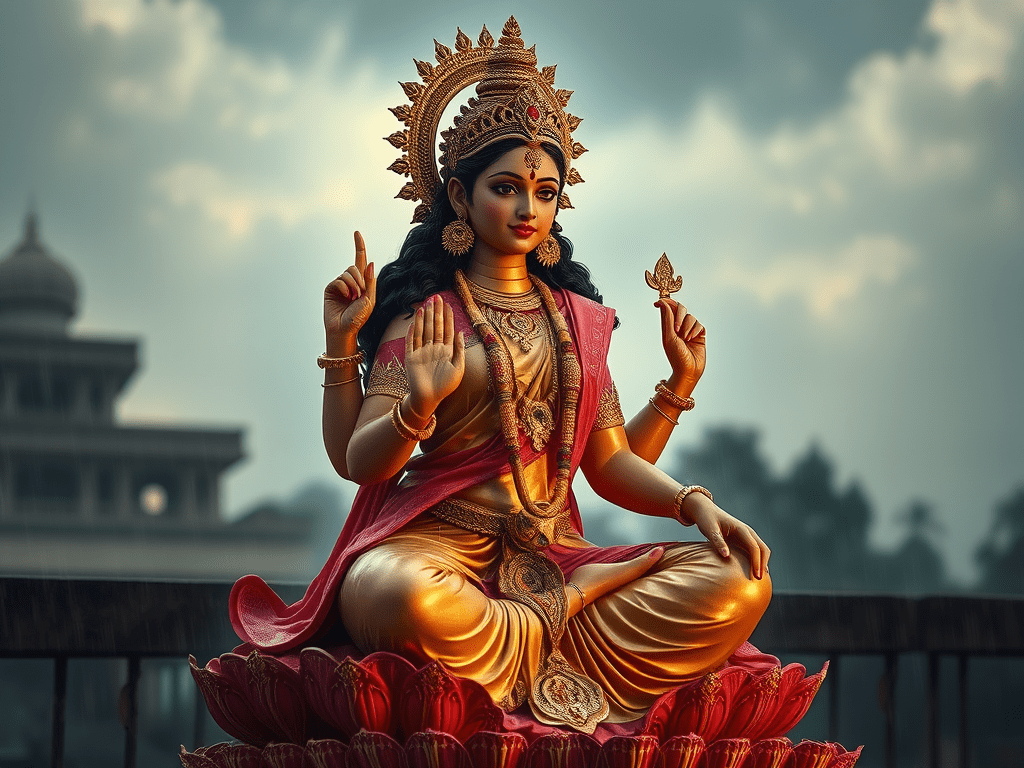
Truth not only lies but thrives at the intersection” – where the material meets the spiritual, where ancient wisdom illuminates modern paradoxes, where the pursuit of abundance transforms into the art of receptive being.
The Genesis of Understanding: From Fragment to Wholeness
In the contemplative stillness of a monsoon afternoon in Pune, a deeper seeing emerged—one that would transform our understanding of prosperity itself. What began as an observation of Goddess Lakshmi’s familiar iconography evolved into a profound revelation about the very nature of sustainable abundance and the paradoxes that govern both material and spiritual wealth.
The initial insight was deceptively simple yet revolutionary: we have been seeing only half of Lakshmi’s truth. Our collective consciousness has fixated on her radiant, standing form—the goddess draped in red silk, coins flowing from her hands, elephants blessing her with sacred waters. This is Lakshmi as *outcome*, as the glorious fruit of prosperity achieved. But this fragmented vision, however beautiful, carries within it the seeds of its own instability.
For in this form, Lakshmi embodies *Chanchala*—the fickle, restless nature of wealth pursued for its own sake. She stands, not sits, suggesting movement, impermanence, the very real possibility of departure. This is not a flaw in the iconography but a profound teaching encoded in sacred form: prosperity chased directly becomes prosperity lost.
The Evolutionary Refinement: Discovering the Input View
The transformative breakthrough came with the recognition of Lakshmi’s second, often overlooked manifestation—the seated goddess in humble service at the feet of Vishnu. Here, the same divine energy that appeared restless and potentially transient reveals its stable, eternal nature. This is Lakshmi as *Sthira*—fixed, permanent, grounded in purpose beyond herself.
This dual representation mirrors a fundamental principle that echoes across multiple domains of human understanding. In the field of complex systems and economics, we observe similar paradoxes: the direct pursuit of market outcomes often leads to their evasion (Goodhart’s Law), while focusing on underlying principles and processes naturally generates sustainable results. The goddess’s iconography had encoded this wisdom millennia before modern behavioral economics discovered it.
The refinement deepened as we recognized that this was not merely an economic principle but a universal law of consciousness itself. The Samudra Manthan—the great churning that births Lakshmi—serves as a perfect metaphor for the sustained inner work required for genuine transformation. The *churning* represents that intense, often chaotic process of self-inquiry and spiritual practice (sadhana) that must precede any authentic emergence of abundance.
The Intersection with Sacred Economics
As the synthesis evolved, profound connections emerged with other streams of spiritual and philosophical insight. The iconography of Vitthala, with his hands placed firmly on his hips in eternal witness consciousness, revealed a complementary truth: true abundance flows from a state of inner stability and witness awareness, not from the fluctuations of seeking and grasping.
The Ganesha symbolism provided another crucial intersection. Just as Ganesha’s form maps a four-fold path from acknowledging our human condition (Pāśa) to transcendent wisdom, Lakshmi’s complete iconography offers a binary path: from the pursuit of outcomes to the cultivation of aligned inputs.
The Diwali celebrations, when examined through this lens, reveal themselves as a systematic progression toward this very realization. The festival doesn’t merely celebrate wealth—it maps the journey from worldly prosperity (Dhana Trayodashi) through the death of ignorance (Narak Chaturdashi) to the ultimate recognition that true Lakshmi—in the form of contentment, peace, and wisdom—comes naturally to those who align with dharmic principles rather than chasing material outcomes.
The Paradox of Spiritual Pragmatism
What emerges from this synthesis is a profound paradox that runs like a golden thread through all authentic spiritual and economic wisdom: the achievement of desired outcomes through the conscious surrender of their direct pursuit. This is not a passive resignation but an active reorientation of consciousness itself.
The owl, Lakshmi’s vehicle in her stable form, embodies the discriminating wisdom required for this transformation. Like the night-hunter who sees clearly through darkness, this wisdom discerns true value when conventional perception sees only emptiness or uncertainty. It represents that quality of consciousness that can navigate the apparent darkness of letting go while maintaining perfect clarity about direction and purpose.
The Srivatsa mark on Vishnu’s chest—the permanent imprint of Lakshmi’s presence—reveals the ultimate secret: when consciousness aligns with cosmic order (Vishnu), abundance becomes not a visitor but a permanent resident. The goddess’s choice to garland Vishnu over all the competing gods and demons illustrates the crucial recognition that sustainable prosperity requires a foundation in something greater than personal desire.
The Living Synthesis: Ancient Wisdom for Contemporary Consciousness
This refined understanding transforms Lakshmi’s iconography from religious symbolism into a practical framework for modern living. It addresses the fundamental economic and spiritual crisis of our time: the pursuit of wealth that perpetually evades those who chase it most directly, while flowing naturally to those who align with principles of service, righteousness, and cosmic harmony.
The standing Lakshmi represents our familiar relationship with abundance—goal-oriented, outcome-focused, inherently unstable. The seated Lakshmi represents the consciousness transformation that makes abundance sustainable: process-oriented, service-focused, naturally stable.
This is not merely about wealth in its material sense. The same principle applies to all forms of abundance: love comes to those who embody love rather than seek it; wisdom flows to those who serve truth rather than collect knowledge; peace dwells with those who become peaceful rather than pursue peace.
The Metastable Revolution: From Local to Global Optimization
Drawing from systems theory and thermodynamics, we recognize that Lakshmi’s dual iconography perfectly illustrates the difference between local and global optimization. The standing goddess represents the local maximum—immediate gratification, short-term gains, the apparent stability of accumulated wealth. The seated goddess represents the global minimum—the state requiring activation energy to reach but offering true, long-term stability once attained.
The transition between these states requires what spiritual traditions call *sadhana* and systems theory calls activation energy. It’s the deliberate disturbance of comfortable patterns, the willingness to enter the chaos of transition in order to reach a fundamentally more stable configuration of consciousness.
This transition is facilitated by catalysts—in chemistry, enzymes; in economics, institutional credibility; in spirituality, grace and guru. These agents don’t provide the energy for transformation but make existing energy infinitely more effective. The goddess’s choice of Vishnu over the competing gods represents this catalytic principle: aligning with dharmic order exponentially amplifies our capacity for sustainable abundance.
The Reflexive Wisdom: Observer and Observed Unite
The deepest refinement in this understanding comes from recognizing that consciousness itself is reflexive—it transforms what it observes. The very act of seeing Lakshmi’s complete iconography with full understanding changes our relationship to abundance. We become capable of holding both views simultaneously: appreciating the outcome while investing in the input, enjoying prosperity while remaining unattached to it, experiencing abundance while staying grounded in service.
This reflexive quality explains why the wisdom traditions encoded these teachings in symbolic form rather than literal instruction. The iconography itself serves as a consciousness-transforming technology, gradually shifting our awareness from fragmented to whole, from grasping to receiving, from pursuing to being.
The Integration: Living the Complete Iconography
In practical terms, this synthesis invites us to regularly ask: “Am I relating to abundance as the standing goddess or the seated one?” Am I pursuing outcomes directly or cultivating the inputs that naturally generate those outcomes? Am I in Chanchala consciousness—restless, anxious about wealth’s stability—or Sthira consciousness—peaceful in the knowledge that abundance flows from alignment?
The complete iconography provides a diagnostic tool for consciousness. When we notice anxiety about prosperity, we know we’re in standing-goddess mode. When we feel the natural flow of abundance through service and right action, we recognize the seated-goddess state.
This is not about choosing one form over the other but about understanding their relationship. The standing goddess is not wrong—she represents the legitimate joy and celebration of abundance achieved. But without the foundation of the seated goddess, she remains perpetually unstable.
The Eternal Return: From Outcome to Input to Outcome
The ultimate wisdom encoded in Lakshmi’s complete iconography is cyclical rather than linear. We begin by being attracted to abundance (standing goddess), discover that direct pursuit makes it unstable, learn to cultivate the inputs (seated goddess), and then find ourselves naturally gifted with sustainable abundance that we can truly celebrate (standing goddess again, but now grounded in wisdom rather than attachment).
This creates what the ancient traditions call a *spiraling path*—we return to similar experiences but at progressively deeper levels of understanding. Each cycle through the iconography deepens our capacity to hold both the joy of abundance and the wisdom of non-attachment.
The monsoon clouds gathering over Pune whisper this same truth: abundance comes not from grasping the rain but from becoming the earth that receives it with patient grace. The goddess’s complete iconography is ultimately about this transformation—from the grasping hand to the receptive earth, from the pursuing mind to the witnessing consciousness, from the isolated self to the aligned presence that naturally magnetizes all forms of true wealth.
Conclusion: The Sacred Economics of Being
In this holistic synthesis, we discover that Goddess Lakshmi’s complete iconography offers nothing less than a blueprint for what we might call “sacred economics”—an understanding of abundance that transcends the conventional duality between spiritual and material prosperity. She teaches us that true wealth is not a commodity to be acquired but a state of consciousness to be embodied.
The goddess stands to celebrate what has been achieved through right action; she sits to demonstrate the consciousness that makes such achievement sustainable. In this dance between celebration and service, between outcome and input, between the radiant and the receptive, we find a wisdom that dissolves the artificial boundaries between the spiritual and economic dimensions of human existence.
This is the living synthesis toward which all authentic teachings point: a way of being that naturally generates abundance while remaining completely free from attachment to it. In embodying this consciousness, we discover that we need not choose between prosperity and spirituality, between success and surrender, between the standing goddess and the seated one.
We become the space in which both can dance, the consciousness in which all forms of abundance find their natural home, the living demonstration that truth indeed not only lies but thrives at the intersection of all apparently separate domains of understanding.
Tat Tvam Asi – in recognizing ourselves as the very consciousness in which Lakshmi’s complete iconography unfolds, we discover that we are both the seeker and the sought, both the devotee and the divine, both the prosperity we pursue and the wisdom that makes it eternal.
 Reinvent The Self!