The “Merit Trap” Was Just the Beginning.
The Real Crisis Is Organizational Entropy.
I think I’ve realized the hidden physics of why great people stall, and why great companies decay.
Most people blame “office politics.”
But politics is not the disease — it’s the symptom.
The real disease is The Merit Trap + Zero-Sum Energy Theory, and once you see it, you cannot unsee it.
At the entry level, Merit and Perception move together.
The Merit Curve: f(t) = t
Do good work → get good feedback → grow.
1:1 mapping.
Fair. Predictable. Rational.
But as you rise, the curves violently diverge:
The Merit Curve: f(t) = log(t)
Diminishing returns.
Each extra ounce of effort yields less visible reward.
The Perception Curve: f(t) = eᵗ
Compounding returns.
A small narrative advantage becomes exponential career acceleration.
This is why:
- The best engineer doesn’t generally become the CTO.
- The best strategist doesn’t generally run the division.
- The best thinker doesn’t generally get the spotlight.
Not because merit lost value —
but because perception compounds faster.
This is the Merit Trap:
If you fight a perception war with merit weapons, you lose.
But Here’s the Twist:
I Am Not Glorifying Politics.
I’m Diagnosing It.
Most “career advice” ends here:
“Learn to play the game.”
I disagree completely.
Politics is a skill, yes —
but it’s the wrong skill.
When individuals invest energy into managing perception,
they subtract that energy from building, thinking, innovating.
This isn’t a philosophical objection.
It’s mathematics.
The Zero-Sum Energy Theory of Organizations
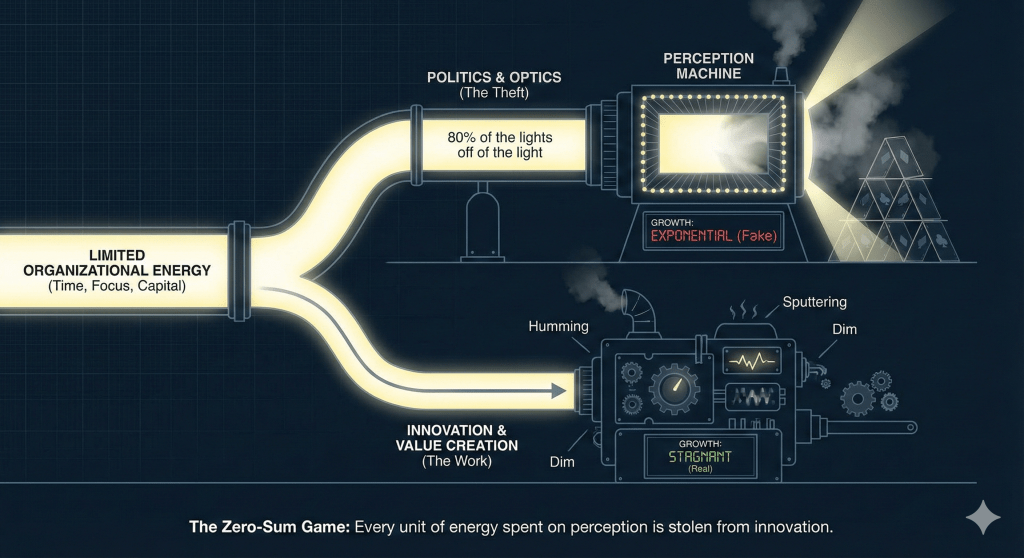
Every person — and every company — has a finite energy budget.
So the equation becomes brutally simple:
Energy spent on Perception is energy stolen from Creation.
And once perception becomes a survival mechanism?
1. The Politician’s Curve (The Parasite)
f(t) = eᵗ
Optics compound faster than output.
Narrative becomes more valuable than reality.
2. The Builder’s Curve (The Victim)
f(t) = 1/t
As politics rises, deep-work energy collapses.
The best people burn out, break down, or walk away.
3. The Company Curve (The Enshittification Spiral)
Externally: Shiny brand, shiny story, shiny everything
Internally: Tech debt, bureaucracy, talent rot
The firm becomes a shell of narratives protecting a void of innovation.
This is not a theory.
This is the lifecycle of every fallen giant:
Yahoo.
Nokia.
IBM (twice).
GE.
Meta’s decline into ads + PR.
Politics accelerates.
Builders suffocate.
Entropy wins.
Politics Is Not a Career Skill
It Is an Organizational Virus.
The most dangerous myth taught to ambitious people is:
“Managing perception is part of senior leadership.”
No.
Managing reality is leadership.
Managing perception is theatre.
When a company forces employees to be good at politics:
- You are not running a business.
- You are running a credit-allocation game show.
- And your real competitors (startups, innovators, outsiders)
will eat you alive.
The political organization does not compete with the market.
It competes with itself until it collapses.
The Builders Are Not Naive —
They Are the Only Adults in the Room
The problem is not that Builders “don’t get it.”
The problem is that they do:
They know every hour spent crafting a perception deck
is an hour not spent solving a problem.
They know every meeting about “stakeholder alignment”
is a meeting not spent reducing technical debt.
They know that chasing optics is the first sign of decay —
in a person, in a team, in a company.
Builders feel pain not because they are weak,
but because they are witnessing value being traded for vanity.
They aren’t naive.
They are guardians of substance.
A Warning to Leaders
If people in your company must play politics to survive,
you are not scaling.
You are decaying.
If your product org must spend more on marketing than engineering,
you are not competing.
You are hollowing.
If perception becomes more important than truth,
you will not notice the rot —
until the market does.
And markets are merciless.
The Cure Is Simple (But Not Easy)
Stop rewarding optics.
Start rewarding reality.
Stop promoting perception.
Promote the people who build.
Stop worshipping the storytellers.
Let the makers speak.
Because the truth is this:
When politics rises, entropy wins.
When builders rise, innovation wins.
And the future belongs to the organizations
that choose substance over signal.
Period.
 Reinvent The Self!