So far we explored the dimensions being and becoming of the lord Shiva. Now this blog tries to explore the “coming back” or the liberation aspect.
Our journey into the cosmology of Shiva now brings us to his right hand, to the emblem that defines his power and purpose: the Trishula. At first glance, it is a weapon, a symbol of might. But to see it only as such is to miss its profound compassion. For this is not a weapon of war, but an instrument of grace; not an instrument of binding, but of liberation.
The Paradox of Pain
The very name holds the key. The Sanskrit word Shoola (शूल) denotes two things simultaneously: a sharp, piercing spear, and the acute, piercing pain of suffering. Shiva, the ultimate healer, holds the very symbol of pain. This is the first clue. It tells us that the power to inflict pain and the power to relieve it stem from the same source. To overcome suffering, one must face its lord. Shiva doesn’t hide from pain; he wields it, demonstrating his absolute mastery over it.
The Three-Fold Bondage
So, what is the Tri-shoola, the threefold pain, that this spear relieves? It is the pain of existence itself, the bondage (bandhanān) of being trapped in a world of multiplicity. Our exploration revealed that these bonds which tie us to the cycle of suffering are all threefold:
- The Three Gunas: We are bound by the qualities of nature—Sattva (harmony, purity), Rajas (action, passion), and Tamas (inertia, ignorance).
- The Three States: We are bound to the cycle of consciousness—Jagrat (the waking state), Swapna (the dreaming state), and Sushupti (the deep sleep state), rarely glimpsing the fourth, transcendent state of Turiya.
- The Three Bodies: We identify with our vehicles of experience—the Sthula Deha (gross, physical body), the Sookshma Deha (subtle, mental body), and the Karana Deha (causal body), forgetting the Atman they enclose.
- The Three Times: We are bound by Kala (Time)—the relentless progression of past, present, and future, which creates the illusion of mortality.
These trinities weave the very fabric of Samsara, the cycle of birth and death that brings suffering.
The Prayer for Release
How does one escape such a fundamental prison? Not by fighting, but by surrender. This surrender is perfectly encapsulated in the ancient and powerful Maha Mrityunjaya Mantra. The devotee does not ask for a battle, but for a release, praying:
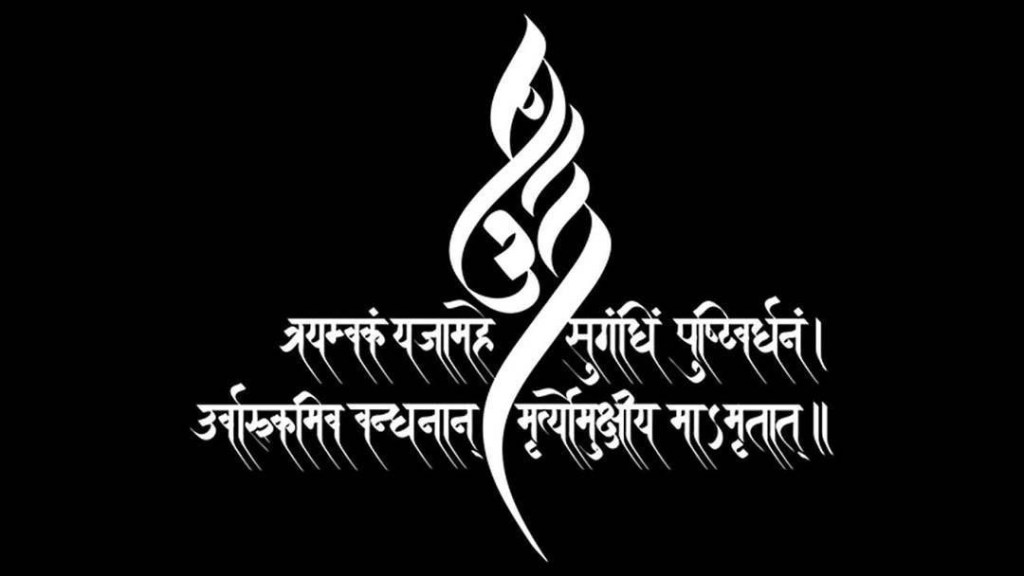
urvārukamiva bandhanān mṛtyormukṣīya māmṛtāt
“As the ripened cucumber is effortlessly severed from its bondage to the vine, so please liberate me from death, for the sake of immortality.”
This is the prayer of a soul that is ripe, that understands its bondage is no longer necessary. The cucumber doesn’t fight the vine; it simply lets go when its time has come. The bandhanān, the bonds, are the very three-fold ties of the Gunas, states, and times we just described.
The Trishula: The Divine Answer
The Trishula is Shiva’s answer to this prayer.
Its three sharp prongs are the divine instrument that pierces the heart of our threefold bondage. It is the power of Shiva that acts simultaneously on every level of our being—physical, subtle, and causal. It is the force that allows us to transcend the Gunas, to witness the three states from the fourth state of Turiya, and to understand that we are not the body that is born and dies, but the timeless consciousness that witnesses all.
The Trishula is the divine act of severance. It is the hand of the farmer, gently plucking the ripened fruit from the vine. It doesn’t destroy us; it destroys our bondage. It doesn’t end life; it ends Death (Mrityu). It is the ultimate tool of compassion, an emblem that promises that when we are truly ready to let go, the Lord of All will be there to cut the cord and grant us immortality (Amrita).
There’s still a lot of symbolism behind the beloved Mahadev in the form of Shiva Lingam, Nandi, Why he is called Neelkantha, why he uses Tiger skin and a Kamandalu, a water pot in one of his hands. Let’s visit them some time later! I just wonder, just 1 word Shiva and so many shades and symbolism behind it. We will if the time permits, also see the beautiful explanation of Shiva and Shakti as interpreted by poet saint Jnaneshwar in his creation, Amritanubhav.
 Reinvent The Self!