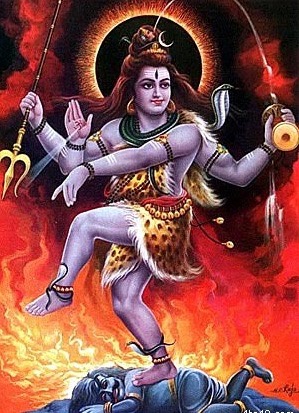
In our last exploration, we sat with Shiva in the stillness of Kailasa. We saw how his form symbolizes the silent, transcendent, and formless Absolute. But that is only half of the truth. The silence of Shiva is not empty; it is pregnant with a rhythm. It is the silence of the dancer moments before the first beat.
This is an exploration of that rhythm, a journey into the dynamic, cosmic dance that is both the expression of Shiva and Shiva Himself.
The Stirring of Creation: Damru and the Serpent
The stillness is stirred into creation by a sound. The Damru, Shiva’s hourglass drum, is not just an instrument. It is the Nada, the first cosmic vibration. Its beat is the pulse of the universe, the rhythm that brings forth time, space, and all of existence from the still potential of the Jata.
As creation unfolds, its primal energy is fiercely embodied by the Serpent coiled around Shiva’s neck. This serpent is no mere creature; it symbolizes two fierce truths—a creative force that sheds its skin, allowing for rebirth. Only by casting off outdated beliefs, biases, and impurities can true creation emerge from the ashes of the old self. Moreover, the serpent ignites pure, primal passion—a burning desire to engage fully in the act of creation, even after reaching the serene state of the unmanifest. The very fact that the snake possesses a forked tongue speaks volumes; it’s a reminder that wisdom can take two divergent paths. My revered Guru Ms Sunandatai Mulay boldly connected these two tongues to karma and writing.
Karma: After attaining a higher state, one’s actions in the world are no longer binding. They become a natural outflow of one’s realized state—selfless, harmonious, and for the benefit of the world (Loka-sangraha, as mentioned in the Bhagavad Gita). This is one “tongue” of expression.
Writing/Scripture: The second “tongue” is the preservation and transmission of that wisdom. It is the sacred duty of the wise to document and share their insights to guide others. This is how a single person’s realization can illuminate generations. The scriptures themselves are the product of this second tongue.
Serpent encompasses the process of purification (shedding the skin), the mastery of life’s passionate energy, and the subsequent expression of that mastered energy through both action and teaching.
The Grand Synthesis: The Dancer and the Dance
This brings us to the grand synthesis. Shiva has two quintessential states: the silent meditator on Mount Kailasa and the ecstatic dancer of the Tandava. One is the eternal, static state of blissful consciousness. The other is the eternal, dynamic dance of creation and destruction.
These are not opposites to be reconciled. They must be superimposed. They are the Dancer and the Dance. One cannot exist without the other. The stillness of Kailasa is the source of the Tandava’s rhythm. The ferocious energy of the Tandava is nothing but the joyful expression of the silent Lord’s own consciousness.
This is why Shiva is known by two of his most profound names. He is Bhootnath, the Lord of all Beings and Elements, signifying his mastery within the created space of the dance. And he is Mahakaleshwar, the Great Lord of Time, signifying his mastery over the very time that the dance creates. He is the stage, the actor, and the director of this entire cosmic play.
To understand this is to move beyond seeing Shiva as an object of worship. It is to see him as the very blueprint of our own reality. The goal is not merely to witness the dance from a distance but to realize that you are both the eternal stillness of Kailasa and the vibrant, joyful dance of creation. It is to live in the world with the profound, unshakeable knowledge of your own inner silence.
It is to declare, with every fiber of your being, Shivoham. I am Shiva.
 Reinvent The Self!