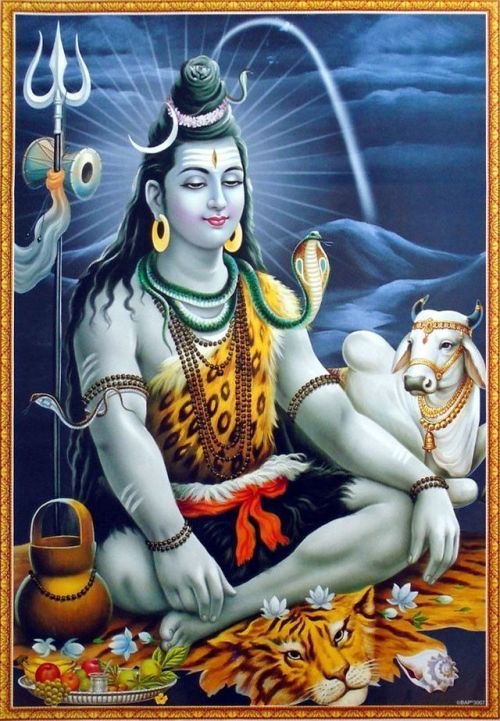
We begin with a paradox. Why does Shiva, the supreme ascetic, the very symbol of renunciation, have one of the richest and most complex iconographies in existence? The answer, as we’ve discovered, is that the form of Shiva is a divine roadmap to the formless. Each symbol is not an ornament but a signpost, guiding the seeker from the manifest to the unmanifest.
This is an exploration of that silent form, a journey into the eternal stillness of the Absolute.
The Seat of Potential: Jata and Ganga
To the common eye, they are matted locks. But to the contemplative eye, Shiva’s Jata represents something far more profound: the primordial emptiness from which all creation is born. It is the Bindu, the singularity of infinite potential, a state before the Big Bang, containing everything in a formless tangle.
And from this seat of potential flows Ganga. She is the river of life, the creative and sustaining force. Ganga or any river is known for sustaining and creating life around it. Colonization happened always near the banks of the river. So we can say Ganga is where the life begins and sustains. And interestingly these 2 properties are of Brahma (creation) and Vishnu (sustenance). But surprisingly these 2 qualities come from 1 source, which is “unmanifest”, beyond the creation and sustenance and that’s Shiva. Its torrential power to shatter the world is a symbol of infinite potentiality. This teaches us that grace, purity, and life itself flow from the unmanifest. Shiva’s Jata doesn’t just hold a river; it holds the very principle of controlled, compassionate grace.
Ganga, the embodiment of purity, demands that we become pure ourselves to “see” or “perceive” her pure creation. Lord Krishna imparted to Arjuna a Divya Drishti, a divine vision. To attain this Divya Drishti, we must first attain the state of Shiva. Interestingly, Shiva becomes the “destination” for this purity, and this “destination” becomes the “source” of seeing the pure creation “as it is,” uncontaminated by our desires, tendencies, or simply Vrittis. Ganga, therefore, assumes twofold functions: purifying those who come to her abode or surrender to her, and creating life itself. This purification, which again has its source in Shiva, means that ultimately, the unmanifest is the embodiment of kindness and grace. It not only purifies you but also absorbs you in itself, like a black hole, making you the source! Shivoham!
The Light of Consciousness: The Third Eye, Rudraksha, and Chandra
To me, Rudraksha embodies the Eye of Rudra—the embodiment of fury and terror. This concept isn’t “different” from Shiva’s fiery “third eye.” This eye possesses an intensity so fierce it can incinerate Kama Deva, obliterating your petty personal desires by unleashing Pralaya, the cataclysm that shatters your delusions spun by Kama. Shiva doesn’t just wear a single Rudraksha; he drapes himself in a mala, a powerful chain of Rudraksha beads. Aksha signifies alertness, a call to stay sharp and “present,” able to detect any twisted misinterpretation, misrepresentation, or misperception lurking in the shadows. Alertness is the quality of mindful perception. In yogic and Vedantic practice, one must become the sakshi (the witness), constantly observing the mind’s tendencies without judgment.
But this fiery state is not one of eternal agitation. Its experiential quality is symbolized by the Chandra, the crescent moon. The light of true enlightenment is not the scorching heat of the sun, but as the great saint Jnaneshwara prayed, a light that is like a “Chandrame je alanchhana” (a moon without a spot) and a “Martanda je tapahina” (a sun without its burning heat). It is a light that is both brilliantly illuminating and blissfully cool. It is the peaceful radiance of the Self.
The Ultimate Shield: Bhasma, The Sacred Ash
Finally, Shiva is covered in Bhasma, the ash from the cremation grounds. It is the ultimate symbol of Vairagya(dispassion), a constant reminder of the impermanent nature of the body and the world. It is what remains when everything material has been burned away.
And here lies a profound truth, a play on concepts. This ash is our ultimate Raksha (protection). The logic is infallible: when we, through detachment, allow the fire of wisdom to burn our ego, our biases, and our impurities, we are reduced to that same sacred ash. And that very state of being—the “ash” of our former, limited self—becomes our shield. When the entity that can be harmed is gone, what is there to protect? You have become infallible, not by building a wall, but by realizing there was never a wall to begin with.
The form of the silent Mahayogi is not a portrait of a deity; it is a mirror reflecting our own ultimate potential.
 Reinvent The Self!