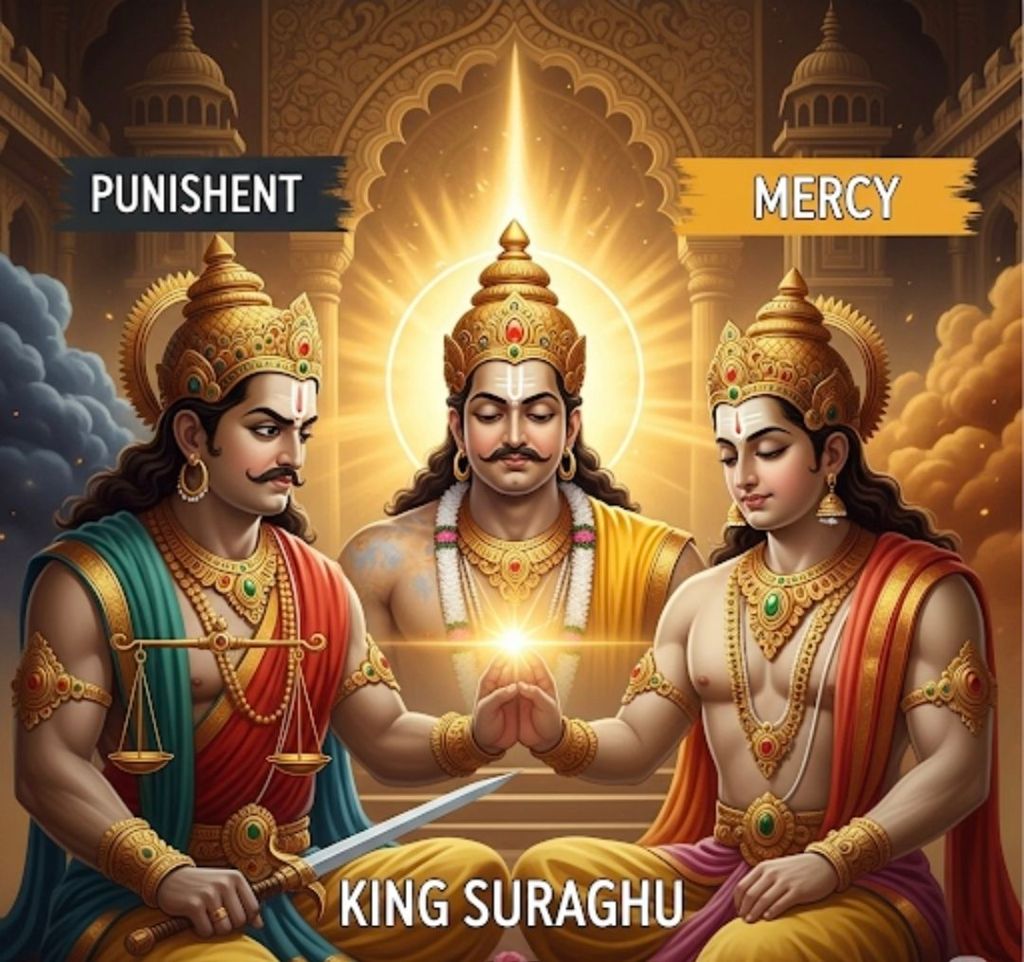
We have seen the blog being very strict in terms of delivering justice by stating justice as non-negotiable. The we saw some harsh critic on restorative or merciful deliverance of justice. Then the blog talks about the justice as everpresent and kind of a Cosmic Principle. And lastly the blog assumes a sense of gratitude and posits the grand vision of ultimate justice, the Rama Rajya as envisaged by mystic poet saint Jnaneshwar. This blog would like to cite a story in Yoga Vasistha that has a character of King Suraghu who faces the dilemma about justice in finding the right balance between tolerance and power, or between reward and punishment.
King Suraghu is noble minded chief of people of Kirata near the Mount Kailasa. He is very brave. As a responsible king his duty is to prevent wrongdoing. For this, he used to offer a reward to virtuous people and a punishment to the vicious people, with the strong sense of duty. In doing so, a thought comes in his mind. He thinks his rewards are the cause of pleasure of the people while his punishments are causing suffering to his people. He thinks, “Why I am I forcibly piercing the hearts of people by punishing them? Like me, everyone of my people is susceptible of pain. I must stop punishing”.
After this, he again realises that the mercy is not worth at all. He thinks, “If I stop punishing people who try to destroy the righteousness in the society, they are sure to eliminate the good altogether.” Yoga Vasistha gives a great analogy here. It says the river bed will dry if there’s no rain! Again he remains in this dilemma. Like to be or not to be. This dilemma aggravated his suffering or pain further. This dilemma is termed as perhaps the greatest pain of a person. He seeks the guidance from sage Mandavya who happens to visit him. Mandavya asks him to reflect on his own self, the nature of who he is, the nature of true self, by introspecting into the state of his mind. Sage says, “By this “turning inward“, you will calm your mind, regain tranquility and your all imaginations would be wiped off.”
Yoga Vasistha places emphasis on the root cause, the mind. It says the mind causes the will which in turn would give rise to the world which our mind then interprets as reality. So one needs to hit the root cause, mind. How? In this particular advice, it says “through self enquiry”.
So unlike in real world cases, this resolution to Suraghu’s painful dilemma doesn’t end in rightly balancing the punishment and mercy, but in attaining self knowledge through self enquiry. This state passes on the great “holy sight” which is required to act flawlessly. The mind then will no longer be troubled when it wears this universal sight given by His sheer Grace. And precisely therefore Raman Maharshi says,
“Attaining self realization is the highest ever goal”.
How? By asking, ‘Who am I?’ And everything—including justice—will follow or fall into place.
 Reinvent The Self!