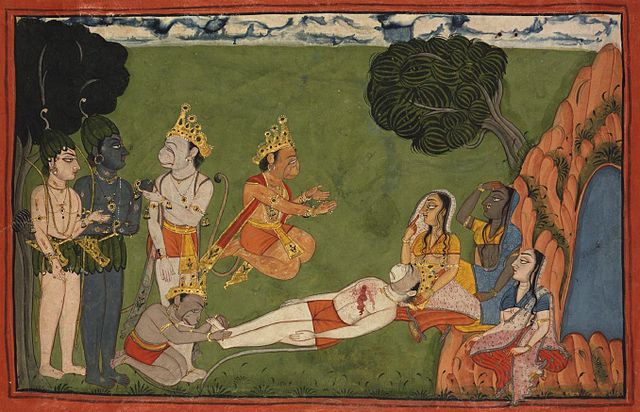
In the spiritual epic that unfolds within our own psyche, the kingdom of the mind—symbolized by Kishkindha—is governed by forces both subtle and profound. Among them stands Tara, a beacon of wisdom and restraint. Revered as one of the Panchakanya, her purity is not merely of conduct, but of an unwavering purpose that shines amidst the chaos of thought. Her strength lies in her ability to steady the mind, acting as the inner compass that guides us back to order.
A Queen’s Courage Amidst Collapse
Tara’s character shines most vividly in the final, tragic moments of her husband Vali’s life. As news of his mortal wound spreads, panic grips the kingdom and his guards flee in fear, believing their own lives are forfeit.
But Tara does not run. She confronts the fleeing soldiers, her voice cutting through the disarray: “Oh! Vanaras, why are you all running away in utter fright and desperation, leaving off your king to whom all of you are guards?”. When they suggest she secure the throne for her son Angada, she dismisses the notion of power. Her response is resolute: “Without my dear mighty and valorous husband Vali, I don’t care whatever happens to my son, the kingdom or myself. I am going to fall at the feet of that great-soul, who is felled down by the arrow projected by Rama.”. This is not despair—it is absolute devotion. Her loyalty is to love and dharma, not to power.
Wisdom Vindicated by Tragedy
Tara is more than a queen—she is the embodiment of Nirodha, the yogic principle of mental restraint. As the Yoga Sutras define it, “Yogah chitta vritti nirodhah”—Yoga is the stilling of the mind’s fluctuations. Tara represents this inner faculty that cautions against ego-driven impulses.
As she mourns over Vali, her wisdom is tragically affirmed. She reminds him, “This is the result of what you did – you have snatched away Sugreeva’s wife… I tried to persuade you with an interest in your well-being and wishing your welfare, but oh, my dear, you brusquely brushed me off.”. Her words are not a reproach, but the sorrowful cry of a conscience that was ignored.
The Bold Voice of Wisdom Against Awareness
Her courage is not limited to grief. When Lakshmana—the very symbol of Awareness—storms into Sugreeva’s court, furious at the king’s negligence, everyone trembles. Yet it is Tara who steps forward, unafraid. She faces his overwhelming wrath with calm reason, diffusing his anger and restoring balance. This moment is crucial: it shows that even Awareness, when inflamed, must be tempered by Wisdom. Tara’s intervention prevents destruction and reorients the mind toward its purpose.
Devotion Tempered by Discernment
Tara’s grief is intense and heartfelt. She cries and holds Vali’s body while worrying about her son Angada’s future under Sugreeva’s rule. However, her mind is still sharp. When Hanuman suggests making Angada the new king, she quickly understands the political implications and declines the proposal gracefully, saying, “Who am I to lead the vanara kingdom or to crown Angada when his uncle Sugreeva is nearby?” This insight earns her Hanuman’s respect, as he recognizes her as the “guardian angel” for all the vanaras.
The Spiritual Allegory of Her Union
After Vali’s death—symbolizing the fall of unchecked, destructive thoughts—Tara becomes the wife of Sugreeva, who represents righteous thoughts. This is not a mere political alliance but a profound spiritual metaphor: wisdom (Tara) must guide even our noblest thoughts (Sugreeva) for the mind (Kishkindha) to be ruled justly.
Tara: The Eternal Inner Guide
Tara’s legacy is a blend of courage, wisdom, devotion, and discernment. Her purity is not a detachment from emotion, but the ability to feel deeply without losing clarity. She speaks truth, leads with integrity, and stands firm when others falter. In the inner kingdom of the mind, she is the guiding star—ever present, ever wise.
 Reinvent The Self!