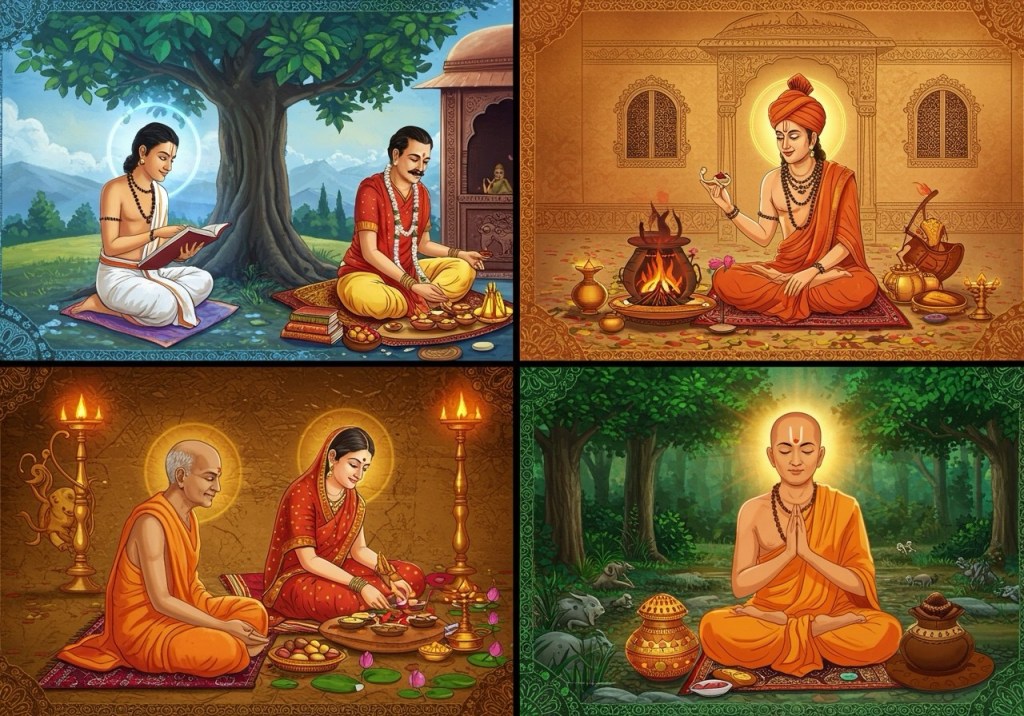
We often seek patterns, a sense of order in the unfolding narrative of our lives. The ancients, with their profound introspection, gifted us frameworks like the Ashrama system from India – a four-stage blueprint for a fulfilling life. Brahmacharya (student), Grihastha (householder), Vanaprastha (retired/forest-dweller), and Sannyasa (renunciate). It’s a map of growth, contribution, withdrawal, and ultimate liberation.
But what if this ancient blueprint resonates in places we seldom look? I’ve been musing on a rather unconventional parallel: the lifecycle of a product, from its conception to its eventual decommissioning. Think Society as a Company and Individual as a Product. That’s the correspondence.
1. Brahmacharya: The Design & Investment Phase
The Brahmacharya stage is one of dedicated learning, discipline, and skill acquisition. It’s where society, through family, mentors, educational institutes and societal structures invests deeply in the individual, shaping them, imparting knowledge, and preparing them for the responsibilities ahead.
This mirrors, quite strikingly, the Design and R&D Life Cycle of a product. A company pours immense resources – intellectual, financial, and temporal – into research, innovation, and meticulous design. It’s an intense period of learning what’s needed, what’s possible, and how to create something of value. Just as society invests in its youth, the company invests in its nascent idea, nurturing it into a viable concept. The potential is being built, the groundwork laid.
2. Grihastha: The Manufacturing & The Crucible of Experience
Enter the Grihastha, the householder. This is the stage of active participation in the world – building a family, pursuing a career, fulfilling societal duties. It’s a period of immense productivity, but also one that involves significant responsibilities and, yes, hardships. Society continues to invest here, providing employment, income, and a vast spectrum of experiences that forge character. The Grihastha navigates financial pressures, emotional complexities, and the daily grind – stresses that shape and temper.
Consider the Manufacturing Lifecycle of a product. The carefully designed concept now faces the rigours of production. The company invests further in materials, machinery, and processes. And the product itself? The product now endures its own “hardships” – the bending, stretching, molding, forging, and meticulous assembly. It’s subjected to stresses, quality checks, and transformations, all to emerge robust and fit for purpose. Both the householder and the product are being tested, refined, and prepared to deliver on their inherent promise!
3. Vanaprastha: The Service & The Season of Giving Back
Traditionally, Vanaprastha marks a gradual withdrawal from primary worldly duties, a time for reflection and sharing accumulated wisdom. It’s not an idle retirement, but a shift in how one contributes. The focus moves from active creation of personal wealth or direct family responsibility to guiding younger generations, offering counsel, and enriching society with experience.
This stage beautifully parallels the Service Life Cycle of a product. Once manufactured and out in the world, the product begins its core function: delivering value, solving problems, and providing the service it was designed for. For the company, this is when the product generates revenue, fulfills its market promise, and reinforces the brand’s reputation. Similarly, the individual in Vanaprastha, having navigated the complexities of Grihastha life, now “gives back” to the Society in a profound way. They offer the distilled essence of their experiences – their wisdom, their mentorship, their calm perspective – adding invaluable richness to the community (brand value). They are, in essence, in their prime “service” period to society at large. It’s time when society starts getting returns on its investment.
4. Sannyasa: Decommissioning & The Ultimate Release
The final Ashrama, Sannyasa, is the path of complete renunciation. It’s a profound detachment from all worldly possessions, identities, and expectations, a focused journey towards spiritual liberation (Moksha). The Sannyasi “leaves” society, not in anger or failure, but as a conscious act of transcending material existence.
How does this connect to a product? Think of Decommissioning. The product has served its purpose, its useful life is over. It “leaves” the company’s active portfolio and the user’s daily life. It must be let go. Ideally, this is done responsibly – recycling, repurposing, ensuring its components return to the earth or the manufacturing cycle with minimal negative impact. The product, like the Sannyasi, relinquishes its form and function. There’s a finality, a departure, a cessation of its defined role.
The Resonance Within
The analogy resonates within me perhaps because it underscores that all manifested things, whether a human life or a human creation (product), follow a cycle of emergence, growth, utility, and eventual dissolution. Recognizing these phases can bring a certain peace and understanding to our own journey.
By seeing our current “stage” – whether we are in a phase of intensive learning and investment, active building and facing challenges, sharing our accumulated value, or preparing to let go – we can perhaps navigate it with greater intention and grace.
The path to reinventing the self often lies in understanding these timeless patterns and finding our unique place within them. What stage do you see yourself in, and how does this dual perspective enrich your understanding of it?
 Reinvent The Self!