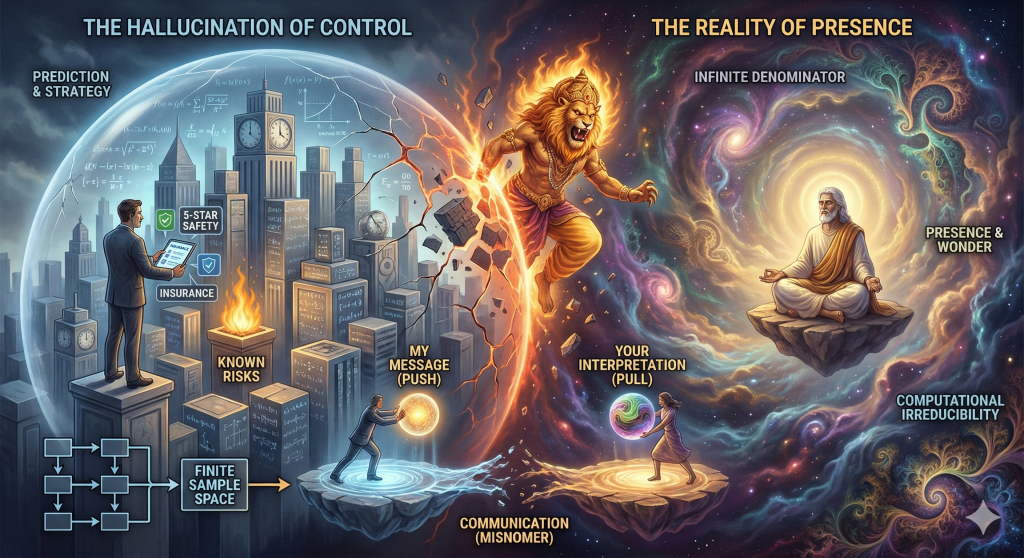
“Prediction itself is hallucination.”
It is a startling thought, but if we look closely at the nature of reality, it is the only logical conclusion. We live our lives convinced that if we just have enough data, enough insurance, and enough strategy, we can map out the future. We treat life like a mechanics problem to be solved.
But life is not a mechanic; it is an organism. And in an open, infinite system, the idea that we can predict what happens next is not just wrong—it is a comforting delusion we tell ourselves to sleep at night.
The Myth of the Formula
There is a fundamental difference between mechanics and life. Everything that can be captured by a formula—like gravity or planetary motion—is a mechanic. It is repetitive, closed, and solvable. These are systems where computation can be compressed. You do not need to simulate every molecule; the equation leaps directly to the answer. But everything else—markets, psychology, relationships, history, the unfolding of a single human life—cannot be compressed. There are no shortcuts. You cannot “jump ahead” to the answer. The only way to know the outcome of a life decision is to live through it, step by step, moment by moment.
When we try to run “counterfactuals”—asking ourselves “What if I had done things differently?”—we are fooling ourselves. We are applying a formula to a story that refuses formulas. The decision you made is woven into the fabric of the present. The person asking “what if” was shaped by the very choice they are questioning. You cannot run an alternative scenario on uncorrupted hardware. The counterfactual is just today’s anxiety dressed in yesterday’s clothes.
The Hiranyakashipu Paradox
We try to manage the uncertainty of existence with strategy and protection. We buy the five-star safety rated car. We purchase insurance. We plan our careers with meticulous care. We believe that if we just name enough risks and guard against them, we will be safe.
But consider the ancient story of Hiranyakashipu, the demon king who sought immortality. He obtained a boon that he could not be killed by man or beast, inside or outside a dwelling, by day or night, on the ground or in the sky. He thought he had covered the entire space of danger. He created a perfect strategy based on finiteness. He enumerated every category of threat he could imagine and closed each door.
But the universe is infinite, and it does not respect our categories. Hiranyakashipu was killed by Narasimha—an avatar who was neither fully man nor fully beast—at twilight, which is neither day nor night, on the threshold of a courtyard, which is neither inside nor outside, upon a lap, which is neither ground nor sky.
Hiranyakashipu’s mistake is our mistake. His boon was not flawed in its logic; it was flawed in its fundamental assumption. He enumerated categories while the Divine emerged from the boundaries between categories, from the spaces his framework could not even name.
Our safety ratings and insurance policies protect us from the accidents and illnesses we can name. They do nothing against the manifestations we cannot imagine. And the manifestations we cannot imagine are infinite. These protections pacify our anxiety, but they do not bind reality. The insurance does not shrink the space of danger; it just helps us stop thinking about it.
The Infinite Denominator
This brings us to the quiet failure at the heart of prediction: the failure of probability itself.
To calculate the probability of any event, you need to know the sample space—the total number of possibilities. This is the denominator of the fraction. In a casino, we know there are fifty-two cards in a deck, six faces on a die. The denominator is closed, finite, knowable. We can calculate odds with precision.
But in life, the sample space is not closed. It is infinite. The denominator stretches beyond any horizon we can see. And here is the mathematical truth we rarely confront: any numerator, no matter how large, divided by infinity approaches zero. The probability of any specific prediction coming true, in a truly open system, is vanishingly small. Not because our models are imperfect, but because prediction in an infinite space is structurally incoherent.
Prediction is not merely difficult. It is a category error. It is applying closed-system logic to an open system. Hallucination is precisely the right word—a vivid, convincing image that corresponds to nothing real.
Two Kinds of Curiosity
We often misunderstand what it means to be curious.
Conventional curiosity tries to find the numerator—the specific answer that makes sense of uncertainty. It wants to close the box, solve the equation, reach the satisfying click of the lock falling into place. This curiosity seeks to minimize possibilities, to narrow the field until only one truth remains.
But there is another kind of curiosity, one that looks in the opposite direction entirely. True curiosity turns toward the denominator—the infinite vastness of what we do not and cannot know. It does not seek to close; it seeks to open. It does not minimize possibilities; it marvels at their infinitude.
The endpoint of conventional curiosity is knowledge, and knowledge is static. Once you know, you stop looking. The question is answered, the file is closed. But the endpoint of true curiosity is wonder, and wonder is eternal. It does not complete; it continues. It is not a failure to reach knowledge; it is the recognition that reaching was the wrong verb all along.
Here, then, is the shift that changes everything: from the anxiety of trying to solve the infinite denominator to the peace of simply standing in awe of it.
The Illusion of Connection
If we cannot know the future with any certainty, can we at least know each other? Surely empathy bridges the gap between isolated minds?
Sadly, empathy as commonly practiced is also a form of projection. When we say “I know how you feel,” we are making an impossible claim. To truly know how you feel, I would need to be you—with your history, your biology, your accumulated joys and wounds, your particular way of seeing the world. Since I cannot be you, I am merely imagining how I would feel in your place. I am running a simulation of you on my hardware. But my hardware has my memories, my fears, my frameworks. So the simulation is always of me-in-your-situation, never of you-in-your-situation. I call it empathy; it is actually autobiography with a different setting.
There is a saying that attempts to comfort us: “All behavior makes sense with enough information.” The implication is that if we just gathered enough data, enough context, enough insight, we could fully understand another person. Their actions would become legible. The gap between us would close.
But this statement defeats itself. There is no “enough.” The more you know about another person, the more you discover how much you do not know. The denominator expands faster than the numerator ever could. “Enough information” is a horizon that recedes as you approach it.
The great saints and mystics understood this. Many began with the path of knowledge, seeking to comprehend the Divine through study, analysis, and understanding. They wanted to close the gap through knowing. And every single one of them hit a wall. Not because they failed, but because success was structurally impossible. The object of their knowing was infinite. And so, pursued honestly, knowledge transforms into something else entirely. It becomes love. Not as a consolation prize for failed understanding, but as the only coherent response to infinity.
When “never enough” stops being a frustration and becomes a wonder, the seeker has crossed over.
The Misnomer of Communication
We imagine communication as a bridge between minds—a two-way exchange where meaning travels intact from one person to another. But this image is misleading.
In practice, communication is always one-way in any given moment. I push my words out into the world. You pull them in when you are ready. But the message I push is not the message you pull. I push my meaning; you pull your interpretation. The encoding and decoding are never lossless. They cannot be. For that, you would need to share my entire life, my entire schema. You would need to be me.
We are like two people standing on different mountains, sending smoke signals across a valley. I send a signal that means “love.” You see a signal and read “fear.” We both believe communication has occurred. But we have only exchanged customized illusions, each of us projecting our own understanding onto the other’s transmission.
Even silence is not a cure for this. We like to think silence is pure—an absence of communication, a space free from misunderstanding. But silence is just a wordless word. The message is still sent. The receiver still pulls. They still interpret. “He went silent” carries as much weight as any sentence, perhaps more, because the infinite interpretability is not even constrained by language. Silence is a blank screen onto which the receiver projects their own story, their own fears, their own hopes.
Silence cannot be isolated from the thread of context that surrounds it. Is the silence angry? Peaceful? Indifferent? We do not know. We only guess based on the thread that precedes it. And our guess says more about us than about the silence.
Strategy and Its Limits
Strategy has an aim. It operates on the principle of scarcity and finiteness. It names a goal and builds a path toward it. There is nothing inherently wrong with this. Arjuna still draws his bow. We still make decisions, take actions, pursue outcomes. Strategy is how we function in the world of numerators.
But strategy can only protect against dangers it can name. It can only pursue goals it can see. And the unnamed, the unseen, the unimagined—these constitute an infinite field that strategy cannot touch. The limit of strategy is the edge of our imagination, and our imagination is finite by nature.
Acknowledging this limitation is itself a form of wisdom. It does not mean we abandon strategy, but that we hold it more lightly. We recognize that our plans are sketches, not blueprints. They are useful, but they are not true in the deep sense. They are our best guess at a future that does not yet exist and will not unfold according to any formula.
There is a concept called antifragility—the quality of systems that grow stronger from shocks rather than merely resisting them. But here is the paradox: antifragility cannot be aimed at. The moment you say “I will become antifragile,” you have created a target, a scarcity, a gap to close. You have fallen back into the numerator. Antifragility is not a strategy; it is a result. It is what precipitates naturally when you stop trying to eliminate uncertainty and start orienting toward the infinite field from which all uncertainty emerges.
The shift required is not from one strategy to another. It is from the mindset of doing everything to avoid shocks to the mindset of doing everything to remain open to whatever comes. This openness cannot be manufactured through planning. It can only be cultivated through presence.
From Controller to Witness
So if prediction is a hallucination of the future, empathy is a projection of the self, communication is a one-way exchange of customized illusions, and strategy only touches the finite edge of an infinite reality—what remains?
Presence.
The only thing that is not a hallucination is this exact moment. Not our interpretation of it, not our plans for what comes next, not our memories of what came before. Just this. Here. Now.
The mind that tries to control is caught in perpetual anxiety because it is trying to solve an infinite equation. It keeps seeking the numerator—the answer, the certainty, the closure—and the closure never comes. The denominator is too vast. The Controller exhausts itself against infinity.
But there is another posture available. The Witness does not try to solve. It observes. It does not grasp at the numerator; it turns its attention toward the infinite expanse of the denominator. And in that turning, something shifts. The anxiety of needing to know transforms into the peace of standing in awe of what cannot be known.
This is not passivity. The Witness still acts. Arjuna still draws the bow. But the fundamental orientation has changed. The hands move in the world of strategy and numerators; the awareness rests in the infinite field. Action happens; attachment to outcome dissolves.
The Controller and the Witness are not different people. They are not even different states. They are the same awareness looking in different directions. One looks at the wave, trying to measure its height and predict its crash. The other looks through the wave to the ocean that makes all waves possible.
The Thread That Belongs to All
If communication is not truly two-way, what then is genuine connection?
Perhaps what we call “shared presence” is not shared content at all. It is shared orientation. Two people, each in their own one-way stream, each in their own interpretation, but both facing the same infinite ocean. Not communicating about reality, but being in reality, together, separately, all at once.
In moments of true presence, the boundaries we take for granted begin to soften. The sender, the receiver, the space between—these categories that seemed so solid start to merge. The thread of connection does not belong to me or to you or to the space between us. It belongs to all, because in presence, all become one.
This is not a mystical abstraction. It is simply what happens when we stop projecting, stop predicting, stop trying to close the gap through understanding. When the project of knowing honestly completes—when we admit it cannot succeed—what remains is love. Not sentimental love, not love as emotion, but love as the natural state of awareness when it is no longer contracted around the need to know.
The Only Non-Hallucination
We are not here to solve the world. We cannot. The denominator is infinite, and we are finite beings with finite minds and finite lives. Every prediction we make is a beautiful, intricate hallucination. Every act of empathy is a projection wearing the mask of connection. Every strategy is a sketch drawn on the edge of an abyss.
But we are here to be present. That is not a hallucination. This moment, whatever it contains—this is real. Not our story about it, but the bare fact of being here, aware, alive.
We move from the anxiety of the Controller to the peace of the Witness not by gaining more knowledge but by releasing the need for it. We stop trying to decipher the infinite denominator and simply stand in awe of it. We stop trying to close the gap between ourselves and others and simply remain here, in our unknowing, beside them in theirs.
Knowledge ends. Wonder continues.
Strategy aims. Presence simply is.
The Controller exhausts itself. The Witness is inexhaustible.
And love is what remains when the project of knowing honestly completes—not as failure, but as the only coherent response to the infinite.
We began by chasing the numerator, believing that if we could just find the right answer, the right protection, the right understanding, we would be safe. But safety was never possible in the way we imagined it. What is possible is something better: the freedom that comes from no longer needing the answer, no longer needing to predict, no longer needing to control.
This is the grand hallucination dissolving. Not into despair, but into wonder. Not into isolation, but into love.
We are not here to solve the world. We are here to be present in it.
 Reinvent The Self!