The content wants to muse on the Causality and the Confused nature of It in the Middle Ground.
-
I – The Unstable Middle: Why Causality is Confusion’s Most Elegant Disguise
A meditation on the poles of truth and the seductive illusion between them I. The Geography of Reality There is a teaching so simple it escapes us, so radical it appears conservative, so obvious it remains hidden: Reality has two faces, and we’ve been staring at the space between them, calling it truth. Imagine consciousness… Read More
-
II – The Butter Thief’s Playbook: Why Knowledge is the Rope, and Liberation is a “Theft”
In our last meditation, “The Unstable Middle,” we laid out a stark geography of reality. We found two “stable” Poles of Truth: And between them, we found the “unstable Middle Realm”—the Anitya (impermanence) of the causal world we inhabit. We defined this realm as the “maddening confusion” of our normal waking state, and causality as… Read More
-
III – After the Theft: The Morning Yashoda Still Wakes Up
A closing meditation on living after liberation I. We’re Still Here Three essays now. Three attempts to map the unmappable, explain the unexplainable, capture in words what exists before words. In “The Unstable Middle,” we drew the geography: two stable poles of truth (Emptiness and Fullness), and between them the seductive confusion of causality. In… Read More
-
Shesha, Mathematical Beauty, and the Recognition (Not Invention) of Intelligence

The Eternal Remainder In Hindu cosmology, there exists a profound concept that changes everything about how we think about AI and knowledge: Shesha, the infinite serpent upon which Lord Vishnu, the preserver of the universe, rests. Shesha literally means “that which remains”—the irreducible residual that survives all attempts at comprehension. This isn’t merely mythology but… Read More
-
The Gaze That Liberates: Observation, Decoherence, and the Path of Bhakti
Preface This text is not an attempt to conflate spiritual realization with scientific theory. Rather, it seeks to draw resonant analogies that illuminate the structure of our experience. When invoking concepts like decoherence and observation, it is essential to recognize: it is the act of observation—not consciousness alone—which, in the language of quantum mechanics, metaphorically… Read More
-
Consciousness as the Source of Order: Beyond Scientific Emergence
A philosophical journey from the traces of consciousness in science to the pre-cosmological choices that shape reality Introduction: The Initial Intuition The dialogue began with a seemingly simple yet profound observation: “Science is the trace of consciousness. The most loved trace probably.” This statement, while appearing straightforward, contained within it the seeds of a revolutionary… Read More
-
Unpacking a Sacred Trap: My Journey Through ‘Shariram Adyam Khalu Dharma Sadhanam’
There is a phrase I have always known, one that is held up as a cornerstone of a righteous life: “Shariram adyam khalu dharma sadhanam.” The body is indeed the primary instrument for fulfilling one’s purpose. On the surface, it is impeccable logic. Wise. Practical. For years, I took it at face value. And for… Read More
-
The Great Inversion: When Consciousness Outruns the Rulebook
What if the true revolution isn’t to do things differently, but to cease being defined by the “need” for difference at all? What if it’s not about writing a better rulebook, but about seeing that action—the living gesture—always precedes whatever’s written down? I. Every Model is a Shadow Pandemics, depressions, black swans—they never arrive from… Read More
-
The Day I Stopped Causing and Started Being: A Philosophical Detonation
What if everything you’ve been taught about cause and effect is not just wrong, but the very prison keeping you from recognizing what you already are? The Unraveling Begins It started with a simple question on a Wednesday morning in Pune: “Should I give my child a mobile phone?” Harmless enough. A modern parenting dilemma.… Read More
-
The Emergent World and the Ghost of Causality
In our last exploration, “From Anguish to Instrument,” we arrived at a profound resolution to the problem of action: the state of being a Nimitta Mātram, a divine instrument. In this state, the anxious, decision-making “I” gives way, and action flows through us as a divine command. Arjuna doesn’t decide to fight; the fight is… Read More
-
The Inverted Universe: When the Self Becomes the Source
In our previous post, we were left with an unsettling question. If the world is pure “emergence” and causality is an illusion, on what ground can we stand to make ethical choices? How do we avoid a detached quietism in the face of suffering—the proverbial “drowning child”? The dialogue from which this series springs did… Read More
-
From Anguish to Instrument: A Philosophical Journey into the Nature of Action
In a world that demands our constant engagement—a world of professional deadlines, parental decisions, and personal dilemmas—we often operate on the assumption that “I” am the one making the choices. A recent, profound dialogue challenged this fundamental assumption, sparking an exploration that journeyed from modern anxieties to ancient wisdom, confronting one of philosophy’s most formidable… Read More
-
When Everything Is Emergence: The End of Cause and Effect
How seeing through the illusion of causation reveals the unchanging source “Every damn thing this world cares about is actually an emergent property.” These words, spoken during a profound dialogue on consciousness and action, cut through millennia of human assumption about how reality works. We live in a world obsessed with causes and effects, with… Read More
-
Beyond the Subtle Ego: When Krishna Consciousness Dissolves the Doer
On the difference between using divine faculties and letting divinity use you A mother sits across from her ten-year-old child who asks, for the hundredth time, “Can I have a mobile phone? All my friends have one.” In this moment, she faces what seems like a modern parenting dilemma requiring careful consideration of screen time… Read More
-
The Grand Hallucination: Why Prediction, Empathy, and Communication Are Illusions
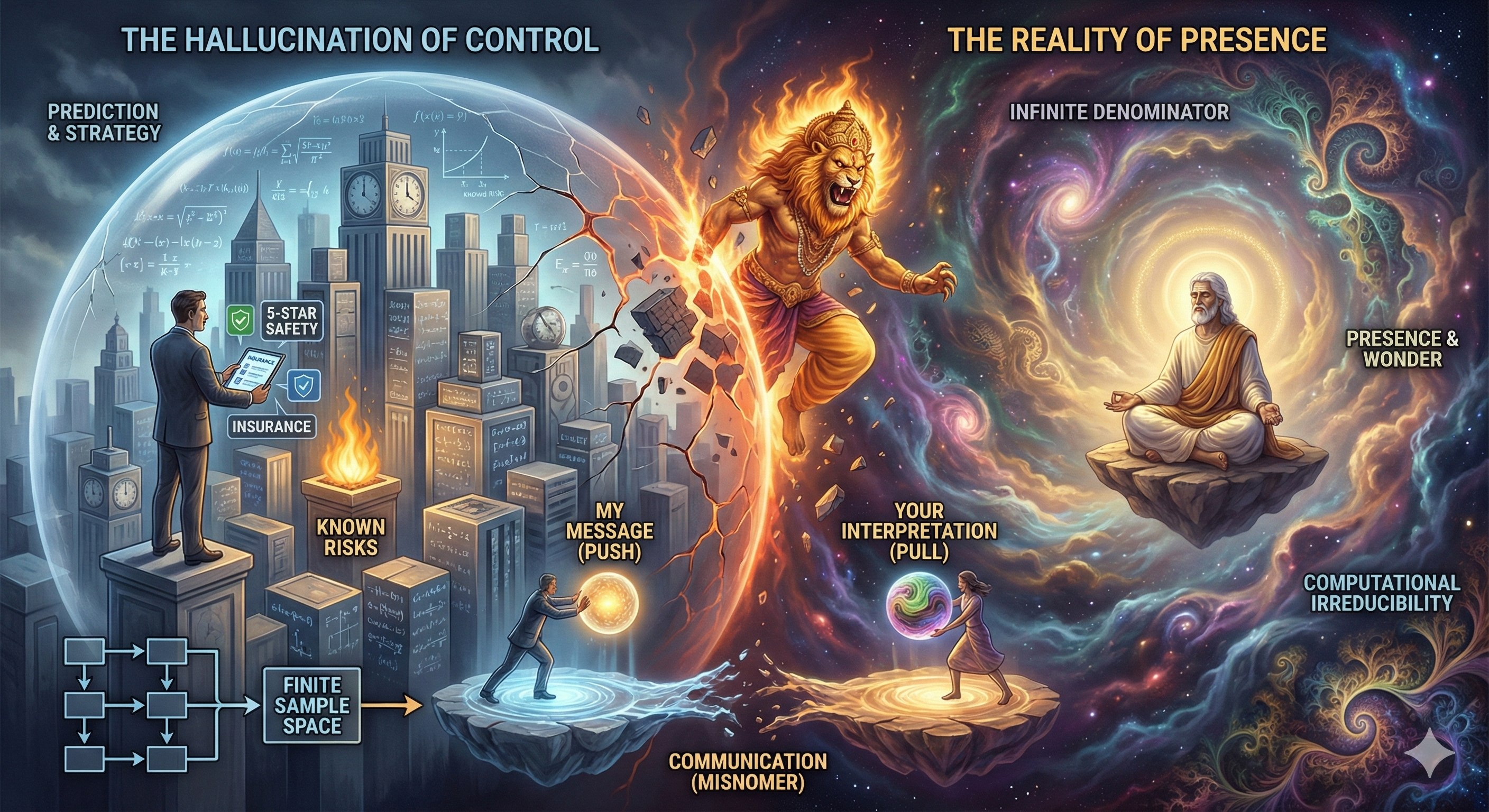
“Prediction itself is hallucination.” It is a startling thought, but if we look closely at the nature of reality, it is the only logical conclusion. We live our lives convinced that if we just have enough data, enough insurance, and enough strategy, we can map out the future. We treat life like a mechanics problem… Read More
-
Operating Constraint

The other blog, Grand Hallucination, lays out the foundation or the posture. This blog makes it purely existential. A Manual for Existing in an Open System. Reality is not a system with a solution.It is a process that cannot be fully compressed. Prediction is a constructed projection.Not because it is useless,but because it assumes closure… Read More
-
Hidden Tax of Prevention: “Better Than Cure” May Be Costing You More

An inquiry into the paradox of preventive health, the anxiety it breeds, and the possibility of a different way The Unquestioned Axiom “Prevention is better than cure.” We inherit this phrase like furniture from a deceased relative — useful, familiar, but never examined. It sits in our mental living room, shaping our movements without our… Read More
 Reinvent The Self!