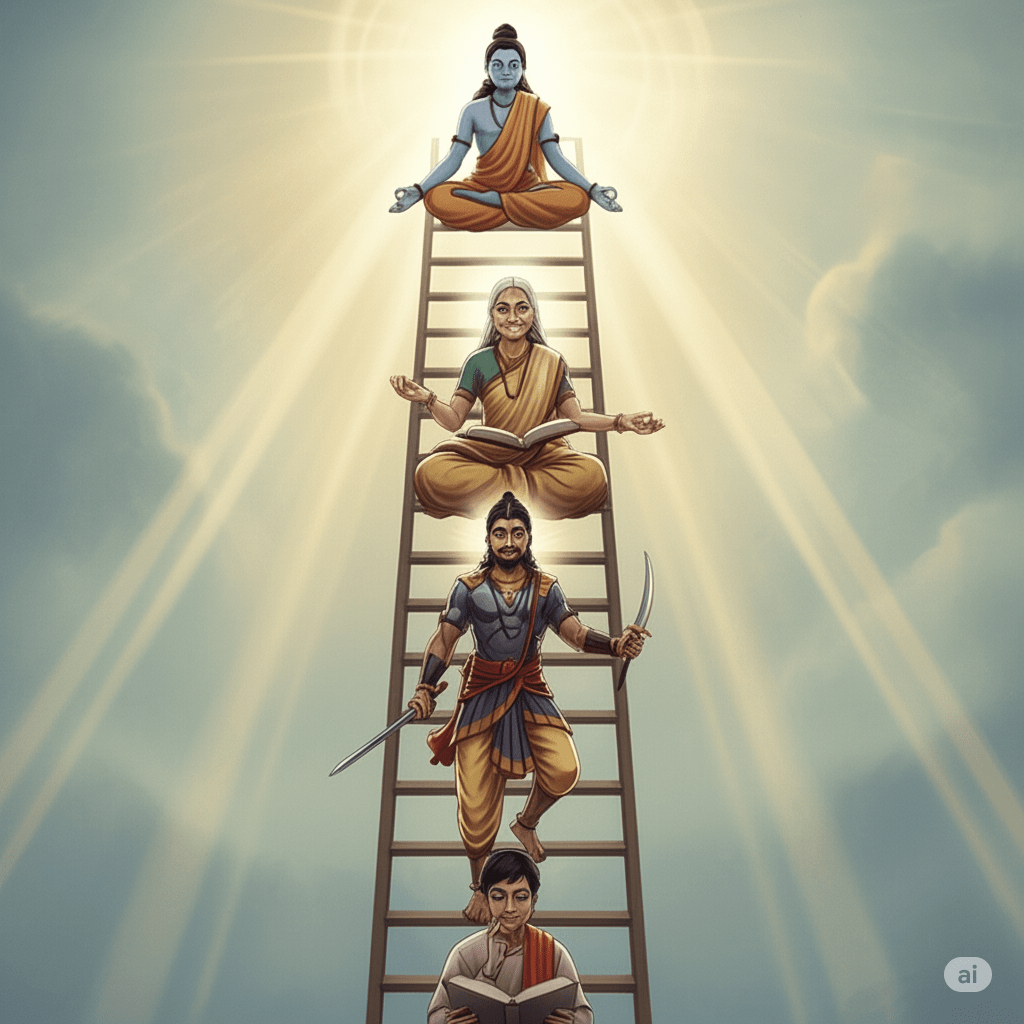
We often search for maps to navigate the complex terrain of personal growth and spiritual seeking. Ancient traditions offer many such frameworks, and the Indian Varna system – often understood in societal terms – holds a surprisingly profound blueprint when viewed through an individual, spiritual lens. What if these stages, Brahmin, Kshatriya, Vaishya, and Shudra, chart a course not of social standing, but of our evolving relationship with knowledge, culminating in ultimate wisdom?
Let’s explore a perspective that reimagines this journey, suggesting a spiritual ascent where the path unfolds in perhaps an unexpected, inverted order of “value” compared to worldly measures.
1. The Brahmin Phase: The Dawn of Knowing (The Nascent Stage)
Our journey often begins in the Brahmin mode – the eager student, the seeker. This is where we immerse ourselves in learning Vidya: acquiring knowledge, studying scriptures, understanding philosophies, and gathering information. We build our intellectual foundation, absorb concepts, and sharpen our understanding of the world and its wisdom traditions. This is a vital, yet nascent, stage – the initial spark of conscious inquiry, the diligent gathering of the tools of intellect.
2. The Kshatriya Phase: Wisdom in Action (The Growing Stage)
Knowledge unapplied remains dormant. The Kshatriya’s role involves action, protection, governance, and the practical application of principles. Here, the individual takes the Vidya learned and begins to wield it in the “kingdom” of their own life. We apply principles to navigate challenges, manage our responsibilities (running our “home” with order and care), cultivate discipline, and make choices aligned with our understanding. This is knowledge tested in the crucible of experience, a stage of growth where learning is integrated into living, demonstrating a developing strength and practical wisdom. Managing a household is akin to managing one’s own kingdom, by fulfilling worldly duties effectively with courage, discipline, decision-making, and the skillful use of one’s knowledge and abilities to maintain order and well-being!
3. The Vaishya Phase: The Ripening and Sharing of Knowledge (The Mature Stage)
As our understanding deepens and our applied knowledge bears fruit, we may enter a Vaishya phase. In this mature stage, the “commerce” is not of material goods alone, but of insight and wisdom. The individual, rich in experience and refined understanding, now “sells” or, more aptly, shares this invaluable product. They might teach, mentor, write, or simply inspire, nourishing “curious young minds” and communities with the clarity they have cultivated. The value exchanged is profound: the growth and enlightenment of others, a true sign of ripened wisdom generously offered.
4. The Shudra Phase: The Sacred Unlearning (The Highest Spiritual State)
And here lies the most transformative, call it a paradoxical turn, in this spiritual progression. The final ascent involves entering what we might call the Shudra stage, but in a context far removed from traditional societal (mis)interpretations. This is the ultimate “cleanup act.” Having gathered, applied, and shared Vidya (worldly and intellectual knowledge), the seeker now realizes its limitations in the face of ultimate Truth (Jnana).
This “Shudra” service is the profound, internal act of unlearning. It’s the courageous letting go of accumulated concepts, doctrines, and even the identity of being “knowledgeable.” It is a cleansing of the mental space, an erasure of the very scaffolding that helped one ascend, because the scaffolding itself is not the destination. As the individual transitions from the Vyavaharika (transactional, relative world) to the Adhyatmika (the realm of pure Spirit), this prior knowledge becomes “useless” for grasping the Ineffable.
In this sacred act of emptying, of becoming utterly receptive and unconditioned, true Jnana – direct, experiential wisdom, or enlightenment – can dawn. This isn’t a regression, but the highest leap.
The Inverted Ladder to Liberation
If you notice the beautiful inversion this framework presents, what begins as the accumulation of knowledge (Brahmin – nascent) finds its ultimate spiritual fulfillment in the transcendence of that very knowledge through a process of profound unlearning and surrender (Shudra – highest). The journey isn’t about endlessly adding to our intellectual baggage, but about a progressive refinement that ultimately leads to the shedding of all that is not the essential Self.
The Kshatriya grounds us in reality, the Vaishya expands our positive impact, but it is this Shudra-like humility – the willingness to serve the truth by dismantling our own intellectual castles – that opens the door to the infinite.
What This Means for Our Path
This perspective invites us to:
- Value each stage of our learning and application.
- Recognize the beauty and responsibility in sharing our wisdom.
- Most importantly, cultivate the courage to let go, to unlearn, and to understand that the highest wisdom often lies beyond the confines of what we think we know.
The path to reinventing the self, to discovering our deepest truth, might just involve this sacred cycle: learn diligently, apply courageously, share generously, and finally, unlearn completely to truly See.
A journey from Destin(y)ation to Source!
Matthew 5:5
Blessed are the meek, For they shall inherit the earth.
Disclaimer:
The Varna system, as an ancient framework, has a complex and often contentious history, including associations with social stratification and caste-based discrimination. This article does not endorse or promote any form of social hierarchy, discrimination, or inequality based on birth or caste. Instead, it explores the Varna concepts as symbolic archetypes or functional roles relevant to personal growth, organizational dynamics, and spiritual development. Readers are encouraged to approach these ideas critically and contextually, recognizing the distinction between philosophical insights and historical social practices.
 Reinvent The Self!