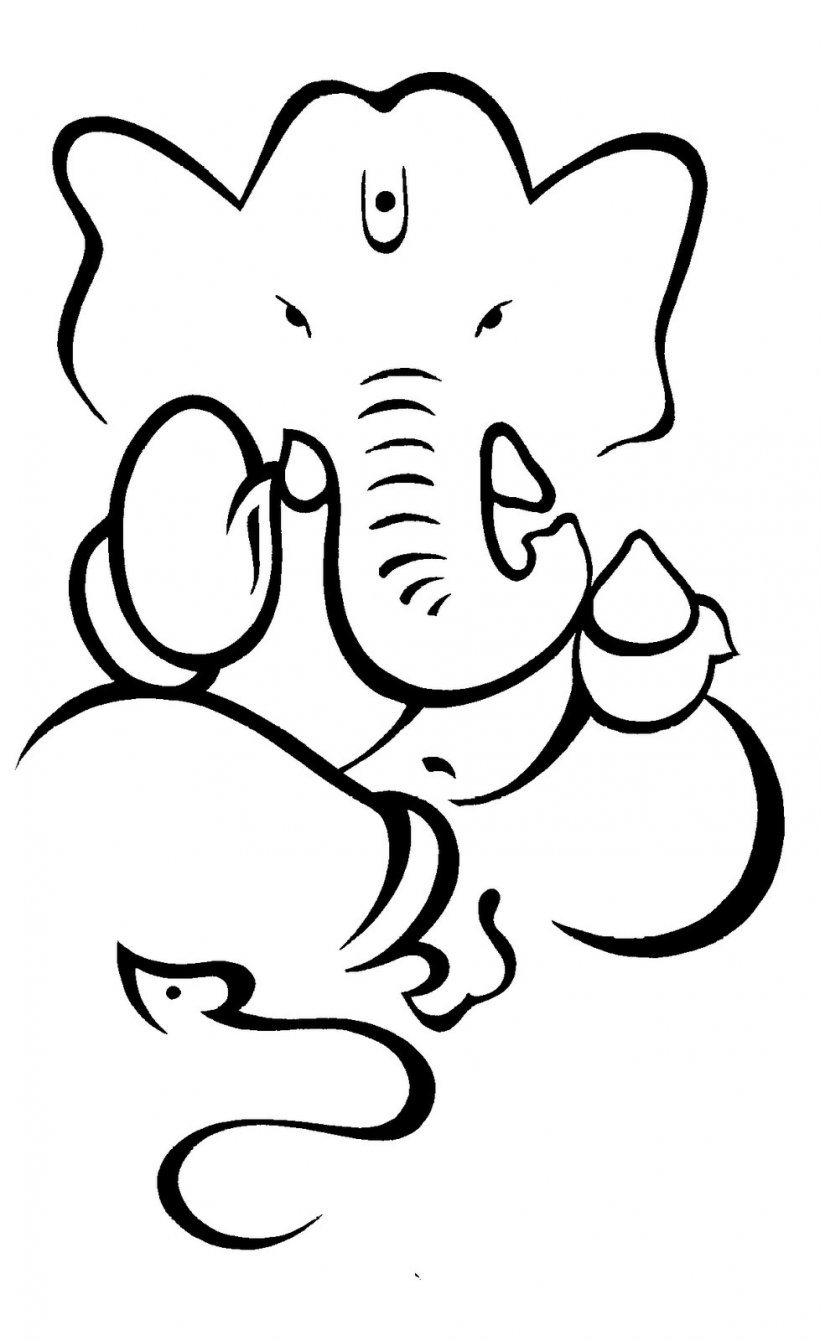
After we have discussed how Ganesha was born, I decided to ponder on the map of symbolism behind Ganesha. I found there are 2 lenses through which we can interpret Ganesha. Here’s the map from the internal lens.
The Form as a Four-Fold Path
The familiar image of a four-armed Ganesha, when viewed through this philosophical lens, transforms from a static icon into a dynamic guide for spiritual practice (sādhana). It presents a stunningly coherent, four-step progression.
Step 1: The Pāśa (The Noose) — Our Human Condition We begin by acknowledging the hand that holds the Pāśa. As the Tirumantiram explains, this isn’t just a rope. It’s the very web of worldly existence—the bonds of ego (Anava), action (Karma), and illusion (Maya). We are all bound in this pāśa. This is our starting point, the diagnosis of our condition. As we can see these 3 bonds result in suffering.
Step 2: The Aṅkuśa (The Goad) — The Path of Yoga How do we navigate this web? Ganesha shows us the Aṅkuśa. This sharp goad is the perfect symbol for the discipline of Yoga, specifically the Nirodhaḥ (restraint) of our mental fluctuations as described by Patanjali. It is the one-pointed focus and spiritual will required to guide the wild elephant of our mind. Interestingly, we can also see the Aṅkuśa as the set of “Rules”—the Cosmic Order or Ṛta—that governs the system of the Pāśa. To follow the path, we must understand and apply these universal principles.
Step 3: The Radaṁ (The Broken Tusk) — The Price of Progress Applying the discipline of the Aṅkuśa comes at a cost. We must be willing to sacrifice our most cherished possession: our ego. The broken tusk, the Radaṁ, symbolizes this profound act of tyāga. It represents the breaking of our limited identity for the sake of a higher Dharma. It is the painful but necessary process of transformation, where a personal loss becomes a tool of universal wisdom.
Step 4: The Varadaṁ (The Boon) — The Fruit of Liberation When we successfully navigate the first three steps, we arrive at the fourth hand: the Varadaṁ, the gesture of granting boons. But this is no ordinary boon. After sacrificing the ego, the boon we receive is the ultimate one—Mokṣa, everlasting bliss, the state of pure Ānanda. It is the grace that flows freely once the vessel of the self has been emptied of the ego.
The Destination and the Victory
This four-step journey fundamentally changes our state of being, which is beautifully symbolized by two other key attributes of Ganesha.
Ekadantaṁ (The One Tusk): The Journey to Non-Duality The entire process is a journey from perceiving the world with two tusks (the illusion of duality) to realizing the ultimate reality of the one remaining tusk. It is the path from Dvaita to Advaita. The state of Ekadanta is the destination—the realization that all opposites merge into a single, non-dual consciousness.
Mūṣakadhvaja (The Mouse as an Emblem): Dominion over Chaos And what happens to the chaos of our old life? The scurrying mouse—symbolizing our restless desires, nagging thoughts, and distractions—is not killed. It is tamed. It is placed “under his feet,” signifying perfect control. More profoundly, it becomes his Dhvaja—his emblem, his flag of victory. This is a stunning statement. True mastery means the very forces of chaos that once bound us are so completely integrated and subdued that they become a testament to our power. The space previously occupied by chaos is now the very seat of our dominion.
The Ground of Being
Ultimately, Ganesha’s form declares him as the source of all. The Atharvashirsha describes him as Jagatkāraṇam Acyutam (the infallible cause of the universe) and Prakṛteḥ Puruṣātparam (beyond both Matter and Spirit). He is the ultimate ground into which the universe will dissolve (Layameṣyati) and the constant reality in which it is always established (Pratyeti).
The form of Ganesha, then, is not just an object of worship. It is a complete darśana, a philosophy you can live by. It is a map that says: Acknowledge your bonds, pick up the tools of discipline, be ready for sacrifice, and the ultimate bliss will be yours. You will find such mastery that the chaos you once feared will become the vehicle you ride to freedom. Perhaps every divine form is just such a map, waiting for us to learn how to read it.
एकदन्तं चतुर्हस्तं पाशमङ्कुशधारिणम् ।
रदं च वरदं हस्तैर्बिभ्राणं मूषकध्वजम् ॥

