
The content wants to muse on the parallels between Information Security Governance and Inner Life Governance
-
The Secure Enclave of the Soul – 1
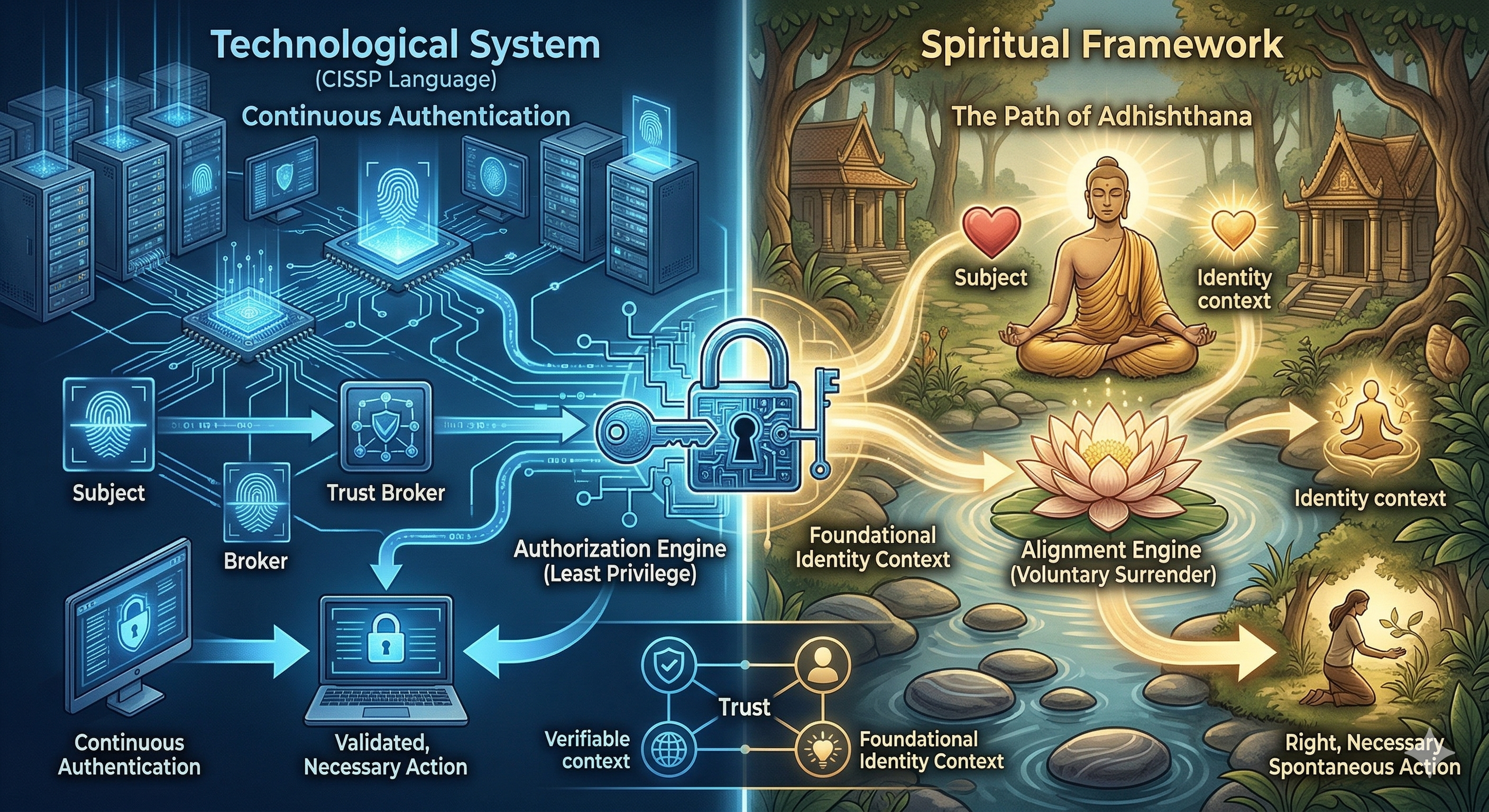
The Continuous Authentication of the Heart Namasmarana, Adhishthana, and the Least Privilege of the Ego In security, one of the first lessons we learn is that initial trust is never enough. A user may log in correctly at 9:00 AM.The password may be valid.The device may be recognized.The session may begin cleanly.The system may have… Read More
-
The Secure Enclave of the Soul – 2
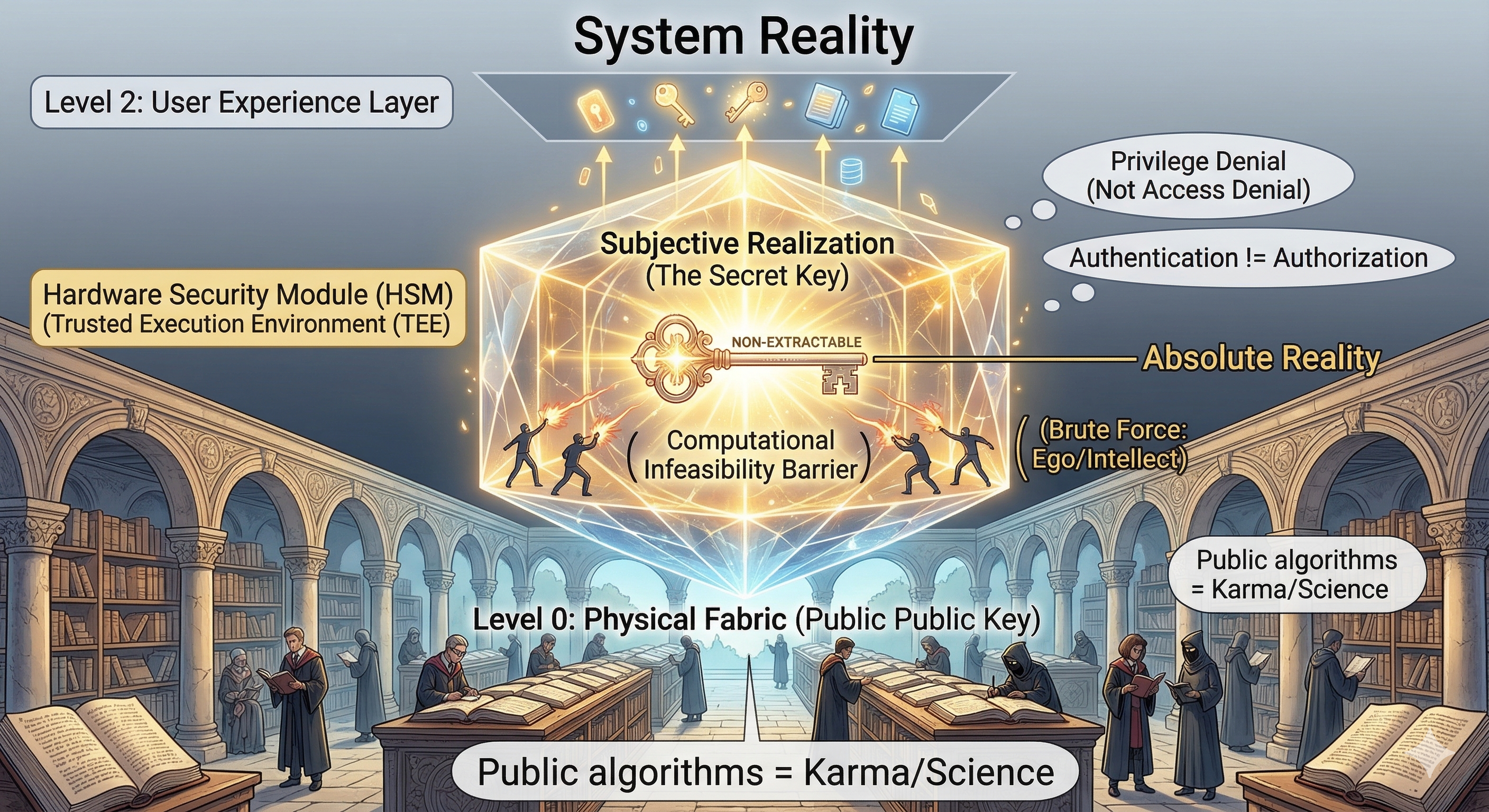
The Non-Extractable Key Kerckhoffs’ Principle, Secure Enclaves, and the Difference Between Information and Realization In security, there is a mistake people make again and again. They confuse secrecy with strength. A company hides part of its code and assumes the system is secure.A developer keeps an implementation obscure and calls that protection.A process is poorly… Read More
-
The Secure Enclave of the Soul – 3
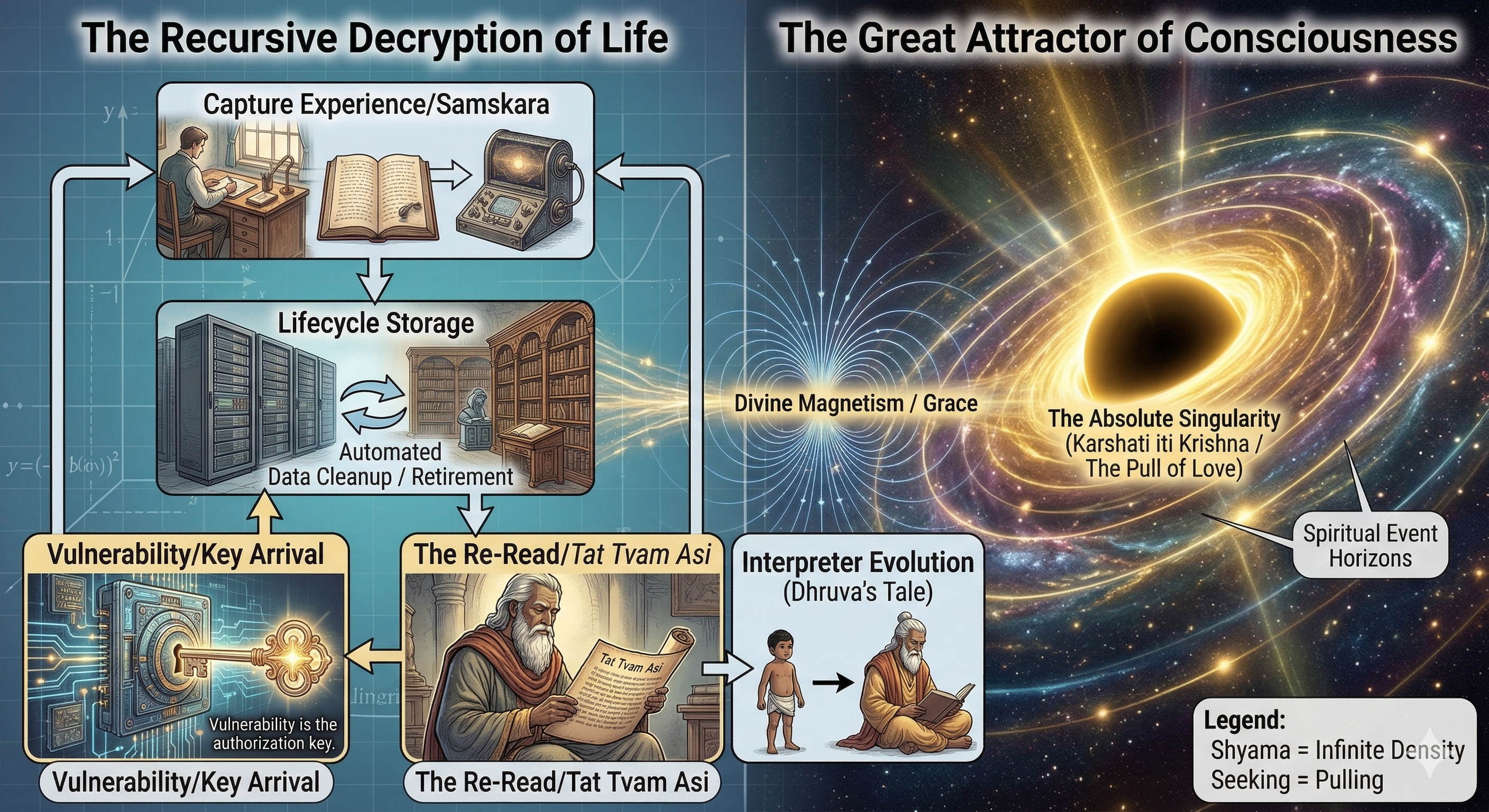
Harvest Now, Decrypt Later Childhood, Ripening, Grace, and the Slow Arrival of Meaning In cybersecurity, there is a phrase that has become increasingly important in the age of quantum anxiety: Harvest Now, Decrypt Later. The idea is simple, and unsettling. An attacker may capture encrypted data today even if they cannot read it yet. They… Read More
-
The Secure Enclave of the Soul — Closing Note

The Private Key of the Soul Part 4 left us at a threshold. The innermost center of a human being, it argued, is not extractable — not by surveillance, not by inference, not by the most refined model. It is irreducible. The metaphor of the private key carried us that far and then stopped, because… Read More
-
Rama Raksha: A Dharmic Rereading of the CIA Triad in the Age of Algorithmic Governance
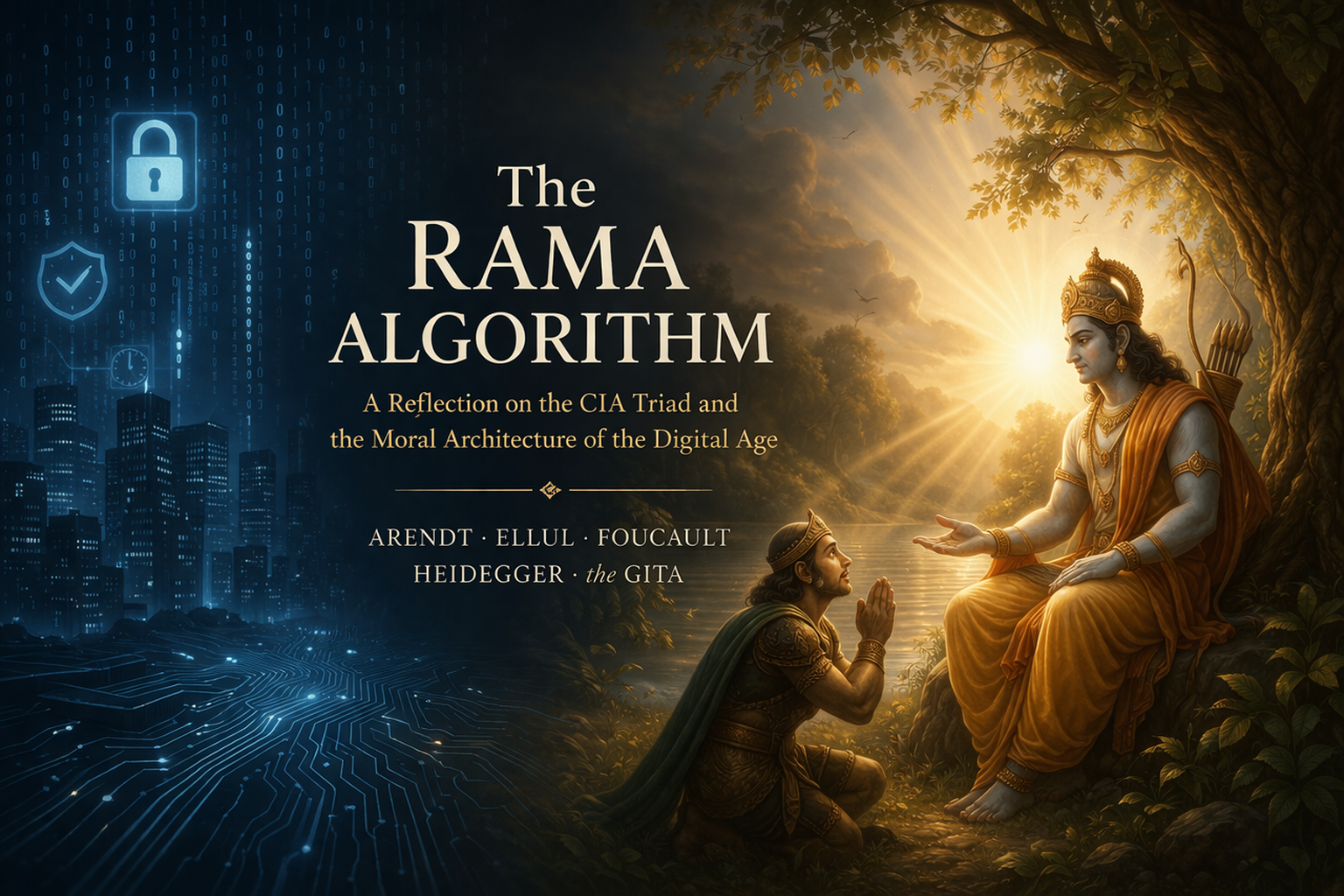
We often say that we live in an algorithmic age. That is true in the obvious sense that software now mediates communication, commerce, logistics, search, entertainment, and increasingly judgment itself. But the phrase conceals a deeper transformation. We are not merely surrounded by technical systems; we are being formed by them. They shape not only… Read More
-
I think. Therefore, IAM: A series on Identity, Access, and the Architecture of Trust
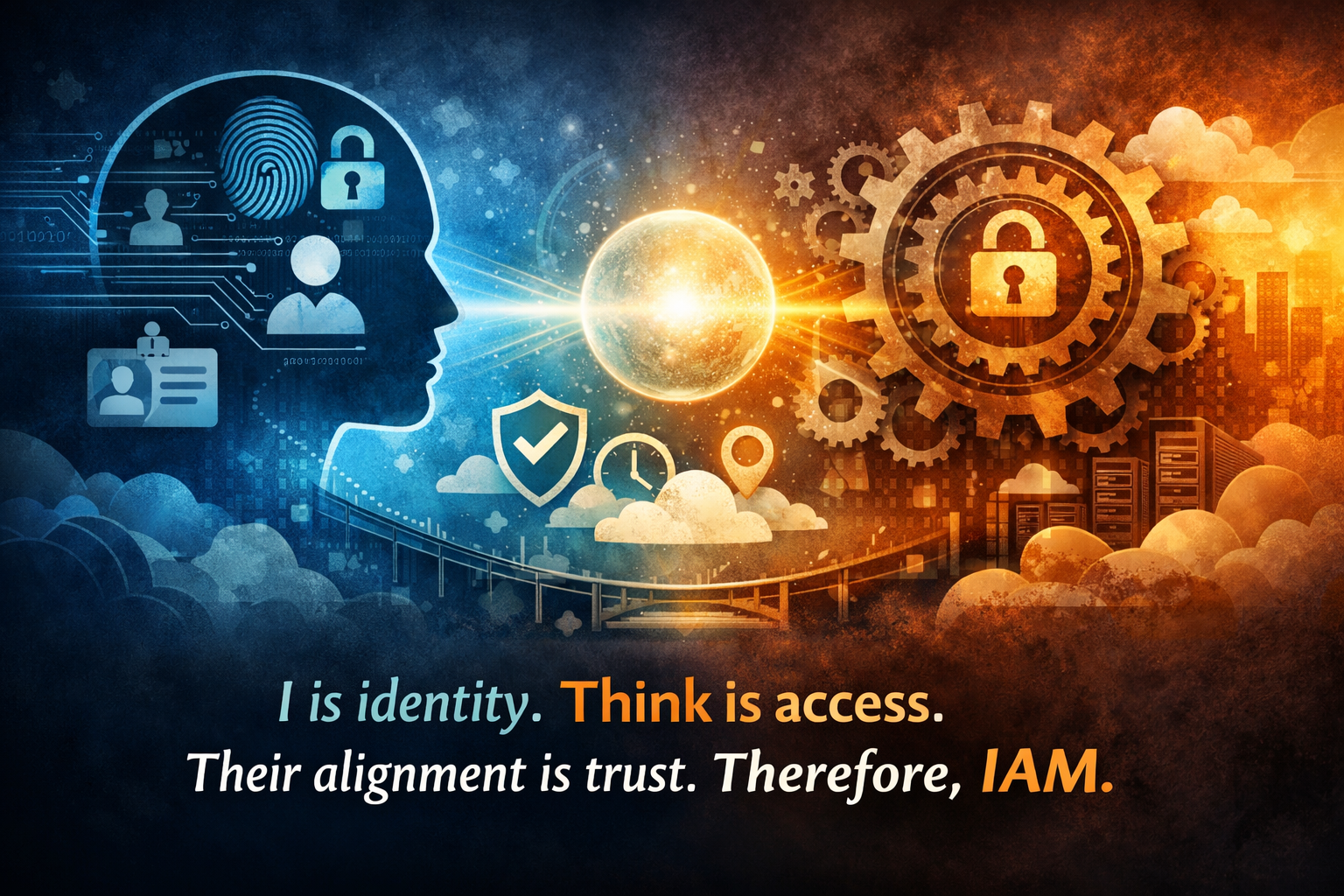
Descartes’ idea that thinking proves existence is limited; action is crucial for true knowledge. This series argues that identity and access are distinct yet must align with truth to establish trust. The concept of IAM embodies this alignment, emphasizing the importance of authentic identity and authorized access as foundations of being. Read More
-
I. Think. Therefore, IAM- Part 1- The Zero Trust Invariant

The content discusses the concept of Zero Trust, emphasizing that trust is about the alignment of authenticated identity and authorized access with current organizational and contextual truths. It clarifies misconceptions about continuous checks, asserting that true alignment must be re-evaluated over time to prevent security issues like privilege creep and breaches. Read More
-
I. Think. Therefore, IAM- Part 2- The Architecture of Impermanence

The article discusses the concepts of Identity, Access, and Action within the context of Zero Trust security. It argues that identity is inherently fluid, while access is dynamic. By embracing these impermanences and recognizing their interdependence, organizations can design systems that adapt and validate the current state of users and permissions, rather than relying on… Read More
-
I. Think. Therefore, IAM- Part 3- Friction as Systemic Mindfulness

This content explores the concept of Alert Fatigue within a Zero Trust architecture, highlighting the often-overlooked importance of friction points like MFA prompts as opportunities for user mindfulness. It suggests that reducing security to satisfy the desire for constant action is misguided, advocating for a system aligned with Default Deny, where users can relinquish the… Read More
-
I. Think. Therefore, IAM- Part 4- The Ultimate Orchestrator

The text explores the intersection of technology and spirituality, emphasizing the shift from manual control to autonomous execution in system architecture. It highlights the Mahavakyas as declarative principles governing existence and suggests that recognizing ourselves as instruments—service accounts—of a higher intelligence can relieve the burdens of control and anxiety. Read More
-
I. Think. Therefore, IAM- 5- Closing Note- The Perturbation Principle

The essay argues that a Zero Trust system’s Default Deny state reflects an essential ethical foundation rather than a mere policy choice. It explores concepts like Spanda and Vasana, emphasizing the natural ebb and flow of access requests in a system designed for temporary grants. Access should be purposeful, with users acting mindfully within this… Read More
-
When AI Finds Your Zero-Days: Patanjali, Brené Brown, and the Courage to Be Vulnerable

From Patch to Posture, from Wariness to Awareness: A reflection on Anthropic’s Mythos, ancient yoga philosophy, and the future of security The Earthquake No One Expected On April 7, 2026, cybersecurity’s operating assumptions took a visible step toward rupture. Anthropic released preliminary findings from Claude Mythos Preview, a non-public frontier model that autonomously discovered and… Read More
-
The Manthana: On AI Security Governance, Equipoise, and Why the Devas Were Ready
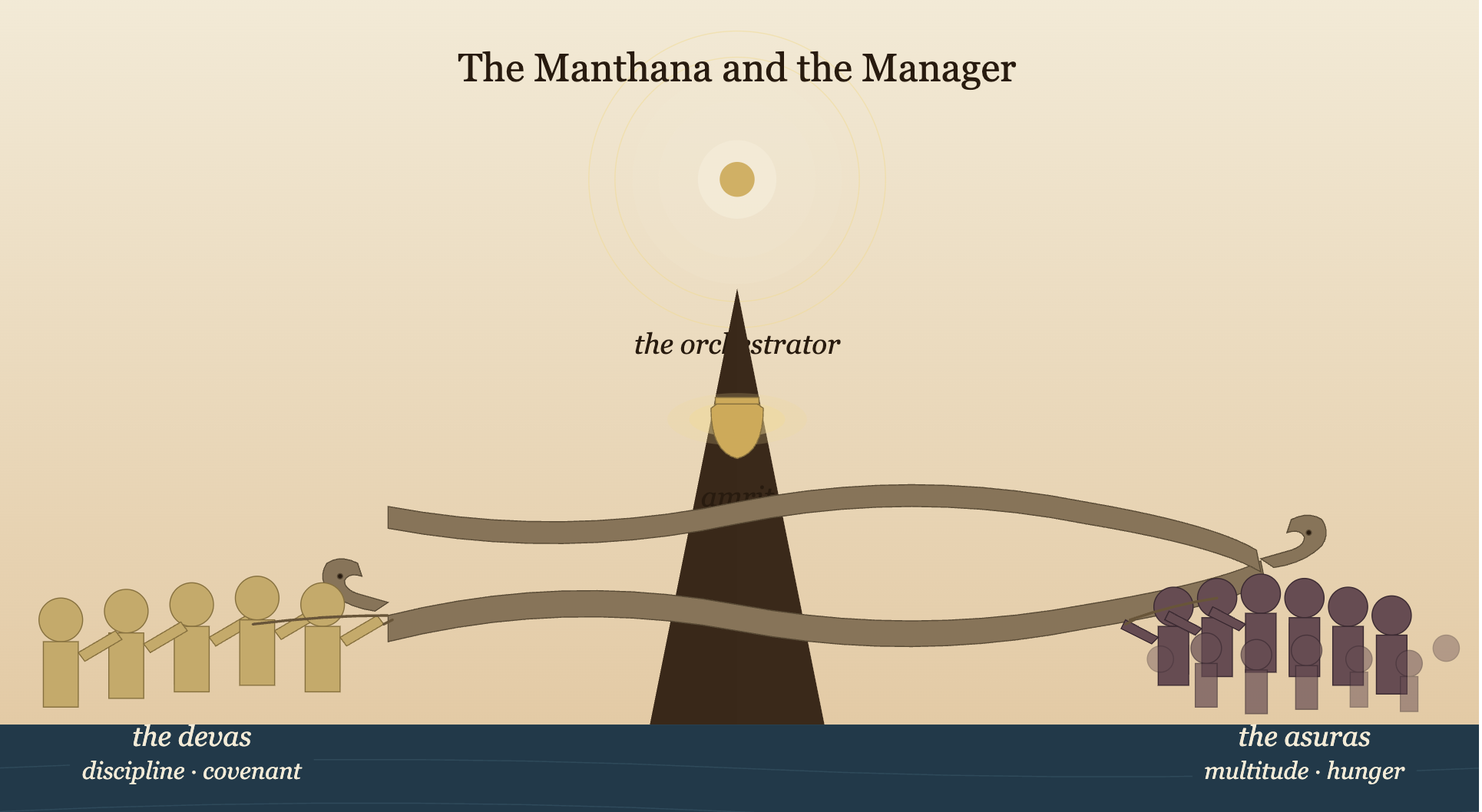
Capability is churned together, Distribution is decided above, Readiness is the only Asymmetric Advantage There is a moment in every emerging technology cycle when the ground shifts beneath an entire industry in a single afternoon. On April 7, 2026, Anthropic announced “Mythos”—a frontier AI model representing such a profound step-change in cybersecurity capabilities that the… Read More
-
The Vocabulary of Readiness

On the Limits of the Manthana and the Disciplines That Refine It Every thesis worth stating is worth qualifying. The first piece in this sequence — The Manthana and the Manager — argued that in an AI ecosystem no single organization can orchestrate, the only sustainable asymmetric advantage is the quality of participation, and that… Read More
-
The Four Layers of Refuge

What the Ramayana Quietly Teaches About Protection There is a structure inside the Ramayana that the epic never states directly but enacts at every turn. It is a structure of protection — not a single shield, but a layered one. Four layers, each catching you when the previous one is lost. Read this way, the… Read More
-
The Secure Enclave of the Soul – A Series on Security as a Language for the Inner Life

My earlier series, I. Think. Therefore, IAM, used philosophical language to describe security architecture. It asked what Zero Trust, identity, access, privilege, drift, denial, and return look like when read through older vocabularies of consciousness, action, impermanence, and alignment. This series moves in the opposite direction. It uses the language of security to describe spiritual… Read More
-
The Secure Enclave of the Soul — 4

The Side Channel and the Private Key Profiling, Inference, and the Limits of Extraction At the end of all these metaphors — continuous authentication, least privilege, non-extractable keys, secure enclaves, confidential computing, and delayed decryption — one truth remains quietly standing: The human being is not merely an information system. Yes, we emit signals. We… Read More
 Reinvent The Self!