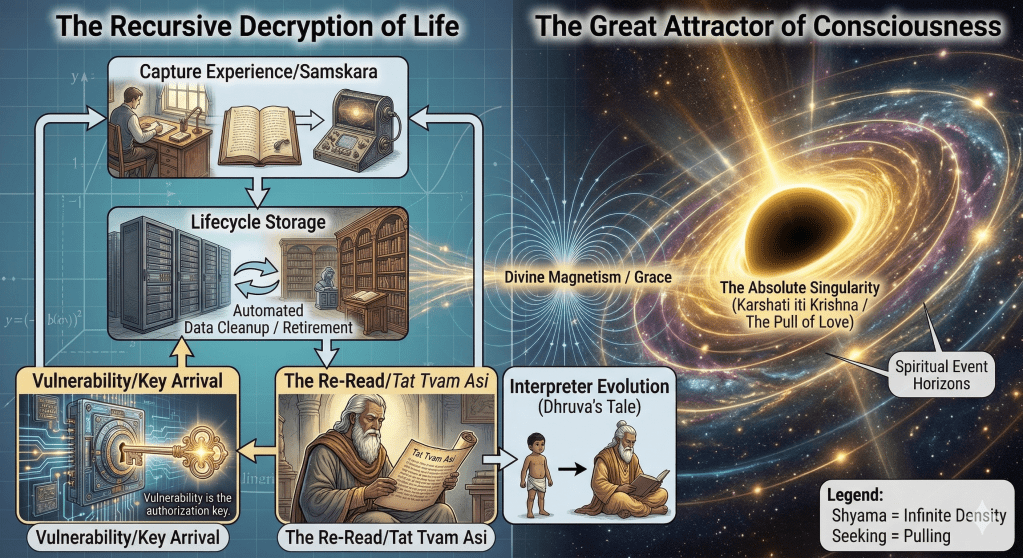
Harvest Now, Decrypt Later
Childhood, Ripening, Grace, and the Slow Arrival of Meaning
In cybersecurity, there is a phrase that has become increasingly important in the age of quantum anxiety:
Harvest Now, Decrypt Later.
The idea is simple, and unsettling.
An attacker may capture encrypted data today even if they cannot read it yet. They store it, preserve it, and wait for a future moment when better tools, greater computing power, or some new breakthrough may finally make decryption possible.
For now, the data remains opaque.
It has been gathered before it can be understood.
In security, this phrase is ominous. It belongs to the language of adversaries, stored secrets, future compromise, and delayed exposure.
And before we soften it, we should be honest that this ominous version is not only a property of machines. It runs inside human beings too.
A cruel sentence spoken to a child is captured and held long before the child can understand it. The child lacks the context to decrypt it, so it waits. Years later, when the person has finally acquired the capacity to feel its full weight, the old sentence opens — and wounds. It was harvested in innocence and decrypted in vulnerability, at the precise moment the person became able to be hurt by it.
This is harvest-now-decrypt-later in its adversarial form, operating within a life. Trauma works this way. Conditioning works this way. The latent impressions the Yoga tradition calls vasana work this way — residues laid down by experience, stored beneath awareness, waiting for the right interior climate to activate as compulsion. The reactive pattern that governs our worst moments was often harvested long ago, and it decrypts on a schedule we did not choose.
We name this plainly because the gentler reading that follows is only worth anything if it can stand beside this one without flinching. Only then can the metaphor become honest enough to carry grace.
Because in spiritual life, the same structure appears in a gentler and more mysterious form.
We receive things before we understand them.
We hear words before we can live them.
We inherit stories before we can read their depth.
We absorb rituals before we know what they are doing to us.
We carry wounds before we can name what they are teaching.
We repeat prayers before they become breath.
We encounter beauty before we know why it hurts.
At first, these things remain opaque.
They enter us, but they do not immediately open.
Then years later, without warning, something decrypts.
A sentence heard in childhood returns with force.
A story once dismissed becomes luminous.
A ritual once performed mechanically begins to breathe.
A teaching that once sounded decorative becomes existential.
A name once repeated by habit becomes refuge.
Nothing in the outer data changed.
The interpreter changed.
The crucial insight is this: the storage is neutral. The archive does not choose what it holds. The same delayed decryption that can open a wound can also open a blessing. What differs is the key that arrives — and which key we learn, over a lifetime, to cultivate.
And perhaps that is one of the great truths of spiritual life:
We are always harvesting before we are ready to decrypt.
Childhood as Sacred Storage
Many of the deepest things in life arrive too early for explanation.
A child hears the story of Dhruva.
A child watches a grandmother pray.
A child hears the name of Krishna.
A child sees a lamp before an altar.
A child listens to a bhajan without understanding its theology.
A child watches adults bow, chant, fast, serve, grieve, forgive, and continue.
At the time, much of this is not understood in the adult sense.
It is simply received.
Stored.
Held somewhere deeper than analysis.
But storage is not failure.
A system does not capture encrypted data because it has already understood it. It captures it because it knows that what is preserved may one day become meaningful.
Human life works similarly.
Childhood gathers symbols before interpretation.
It receives rhythm before doctrine.
It absorbs tone before philosophy.
It stores atmosphere before analysis.
It learns reverence before it can define reverence.
The child often cannot decrypt what has been received.
But something has already entered the archive.
This is why the Prologue’s metaphor matters. The soul is not merely a container of impressions. It is a protected interior where impressions are preserved until life, suffering, maturity, grace, and remembrance make deeper processing possible.
Many things we think we “did not understand” were not wasted.
They were waiting.
The Text Does Not Change, But the Reader Does
This is why sacred stories feel strangely alive across decades.
A story heard at seven is not the same story heard at twenty-five.
The same verse does not sound the same at forty as it did at sixteen.
A prayer repeated in comfort does not mean the same thing when repeated in grief.
A teaching heard in ambition is not the same teaching heard after failure.
A name spoken casually is not the same name spoken when the heart has nowhere else to go.
It is tempting to say that the scripture changed.
Perhaps, in one sense, it did reveal a deeper layer.
But something else also happened.
The reader changed.
This is crucial.
A teaching can remain stable while its meaning deepens because the human being encountering it is no longer the same.
In childhood, a story may appear moral.
In youth, it may appear psychological.
In maturity, it may appear metaphysical.
In suffering, it may become personal.
In devotion, it may become intimate.
The surface narrative remains.
The depth of access changes.
This is exactly what decryption requires: not merely stored data, but the arrival of the right key.
And in spiritual life, that key is often not cleverness.
It is ripening.
Life as the Slow Arrival of Keys
What gives us access to deeper meaning is often not new information, but new being.
Pain changes us.
Responsibility changes us.
Failure changes us.
Love changes us.
Loss changes us.
Aging changes us.
Humility changes us.
Prayer changes us.
Silence changes us.
We become able to read what we were previously only able to repeat.
A child may hear that surrender is holy and imagine obedience.
An adult, broken open by circumstances, may hear the same word and recognize survival, trust, and release.
A young person may admire detachment as an elegant idea.
Someone who has suffered attachment may understand why freedom is compassionate rather than cold.
A child may hear of devotion as ritual.
A wounded heart may discover it as oxygen.
This is why spiritual life cannot be reduced to information transfer.
The necessary key often arrives through transformation.
Not all truths are unlocked by intelligence.
Some are unlocked only when the defenses of the self have softened enough to receive them.
Vulnerability as Authorization
In security, possession of the right credential authorizes access.
In spiritual life, something similar happens, but the credential is often existential rather than technical.
There are meanings for which vulnerability becomes the authorization factor.
This does not mean suffering is automatically holy. It is not. Much suffering merely hardens people. Pain can embitter, distort, isolate, and wound — and when it does, it is the adversarial harvest doing its work, cutting the key that decrypts the past into compulsion rather than compassion.
But suffering honestly endured can remove illusions that comfort keeps intact.
It strips away false control.
It exposes dependency.
It reveals how little can be owned.
It teaches us the difference between explanation and reality.
It shows us that conceptual strength is not the same as surrender.
Through this stripping, certain spiritual truths become readable for the first time.
A person who has never lost may speak of impermanence.
A person who has lost knows its taste.
A person who has never failed may praise humility.
A person broken open by failure knows why humility is not an ornament but a doorway.
A person untouched by longing may discuss devotion.
A person undone by longing begins to understand prayer.
So vulnerability is not merely a wound in the system.
Sometimes it becomes the condition under which deeper access is possible.
Not because pain is good in itself.
But because the protected interior of the soul often processes pain into capacities the ego would never have chosen: tenderness, patience, humility, dependence, compassion, and prayer.
This is confidential transformation.
The input is visible.
The processing is hidden.
The output arrives years later as a different kind of human being.
Life Interprets Us
We often imagine ourselves as interpreters of life.
We think we stand outside experience, examining it, analyzing its patterns, extracting its lessons, and arranging its meanings.
But spiritual maturity reveals something more unsettling and more beautiful:
We do not merely interpret life. Life also interprets us.
Every experience tests what in us is shallow and what is real.
Every delay examines our hunger.
Every disappointment examines our dependence.
Every success examines our vanity.
Every loss examines our faith.
Every conflict examines our pride.
Every unanswered prayer examines our trust.
Every silence examines whether we still know how to listen.
Life does not merely give us content to decode.
It exposes the condition of the decoder.
This is why the transformation cannot always be mapped from the outside. Even we do not fully know what is being processed within us while it is being processed.
We think we are waiting.
But something in us is being prepared.
We think a story is lying dormant.
But the future reader is being formed.
We think a prayer has gone unanswered.
But the one who prayed is being changed.
In this sense, spiritual growth is recursive.
We interpret experience.
That interpretation changes us.
The changed self returns to experience differently.
That new encounter changes us again.
The decryption never ends, because the decryptor keeps evolving.
Every realization becomes the next layer of storage.
Every understanding becomes the next encrypted archive awaiting a future key.
Dhruva and the Growing Soul
Take the story of Dhruva.
A child may hear it as a tale of determination.
A teenager may hear it as a story of wounded pride transformed into focused effort.
A reflective adult may hear it as the movement from personal hurt toward divine centering.
A devotee may hear something else again: the transformation of ambition into presence.
At each stage, the same story grants different access.
Why?
Not because the story is unstable.
Because the person hearing it is no longer the same person.
This is why spiritual traditions repeat themselves.
Not because repetition is empty.
But because the soul is not constant enough to hear only once.
We circle the same truths because each return meets a different version of us — and because the adversarial harvest keeps reasserting the old, wounded readings, so the redemptive reading must be renewed.
And that is not a defect.
It is the method.
The Divine Name repeated today is not entering the same heart it entered yesterday. The Gita read in grief is not entering the same reader who read it in curiosity. The childhood story remembered in adulthood is not being decrypted by the child who stored it, but by the person life has slowly made.
This is why remembrance matters.
It keeps the archive warm.
It preserves the stored truth until the soul is ready to read it.
Harvesting Is Continuous
Once we see this, we realize that harvesting is not something that only happened in childhood.
It is happening all the time.
Today’s confusion may be tomorrow’s scripture.
Today’s pain may be tomorrow’s key.
Today’s unanswered prayer may become tomorrow’s deepest understanding.
Today’s sentence in a book may remain inert for ten years and then suddenly become alive.
Today’s failure may one day become compassion for someone else’s failure.
Today’s longing may one day become devotion.
We are constantly receiving more than we can presently process.
A conversation stays with us.
A silence stays with us.
A blessing stays with us.
A humiliation stays with us.
A question stays with us.
A name stays with us.
The inner archive keeps growing, holding wounds and blessings in the same dark until their keys arrive.
And often, the most important experiences of life are not the ones we immediately understand, but the ones that remain unresolved within us, waiting for the right interior climate.
In that sense, life is patient.
It stores more than it reveals in a single moment.
Grace as the Hidden Force of Unfolding
At this point, a question naturally appears.
What holds this whole process together?
If the path unfolds over decades, if meanings ripen slowly, if no single act of understanding completes the journey, then what keeps the soul moving toward truth at all? What tilts the contest of keys toward the one that frees?
Why does the search continue?
Why do some old stories keep calling us back?
Why do certain names, forms, verses, and longings refuse to die?
Why do we return again and again to what we do not yet fully understand?
The devotional traditions offer a powerful answer:
Because the search is not driven only by our effort.
It is also driven by attraction.
The old phrase says:
Karshati iti Krishna — Krishna is that which attracts.
This need not be read merely as poetic devotion. It can also be read as metaphysical insight.
There is something at the center of reality that pulls the soul toward itself.
Long before we can explain it, we feel it.
In some, it appears as longing.
In some, as beauty.
In some, as restlessness.
In some, as dissatisfaction with surface life.
In some, as devotion.
In some, as an ache that no worldly success resolves.
This pull is mysterious because it often precedes theology.
One begins searching before one knows what one is searching for.
And perhaps that is the point.
The movement toward truth may already be evidence that truth is drawing us.
The Gravity of the Real
A useful image here is gravity.
A planet does not invent the sun’s pull. It responds to it.
Likewise, perhaps the soul does not generate the whole search from its own resources. It responds to an attraction already present in reality.
This gives spiritual life a different feel.
Seeking is no longer merely ambition.
Practice is no longer self-manufactured progress.
Longing is no longer private drama.
Repetition is no longer mechanical habit.
Return is no longer failure.
They become signs that grace may already be operating.
This does not eliminate effort.
We still pray.
We still study.
We still fail.
We still endure.
We still reflect.
We still return.
But effort itself begins to look less like self-production and more like participation in a pull greater than the self.
This is why devotion often speaks in the language of magnetism, sweetness, yearning, beauty, remembrance, and return.
The final truth is not merely a theorem to be solved.
It is also an attractor.
And because it is an attractor, the journey is not only about decryption.
It is about being drawn — and it is the drawing that decides, in the end, which key opens the buried life.
We Are Being Decrypted Into Openness
This changes the emotional tone of the whole metaphor.
At first, Harvest Now, Decrypt Later sounds cold, technical, even ominous — and we have honored that it genuinely is, that it runs against us as well as toward us.
But alongside the adversarial version runs a redemptive one.
Life stores experiences within us.
Time ripens them.
Vulnerability opens us.
Remembrance preserves them.
Grace draws us.
And slowly, what seemed opaque becomes transparent.
Not all at once.
Not permanently in every moment.
Not without confusion, and not without relapse into the old, wounded readings.
But enough to keep going.
So perhaps the real movement is not simply that we decrypt truth.
Perhaps truth is decrypting us.
It is loosening what is rigid.
It is exposing what is false.
It is making the heart more readable to the Real.
It is opening us layer by layer.
The hidden meaning was never only in the story.
It was also in the future self who would one day be able to hear it.
Conclusion: The Unfinished Reading
No sacred story is ever heard only once.
Even if the ears hear it once, life hears it many times.
The same teaching returns with different force across the years because we are not stable readers. We are changing vessels of interpretation.
What was stored in innocence may one day be opened by sorrow into a wound — or by grace into a doorway.
What was heard in habit may one day be heard in devotion.
What was learned as doctrine may one day become recognition.
What was repeated mechanically may one day become refuge.
That is why patience matters on the spiritual path — and why vigilance matters alongside it, because not every key that arrives is kind.
Not everything unopened is empty.
Not everything delayed is absent.
Not everything misunderstood is lost.
Some truths need time.
Some meanings need tears.
Some doors open only after the self has been reduced enough to walk through them.
And through it all, something deeper may already be at work — not just our effort to reach the Divine, but the Divine drawing us inward through memory, longing, beauty, suffering, silence, and grace.
We harvest now.
We decrypt later.
And even that decryption becomes the next layer of harvest.
The reading is unfinished because the soul is still becoming readable.
Closing Aphorisms
The doctrine is adversarial first: what is stored in innocence can be decrypted as a wound.
Trauma and conditioning are harvest-now-decrypt-later run against us.
The archive is neutral; everything depends on which key arrives.
We often receive truths long before we are able to understand them.
Childhood stores what adulthood later learns to read.
The same story changes because the reader changes.
Ripening is often a greater key than intelligence.
Vulnerability can become an authorization factor for deeper meaning — or harden into compulsion.
We do not merely interpret life; life also interprets us.
The input may be visible, but the processing is hidden.
The soul is not merely storing experience; it is being transformed by it.
Every realization becomes the next archive awaiting future light.
Seeking may already be evidence that grace is pulling us.
We are not only decrypting truth; truth is decrypting us.
Nothing in the outer data changed. The interpreter changed.
Nothing was ever wasted. Every story, every principle, every question was being held, patiently, waiting for the right moment — and the right key.
In cybersecurity, we call this harvest now, decrypt later.
In life, it is simply how meaning unfolds.
The decryption was never in the data.
It was in us.
 Reinvent The Self!