
Consciousness is the ground this library keeps returning to: awareness, the observer and the nature of the self, explored through Advaita Vedanta, the Bhagavad Gita and modern science.
Topics in Consciousness
- Self-Inquiry: asking “who am I?” through Advaita, the Gita and daily life.
- Presence: attention, stillness and awareness in everyday life.
- Empty Ground: Brahman and emptiness, the ground beneath every subject and object.
- Wonderment: how one awareness recognises itself in its many roles.
- Causality: cause and effect, emergence, and the sense of being the doer.
Every essay in Consciousness
-

The Four Layers of Refuge
The Ramayana’s layered structure of protection, from presence and faith to the Lakshmana Rekha: the second essay in The Architecture of Return.
-

When the Architecture Dissolves
Attention, discipline and ethics still work, but who is it all for? When nothing further is required, and even surrender begins to look suspicious.
-

The Architecture of Surrender: Attention, Ethics, and the End of Control
If disposition dominates position, attention is neutral machinery that ethics must direct. On AI, discipline, the limits of optimisation, and absorption beyond control.
-

From Aggregation to Advaita: A Meditation on Money, Attention, and the Moment
Investment advice never ends. Aggregation, position versus disposition, and how money, attention and the moment meet in Advaita, told in four voices.
-

When AI Finds Your Zero-Days: Patanjali, Brené Brown, and the Courage to Be Vulnerable
When AI can find every zero-day, security must move from patch to posture. Patanjali’s siddhis, Brené Brown on vulnerability, and the courage of the architect.
-

Harvest Now, Decrypt Later
“Harvest now, decrypt later”, the security doctrine, read as a spiritual horizon: the story as a horizon rather than a box, the seeker’s three companions, and Krishna as the great…
-

The Monk, The Scorpion, and The Interpreter
A monk keeps saving a scorpion that keeps stinging him. Who is saving whom, the interpreter who must die, and the crocodile in every river.
-

Hidden Tax of Prevention: “Better Than Cure” May Be Costing You More
Is prevention always better than cure? The hidden tax of preventive health: seeking that creates what it fears, worry displaced rather than resolved, and antifragility instead.
-

The Consumption Error
Knowledge treated as something to consume: compression, the illusion of having read, whether LLM summaries are dangerous, and why knowledge can never simply be transferred.
-

Empty Ground
If subject and object share a common base in consciousness, is either of them real? An inquiry into emptiness, observation and the limits of what we can know.
-

Pointers
Every pointer to ultimate reality is different, from Buddhism’s ever-changing sea onwards, yet each aims at the same truth. Quotes that are full of emptiness.
-

Operating Constraint
A manual for existing in an open system. Reality is not a system with a solution. It is a process that cannot be fully compressed.
-
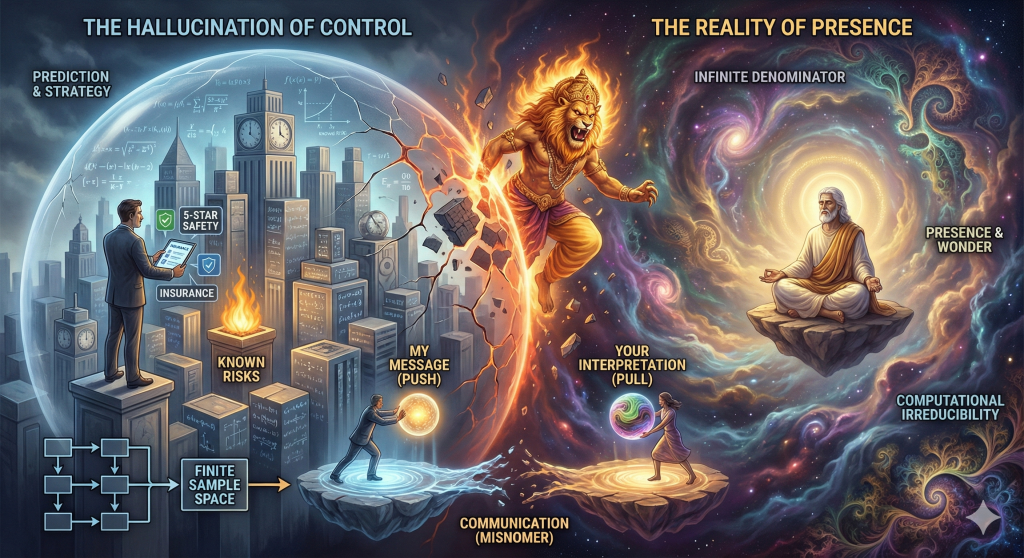
The Grand Hallucination: Why Prediction, Empathy, and Communication Are Illusions
Can enough data make life predictable? Why prediction, empathy and communication are partly illusions: the Hiranyakashipu paradox and the infinite denominator.
-

Language, LLMs, and the Kaleidoscope of Reality
Law, LLMs, scriptures and poems all need language. How language compresses consciousness, points rather than contains, and why wonderment needs no answer.
-

Recognition Arrives. Does Work. Goes Away. What Stays? Gratitude and Eternal Wonder!
Recognition arrives, does its work and goes away. On the intelligence of its timing, why it withdraws, and the gratitude and wonder that remain.
-

The Physics of the Threshold: Why Wonderment is the Only Spiritual Strategy
When recognition arrives and then withdraws, the ego rushes to maintain it. Why maintenance is a trap, awakening a phase transition, and wonderment the only strategy.
-

Beyond the Subtle Ego: When Krishna Consciousness Dissolves the Doer
A parent, a child and a mobile phone: the difference between using divine faculties and letting divinity use you, and the Gita’s teaching on the doer.
-

When Everything Is Emergence: The End of Cause and Effect
Everything the world cares about is emergent. Seeing through the illusion of causation, the prison of identity, and why mithya is the perfect word for it.

