What the Ramayana Quietly Teaches About Protection
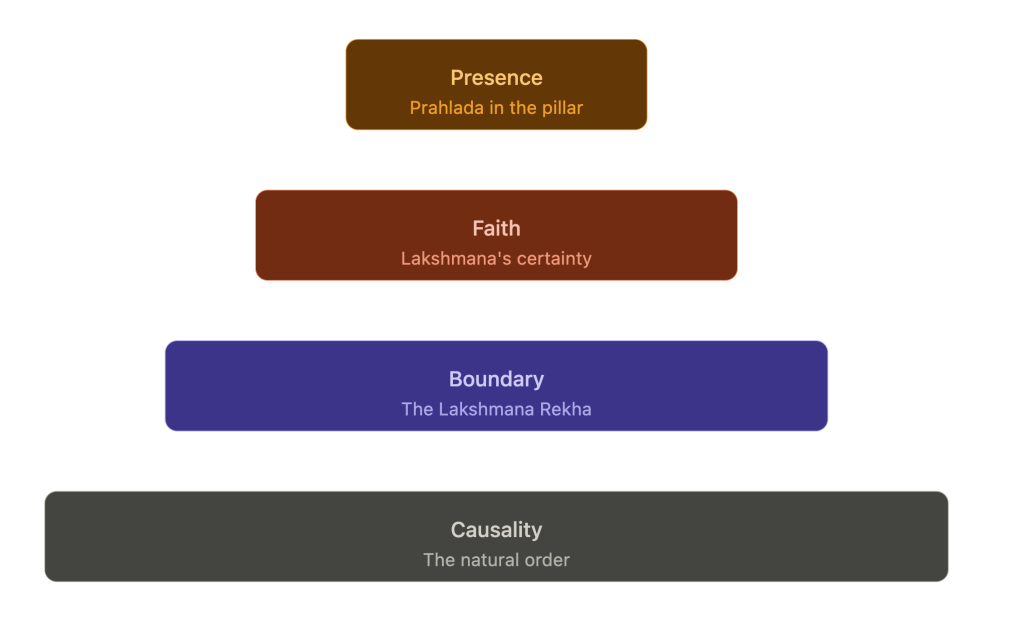
There is a structure inside the Ramayana that the epic never states directly but enacts at every turn. It is a structure of protection — not a single shield, but a layered one. Four layers, each catching you when the previous one is lost. Read this way, the epic stops being a tale of one woman’s misfortune or one king’s dharma and becomes something else: a map of how reality holds its creatures, even as they fall.
The map has four altitudes.
First Layer: Presence
At the highest altitude, there is direct immersion in the Lord. No mediation, no distance, no question of faith — because faith implies a gap, and at this altitude there is no gap. The devotee and the Beloved are not two things bridged; they are one thing not yet describing itself as two.
This is Prahlada in the burning pillar. The fire does not harm him not because he is protected from the fire, but because there is no “he” standing apart from the One to whom the fire also belongs. The pillar bursts open and Narasimha emerges — but in a sense, Narasimha was never elsewhere. Prahlada had never left presence to begin with.
This is also Hanuman in his deepest flights — when he carries the mountain, when he sets Lanka aflame, when he leaps the ocean. In those moments he is not trying to be near Rama. He simply is. The doing flows from the being. There is no Lakshmana Rekha around him because there is no “outside” he could step into.
For one established in this layer, no rule is needed. The rules exist for those who can be elsewhere. The fully present cannot be elsewhere.
Second Layer: Faith
But presence flickers. For most beings, most of the time, the direct contact is not steady. The Beloved is not always felt. The light goes behind a cloud. What holds you then?
Faith holds you. Not as a feeling, but as a stance. You may not see Him, but you know. You may not feel His presence, but you trust His nature. The rope remains in your hand even when you cannot see the other end.
Lakshmana, in the Mareecha episode, is the picture of this layer. The cry comes — Ha Sita! Ha Lakshmana! — in Rama’s voice, asking for help. Sita hears it as Rama in distress. Lakshmana hears the same sound and knows it cannot be Rama. Not because he has special information, but because his faith in Rama’s invincibility is unshakable. No being could harm his brother. Therefore the cry must be illusion. Therefore he should not move.
This is faith doing exactly what faith is for. When presence is not directly available — when Lakshmana cannot see Rama in that moment — faith stands in for presence. It holds the line that direct seeing would have held.
Sita, in that same moment, has lost the second layer too. She believes the cry. She doubts Lakshmana. The rope of faith has slipped from her hand, and she does not know it.
Third Layer: The Lakshmana Rekha
When faith too has faltered — when doubt has entered, when the inner supports have given way — there is still one more layer. The boundary. The drawn line. The rule that does not depend on your inner state to work.
This is the genius of the Lakshmana Rekha. Lakshmana, departing under duress, knows Sita has already lost both presence and faith in this moment. He cannot give her back her inner certainty. So he gives her something external — a line on the ground. It does not require her to feel Rama. It does not require her to trust him. It only requires her to not cross it.
This is the role of shastra in human life. Of vows. Of disciplined practice. Of the rules a tradition lays down for those who cannot yet stand on inner light alone. Yamas. Niyamas. 10 commandments. Don’t lie. Don’t steal. Don’t harm. Honor the boundary, and you remain safe even when your inner compass spins. The rule is impersonal, and that impersonality is exactly its strength. It works whether or not you understand it. It works whether or not you feel devotion. It works as long as you do not cross.
For most of us, most of the time, this is the layer we actually live within. We are not Prahlada. We are not always Lakshmana. But we can, with effort, honor the line.
Sita, in that one moment, did not. The deer-desire had already cost her presence. The cry had already cost her faith. The Rekha was the last layer between her and what came next. She crossed.
Fourth Layer: Causality
Below even the boundary, there is one final structure. Reality itself. Cause and effect. The natural order of things. The way fire burns and water flows and consequences follow actions.
When a being has lost presence, lost faith, and ignored the boundary, this layer still holds — not as protection in the kind sense, but as protection in the educative sense. You will be taught by what happens. The world is not arbitrary. Step off a cliff and gravity will instruct you. Step outside the line and what waits outside the line will meet you.
This is the bare floor of refuge. It is impersonal to the point of harshness, but it is still a refuge of a kind, because it is still structure. There is still a way reality works. You can still learn from it. You can still find your way back.
Even Ravana, in his final hour, has access to this layer. The arrow finds him. The lesson lands. Reality, having been ignored at every higher altitude, delivers itself through the lowest one.
The Geometry of the Fall — and the Climb
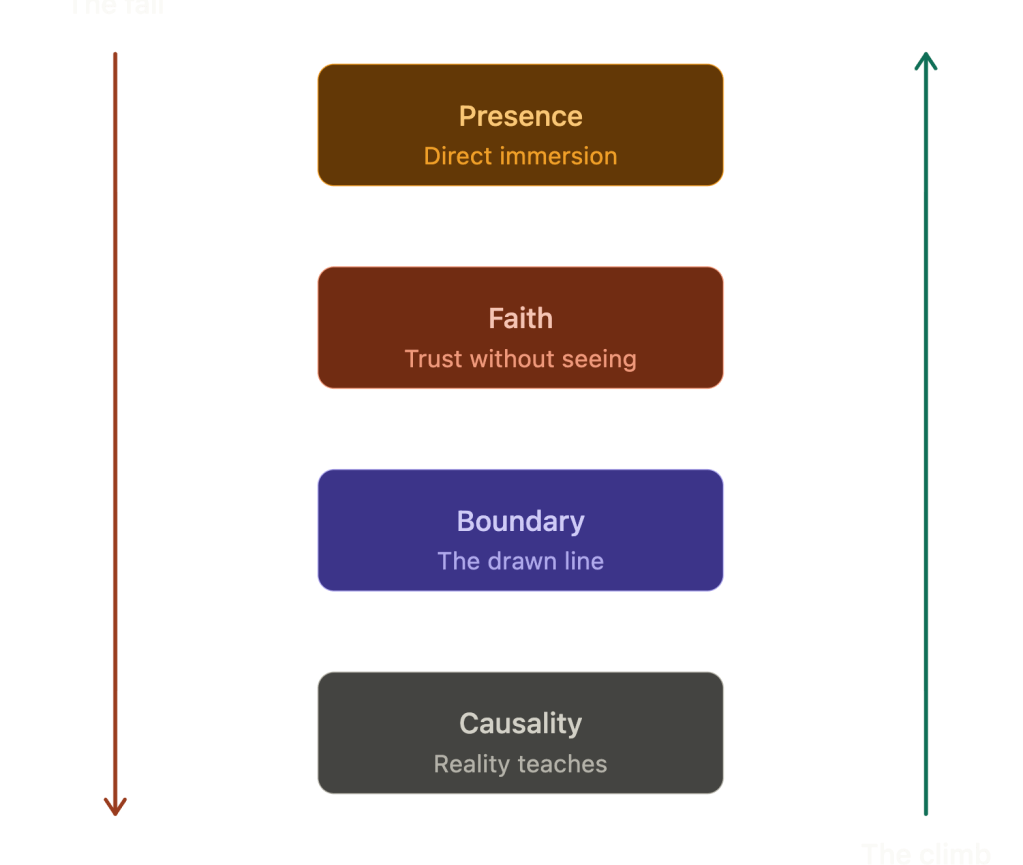
Sita’s tragedy in the Aranya Kanda is the loss of these layers in exact sequence. Presence falters at the golden deer — desire for the glittering thing displaces the presence of the Beloved. Faith fails at the cry — Lakshmana’s word is not trusted, the impossible is believed. The Rekha is crossed at the threshold — the last external safeguard is set aside. And then the fourth layer takes over: causality delivers her, faithfully and impersonally, to the one who waits outside the line.
This is not punishment. It is geometry. Each layer, when honored, makes the next one unnecessary. Each layer, when lost, makes the next one essential. When all four are let go, only consequence remains — and consequence is a teacher, but a stern one.
And here is what is most striking: the path back is the same ladder, climbed in reverse.
Honor the boundary, and faith becomes possible again. The discipline of not crossing clears the noise that doubt thrives in. Within disciplined life, faith can take root.
Hold faith, and presence returns. Trust, sustained, eventually deepens into knowing. The rope you hold in the dark eventually becomes the hand of the One you were holding it from.
Return to presence, and even the boundary dissolves — not because it is broken, but because it is no longer needed. The fully present cannot be elsewhere; the rule has nothing to enforce.
This is why the tradition can hold three apparently contradictory teachings at once: for the bhakta, no rule; for the seeker, all rules; for the worldly, the consequence of broken rules. These are not three different teachings. They are one structure, viewed from three altitudes.
The Generosity of the Map
What strikes me most, sitting with this, is how generous the structure is.
The layers are not punitive. They are catches. The universe, in this reading, is endlessly patient. If you fall from presence, faith catches you. If you fall from faith, the boundary catches you. If you fall from the boundary, even bare causality is still a teacher — still a structure, still a way back to the higher layers.
Nothing is ever left without a hold. The fall is never to nothing. Even at the lowest layer, the world is still teaching, which means the climb is still possible.
And at the top, those who stand in full presence — Prahlada, Hanuman in his deepest flights, Sita herself in the fire-ordeal where she has climbed all the way back, Mira with the cup of poison, the saints whose lives the traditions remember — they walk freely. No Rekha around them. No rules constraining them. Not because they have transcended morality in any rebellious sense, but because they have fulfilled it. The rules fall away not by being broken but by being completed.
This is what the Ramayana shows, layer by layer, fall by fall, climb by climb.
A Closing Thought
When we look at our own lives — our small turnings, our flickers of doubt, our crossed lines — we are usually somewhere on this ladder. Most of us live in the third layer, holding the boundary, sometimes faltering, sometimes restored. A few moments give us the second layer — moments of pure faith. Rarer still are the moments of the first.
The map does not shame us for where we are. It simply shows us the architecture. Wherever you stand, there is a layer above and a way up. Wherever you fall, there is a layer below to catch you and teach you.
Presence, faith, boundary, causality.
The four refuges. Always available. Always layered. Always patient.
The Ramayana, read closely, does not ask us to be Prahlada tomorrow. It asks us to honor the layer we are on, and to know that the next layer is always within reach.
That is enough. That has always been enough.
The InfoSec Perspective
In information security, we call this defence in depth. No serious system relies on a single control. If one layer fails, another catches. If identity fails, policy catches. If policy fails, monitoring catches. If prevention fails, detection and response remain.
The Ramayana reveals the same architecture at the level of the soul. Presence is the original integrity of the being. Faith is the first compensating control when presence is no longer felt. Boundary is the external discipline that protects us when faith weakens. And causality is the final, incorruptible audit trail of reality itself.
This is not punishment. It is divine defence in depth. God loves us so much that even when we try to break free into the illusion we call freedom, He does not abandon us to nothingness. He catches us at the next layer. And then the next. And then even through consequence itself, He keeps pointing us back to the original secure state: presence, wholeness, integrity.
This is the second essay in The Architecture of Return. The first piece, The Eagerness of Love and the Turning of Desire, reads Hanuman and Sita closely as the two instances from which this architecture is drawn. The third piece, The Apple, the Deer, and the Mind, widens the lens beyond the Ramayana — asking why such a layered architecture exists at all, by reading Eden and Patanjali’s nirodhah alongside Sita’s turning toward the deer.


You must be logged in to post a comment.