Reading Hanuman and Sita Closely
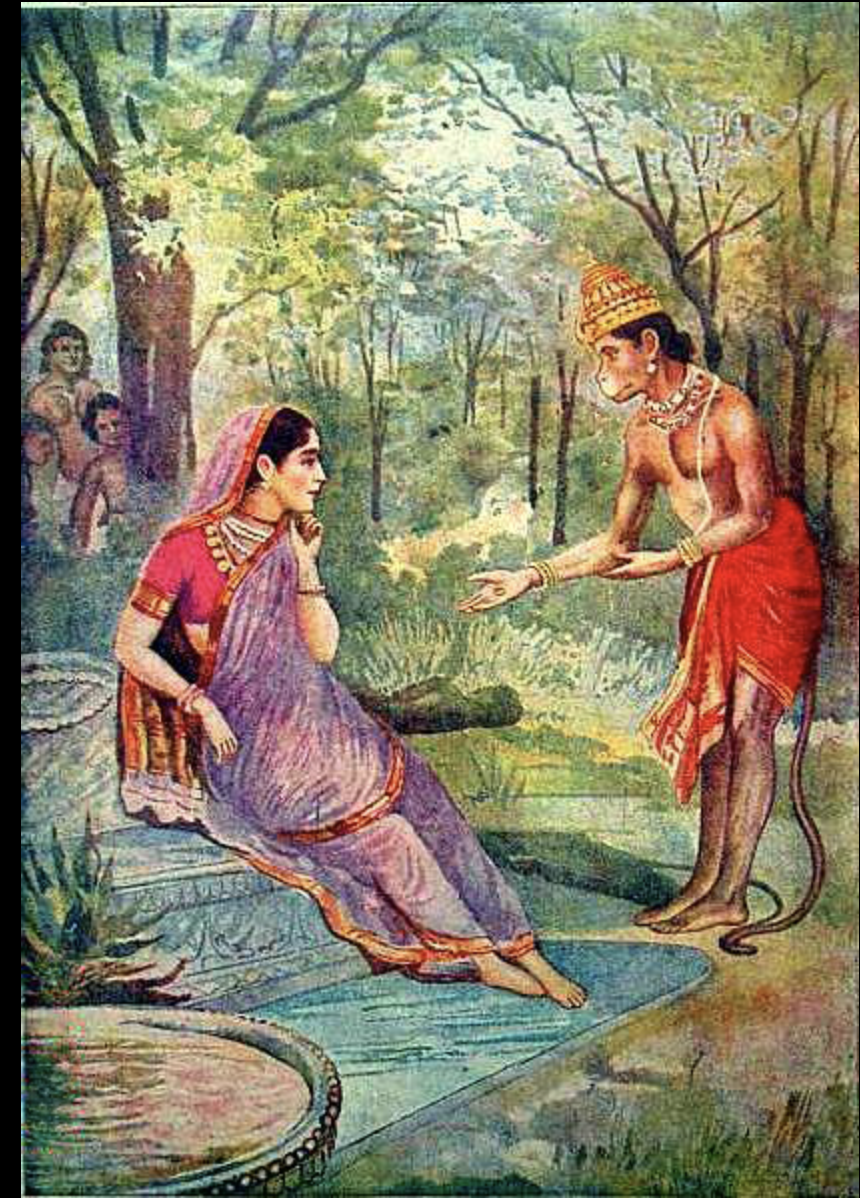
There are two moments in the Ramayana that the popular telling tends to smooth over. One is small and tender — Hanuman, having found Sita in the Ashoka Vatika, offering to carry her back to Rama on his shoulders. The other is large and consequential — Sita, in the forest of Panchavati, turning her gaze toward a golden deer. They seem unrelated. They are not. Read together, they reveal something the sanitized retellings tend to miss: that even the noblest figures in the epic have moments of inner turning, and that these turnings carry weight.
This essay is a meditation on those two moments.
Hanuman’s Offer
In the Sundara Kanda, after Hanuman reveals himself to Sita, shows her Rama’s signet ring, and earns her trust, he sees the depth of her grief. Moved by it, he makes an offer: Mother, climb on my back. I will carry you to Rama. I am capable of this.
Sita declines. The reasons given in the tradition are twofold — she does not wish to willingly touch any man other than Rama, and more importantly, she wants Rama himself to come, defeat Ravana, and rescue her so that his honor is upheld.
It is a beautiful exchange, usually read as a moment of pure devotion on both sides. But there is a question worth sitting with: was Hanuman’s offer entirely free of overreach?
Consider the situation. Hanuman has just leapt the ocean, survived Surasa and Simhika, entered Lanka undetected. His confidence is not unfounded — it is built on what he has just done. And yet, carrying Sita back is a feat he has not yet performed. The return flight would be different — Sita’s weight, the likelihood of Ravana’s forces alerted, the ocean once more beneath. The capability he asserts is projected into an untested future.
A friend once put it sharply to me: Hanuman, the epitome of bhakti and surrender, in this moment loses touch with reality. Not because he is wrong about his strength, but because he extrapolates it. Surrender, strictly speaking, stays with what is given. The future is the Lord’s domain, not the servant’s.
I think there is something to this — and also something that resists it.
The bhakti framework offers a softer reading. When a true devotee says I can do this, the grammar of the statement is misleading. What is really being said is: He will continue to act through me. The confidence is not about self-capacity persisting into the future; it is about the Lord’s grace persisting. From within that frame, Hanuman’s offer is not boast but instrument-readiness — the servant proposing, the Lord disposing.
And yet, the form of the offer was I am capable, not He will accomplish it through me. Form matters. The Gita’s Arjuna eventually learns to say nimitta-matram bhava — be merely the instrument. Hanuman, in this moment of emotional fullness, perhaps had not yet reached that articulation.
This is why Sita’s refusal is itself a teaching. Not only does it protect Rama’s honor and the dharmic shape of the rescue — it quietly corrects the frame. The deed will be done, but not this way. Not by a servant’s projected strength. By the Lord, in His own time.
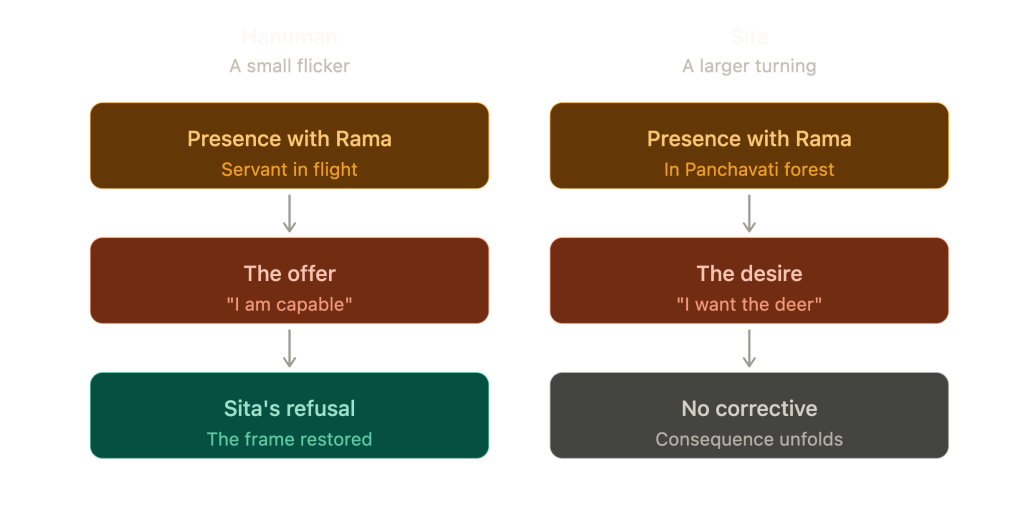
So perhaps Hanuman’s offer is not ahankara. It is the eagerness of love — the longing of a devotee to be chosen as the means. A small flicker, born of seeing the suffering of one beloved by the Beloved. Gentle, beautiful, and yet — for those who watch closely — a micro-turning from pure presence into self-reference.
Surrender, at its peak, knows: He will do everything right. Whether He chooses me or someone else as the medium does not matter absolutely.
Sita’s Turning
In the same epic, much earlier, a deer of impossible gold flickers at the edge of the Panchavati ashram. Sita sees it. She wants it. Rama warns. Lakshmana warns. She insists. Rama goes.
Then a cry: Ha Sita! Ha Lakshmana! — in Rama’s voice, but not from Rama. Lakshmana knows. He has unshakable faith that no being can harm his brother. The cry must be illusion. He says so. Sita does not believe him. She accuses him, harshly and unjustly, of harboring designs on her. Bound by duty, he leaves — but not before drawing a protective line at the threshold. The Lakshmana Rekha. A final layer of care for someone who has already stepped, inwardly, outside the order Rama had set.
She crosses it. The rest is the Ramayana.
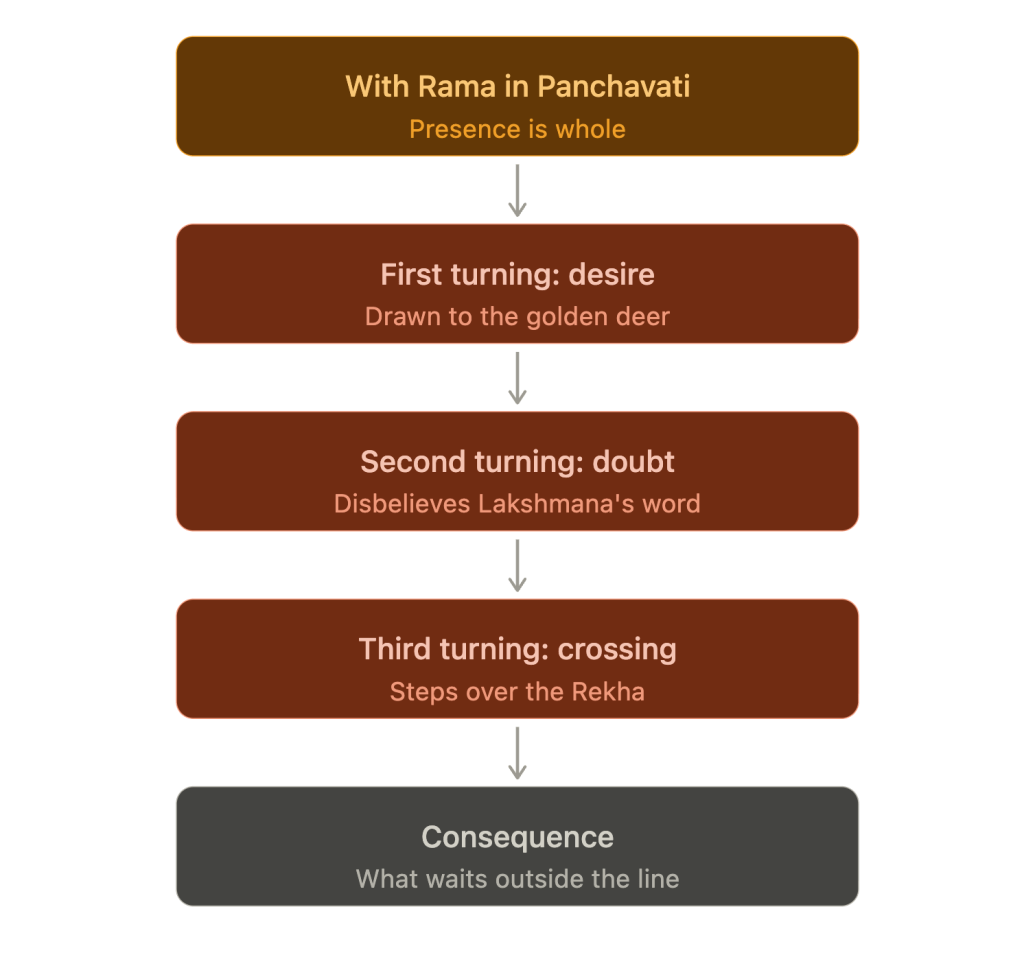
The popular reading paints Sita as wholly innocent here, the pure victim of Ravana’s deceit. But the text shows three distinct turnings, each a step further from the center:
First, desire for the deer over Rama’s counsel. The glittering thing outside became more attractive than the presence within reach.
Second, doubt of Lakshmana’s word over faith in Rama’s invincibility. Lakshmana stood firm in the conviction that no harm could come to his brother. Sita, in that moment, did not.
Third, the crossing of the line. The protection had already been layered down to its last form — a drawn boundary on the ground. She stepped over.
To name these turnings is not to call Sita guilty. It is to call her real. The tradition that paints her flawless is doing devotional flattening, not textual reading. A Sita who never falters is not a Sita one can learn from. A Sita who turns toward the deer, who doubts, who crosses the line — and who still holds to Rama through fire and exile and forest and the final return to the earth — is a far more powerful figure. She is Bhumija, daughter of the earth. Real. Weighted. Not floating.
The crucial distinction: Sita was not innocent in the sense of flawless in judgment. She was innocent in the sense of not deserving what came next. Both are true. Stepping outside a protective line does not make one deserving of abduction. The lapses are real; the consequences are disproportionate. To insist on the first truth is not to deny the second.
The Inner Geometry
What links these two moments?
Both are turnings. Hanuman’s is small, inward, born of love — a flicker of self-reference inside an offering of service. Sita’s is larger, outward, born of desire — a movement of attention away from the present Beloved toward a glittering elsewhere. Different in scale, different in cause, but structurally similar: a micro-departure from pure presence-with-Rama into something that puts the self at the center of the next moment.
The principle, stated cleanly: being with Rama is the supreme state. Once you desire something else — even something noble, even something loving — consequences follow.
This is not karma-accounting. It is not a cosmic ledger that says Sita abandoned Rama first, so Rama’s later abandonment of her balances out. That kind of moral arithmetic flattens the epic into bookkeeping. The Uttara Kanda’s abandonment is presented as Rama’s dharmic act as king, not as personal retribution. And in many readings, Sita’s turning toward the deer is itself part of the divine play — the kidnapping had to occur for Ravana to be destroyed.
What is being said is something subtler. It is a description of inner geometry. Presence with Rama — read it as Self, as dharma, as the Lord’s living presence — is the natural state. The moment desire turns elsewhere, separation has already occurred, inwardly. The external events that follow are the unfolding of what the inner turning already set in motion. Yad bhavam tad bhavati.
Sita’s turning had no corrective in time — the deer was already running, the cry was already coming. Hanuman’s was met by Sita herself, who, by declining, became the corrective for him that no one had been for her. There is a quiet symmetry there: the one who once turned outward becomes the one who turns another back inward.
What the Sanitized Telling Loses
The popular Ramayana wants Sita to be flawless and Rama to be unjust, or Sita to be flawless and her suffering to be inexplicable. It wants Hanuman to be pure servant with no inner motion at all. These framings are devotionally well-meant but they cost the epic its depth.
A Hanuman who has a flicker of self-projection — and is gently corrected by Sita’s refusal — is more instructive than a Hanuman who is a perfect machine of service. He shows us what surrender actually looks like in practice: not the absence of the self, but the catching of the self when it stirs.
A Sita who turns toward the deer, doubts Lakshmana, crosses the line — and still remains the Sita of the fire-ordeal, the forest exile, the final return to Bhumi — is more luminous than a Sita who is glass-smooth. Her holding to Rama after her lapses is what makes her holding worth anything. A faith that has never wavered is not yet a faith.
And the principle they together illuminate — that presence with the Lord is the only safety, and every turning, however small, however loving, opens a door — is one of the quietest, deepest teachings the epic offers.
It is not a warning. It is a description.
Watch where the attention goes. That is where the story will follow.
This is the first essay in The Architecture of Return. The next piece, The Four Layers of Refuge, draws out the structural architecture this reading implies — the four altitudes of protection that catch a soul as it falls. The third piece, The Apple, the Deer, and the Mind, widens the lens to ask why such an architecture exists at all, reading Eden, Panchavati, and Patanjali’s nirodhah as three vocabularies for the same movement.


You must be logged in to post a comment.