My earlier series, I. Think. Therefore, IAM, used philosophical language to describe security architecture.
It asked what Zero Trust, identity, access, privilege, drift, denial, and return look like when read through older vocabularies of consciousness, action, impermanence, and alignment.
This series moves in the opposite direction.
It uses the language of security to describe spiritual life.
Not because the soul is a machine. Not because consciousness can be reduced to computation. Not because devotion, surrender, remembrance, grace, or realization are merely technical processes wearing sacred clothing.
But because modern security has developed a surprisingly precise vocabulary for things spiritual traditions have always known.
Initial trust is not enough. Privilege must be constrained. The deepest key cannot be extracted. Public information is not the same as access. Visibility is not possession. The most important transformation often happens in a protected interior that cannot be fully inspected from the outside.
Some concepts will appear in both series — the ground state, least privilege, the Mahavakyas.
That is not repetition.
Read in one direction, a security primitive borrows older language to become more precise.
Read in the other, the same primitive borrows that language to discover its own limit.
The mapping is shared. The insight runs the opposite way.
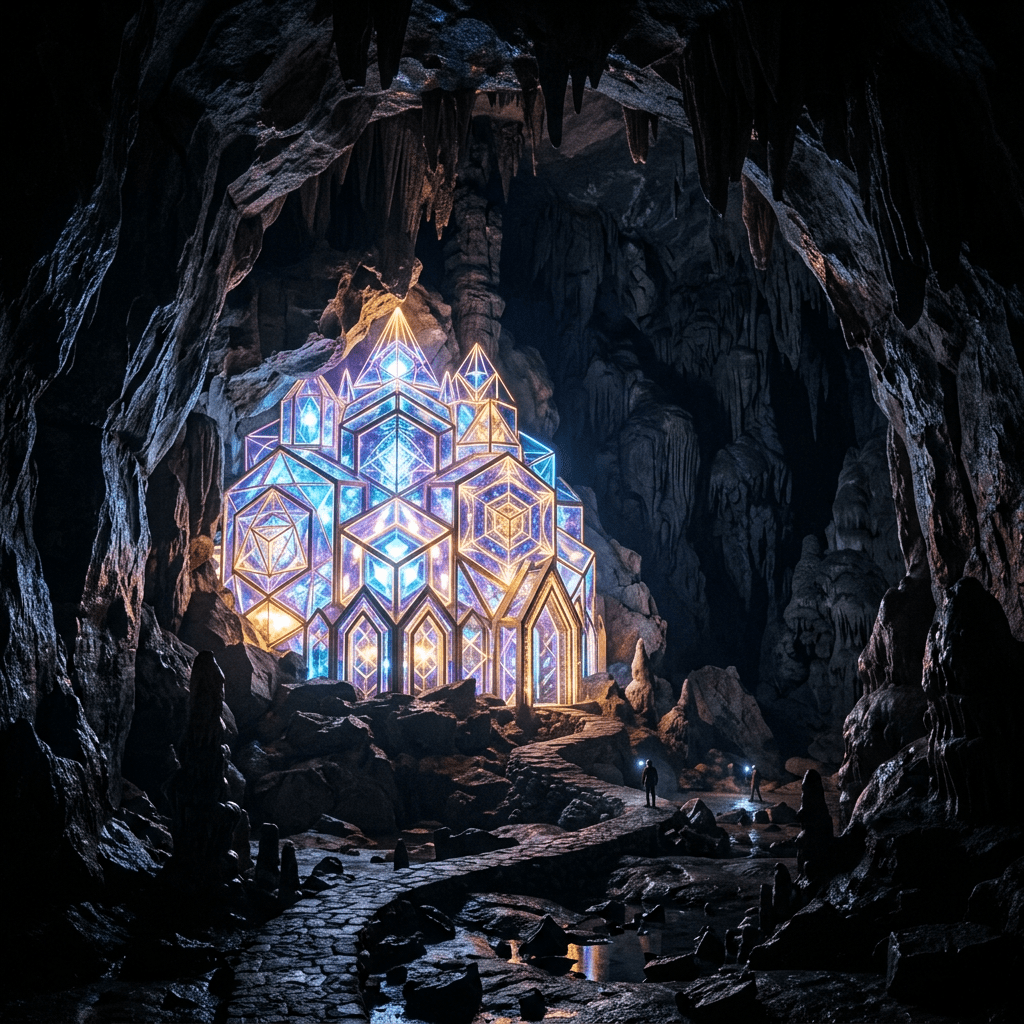
This is the starting point of The Secure Enclave of the Soul.
In computing, a secure enclave is a protected execution environment. Sensitive operations can happen within it. Secrets can be used without being exposed. The rest of the system may request an operation, observe certain outputs, or infer patterns from behavior, but it cannot simply extract the protected key.
Confidential computing extends this idea further. It protects not only stored data, and not only data moving across a network, but data while it is being processed. Something real happens inside the protected environment. Inputs enter. Operations occur. Outputs emerge. But the inner computation is not fully visible to the outside.
This gives us a powerful metaphor for spiritual life.
Experience enters us. Memory enters us. Pain enters us. Prayer enters us. Scripture enters us. Names, stories, failures, longings, silences, wounds, duties, and moments of beauty enter us.
And then something happens.
Not always immediately. Not always consciously. Not always in a way we can diagram, audit, or explain.
But something is processed in the hidden interior.
Years later, we discover that a sentence once heard casually has become luminous. A story from childhood begins to speak. A wound becomes compassion. A failure becomes humility. A prayer once repeated mechanically becomes breath. A name once spoken by habit becomes refuge.
Nothing in the outer data changed.
The interpreter changed.
This is why the metaphor matters. The soul is not merely a storage vault where spiritual impressions are archived. It is closer to a protected execution environment where experience is slowly transformed into being.
We do not always know what is being processed within us. We do not always know which memory is ripening. We do not always know which grief is softening pride. We do not always know which repeated name is quietly reorienting the heart. We do not always know which old teaching is waiting for the future self capable of understanding it.
All we know, sometimes, is that we are not the same.
We are continuously being transformed, but we cannot always map the exact transformation.
That is the mystery this series tries to approach, across five movements.
The first essay begins with continuous authentication. In security, a valid login at 9:00 AM does not guarantee that the same subject is still properly aligned at 10:00 AM. Context changes. Devices drift. Sessions can be hijacked. Trust must be renewed. Spiritually, this becomes a way to understand Namasmarana — remembrance not as occasional emotion, but as continuous inner verification.
The second essay turns to Kerckhoffs’ Principle and the non-extractable key. A strong cryptographic system does not depend on hiding the entire method. The design may be public, but the key remains protected. Likewise, spiritual teachings may be publicly available, scriptures may be printed, philosophies may be explained, and yet realization cannot simply be downloaded by the ego. Information is not access. Description is not transformation.
The third essay takes the phrase Harvest Now, Decrypt Later and holds it in both hands. In cybersecurity the phrase is ominous: an adversary stores encrypted data today in the hope of decrypting it tomorrow. That hostile harvest, the essay admits, runs inside us too — wounds and conditioning stored in innocence and decrypted, years later, in vulnerability. But the same delayed decryption can also be gentle and redemptive. We receive truths before we are ready to understand them. Childhood stores what adulthood later learns to read. The archive is neutral; everything depends on which key arrives.
The fourth essay turns to the side channel and the private key. A system can leak through timing, power, and metadata what it never directly exposed; a human life leaks priorities, wounds, and dependencies through its observable surface. In an age that profiles, predicts, models, and monetizes behavior, it becomes necessary to say clearly: the profile is not the presence, the model is not the Self. And asymmetric cryptography supplies the precise image — the public key may be known to all, yet the private key remains underivable. Visibility is not possession. The empirical self is legible; the deepest self is irreducible.
The closing note carries that irreducibility to its summit, and then lets the metaphor fall silent. A key still implies an owner — a self holding a secret — and at the deepest point of realization even that duality dissolves. What seemed the private key is Atman; the ground in which it is held is Paramatman; and finally the two are no longer experienced as separate. The deepest security of the inner life turns out to be not concealment, but union.
The point of this series is not to claim that spirituality is cybersecurity.
It is to say that security gives us a disciplined language for realities the inner life has always encountered:
the difference between initial access and abiding alignment, the difference between information and realization, the difference between exposure and possession, the difference between signal and source, the difference between a system being observed and its deepest key being held, the difference between a life that is merely visible and a life that is inwardly transformed.
The soul is not a problem waiting to be decoded.
It is not a password to be cracked. It is not a hidden register in the machine. It is not a dataset from which enough inference will finally extract the whole person.
The soul is a protected depth.
It can be approached. It can be purified toward. It can be aligned with. It can be surrendered into. It can be lived from.
But it cannot be possessed by the ego as an object.
That is why the deepest traditions speak not only of knowledge, but of transformation. Not only of seeing, but of becoming. Not only of information, but of surrender. Not only of truth as something known, but truth as something into which one is slowly remade.
This series, then, is an attempt to read spiritual life through the architecture of protection.
Continuous authentication becomes remembrance. Least privilege becomes surrender. The secure enclave becomes sacred interiority. The non-extractable key becomes realization. Harvest Now, Decrypt Later becomes the slow, two-edged unfolding of meaning. The side channel reads the surface, but the private key remains the irreducible Self. And at the summit, the private key is no longer even held apart: Atman rests in Paramatman, and the metaphor falls silent.
And confidential computing becomes a metaphor for the hidden work by which grace, memory, suffering, discipline, devotion, and time transform us from within.
Not everything real is externally observable.
Not everything transformative is consciously inspectable.
Not every truth arrives first as understanding.
Some truths enter us encrypted. Some remain within us for years. Some are processed beneath the surface of ordinary awareness. Some become readable only after life has changed the reader.
Welcome to The Secure Enclave of the Soul!
The soul is not a problem waiting to be decoded.
It is not a password to be cracked.
It is not a hidden register in the machine.
It is not a dataset from which enough inference will finally extract the whole person.
The soul is a protected depth.
It can be approached.
It can be purified toward.
It can be aligned with.
It can be surrendered into.
It can be lived from.
But it cannot be possessed by the ego as an object.
That is why the deepest traditions speak not only of knowledge, but of transformation. Not only of seeing, but of becoming. Not only of information, but of surrender. Not only of truth as something known, but truth as something into which one is slowly remade.
This series, then, is an attempt to read spiritual life through the architecture of protection.
Continuous authentication becomes remembrance.
Least privilege becomes surrender.
The secure enclave becomes sacred interiority.
The non-extractable key becomes realization.
Harvest Now, Decrypt Later becomes the slow unfolding of meaning.
Side-channel resistance becomes the irreducibility of the Self.
And confidential computing becomes a metaphor for the hidden work by which grace, memory, suffering, discipline, devotion, and time transform us from within.
Not everything real is externally observable.
Not everything transformative is consciously inspectable.
Not every truth arrives first as understanding.
Some truths enter us encrypted.
Some remain within us for years.
Some are processed beneath the surface of ordinary awareness.
Some become readable only after life has changed the reader.
Welcome to The Secure Enclave of the Soul!
Happy Reading!
 Reinvent The Self!
Leave a comment