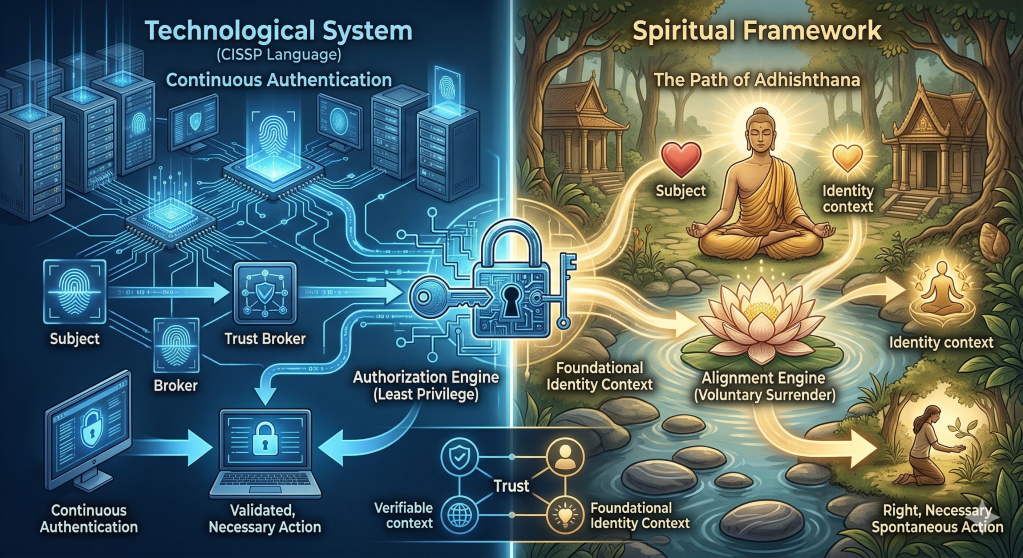
The Continuous Authentication of the Heart
Namasmarana, Adhishthana, and the Least Privilege of the Ego
In security, one of the first lessons we learn is that initial trust is never enough.
A user may log in correctly at 9:00 AM.
The password may be valid.
The device may be recognized.
The session may begin cleanly.
The system may have every reason, at that moment, to believe that the right subject has entered the right environment.
But what about ten minutes later?
What about an hour later?
What if the user walks away from the device?
What if the network context changes?
What if the device posture deteriorates?
What if an attacker takes over a valid session?
What if the identity that was verified at the beginning is no longer the identity effectively acting now?
This is why modern security cannot depend only on one-time verification. A login event is important, but it is not the same as a living state of trust. The system must keep asking, quietly and intelligently:
Are you still who you claimed to be?
Are you still operating from the same context?
Is this action still aligned with what was originally trusted?
This is the movement from initial authentication to continuous verification.
And it gives us a surprisingly precise way to understand spiritual life.
Because human beings make the same mistake.
We think one moment of clarity is enough.
One prayer.
One retreat.
One book.
One insight.
One temple visit.
One emotional experience.
One moment of surrender.
One sentence that suddenly feels true.
We assume that because something was real once, it will remain real automatically.
But life is not static.
The mind is not static.
The heart is not static.
What was clear in the morning can become clouded by evening.
What was surrendered yesterday can become possessive today.
What was devotion in silence can become ego in action.
What was insight in solitude can become irritation in relationship.
The problem is not that the original moment was false.
The problem is that a true beginning is not the same as a continuous state.
The Problem with One-Time Spirituality
Many of us approach inner life the way outdated systems approach identity.
We authenticate once.
We visit a temple and feel peaceful.
We hear a bhajan and feel softened.
We read the Gita and feel elevated.
We repeat a Mahavakya and feel expanded.
We have one glimpse of stillness and believe something permanent has happened.
But the mind does not preserve alignment merely because alignment once occurred.
It drifts.
It forgets.
It gets hijacked by fear, pride, comparison, resentment, desire, anxiety, insecurity, and habit.
A person may have had a genuine spiritual insight yesterday and still act today from ego. A system may have performed valid authentication earlier and still be under hostile control now. The beginning was real in both cases. But reality moved. Context changed. The session continued after the original certainty expired.
So the question is not only:
Have I ever known truth?
The more decisive question is:
What is running in the background of my consciousness right now?
That is the question continuous authentication asks of a system.
And it is also the question spiritual practice asks of the heart.
What is currently active?
What has taken privilege?
What process is consuming attention?
What identity is making this decision?
What hidden impulse has become root?
Spiritual traditions have always understood this. That is why they do not speak only of revelation. They speak of remembrance.
Not because the first glimpse was meaningless.
But because the glimpse must become continuity.
Namasmarana as Background Verification
At first glance, Namasmarana — the repeated remembrance or chanting of the Divine Name — may look like devotional repetition.
A habit.
A ritual.
A comfort.
A rhythm passed down through family or tradition.
But from the perspective of this series, Namasmarana can also be understood as something more architecturally precise:
It is continuous background verification of the heart.
In a well-designed security system, continuous authentication does not necessarily interrupt every action with a dramatic prompt. It often works quietly. It looks for continuity between identity, behavior, context, and risk. It watches for drift. It asks whether the subject currently acting is still aligned with the subject that was trusted.
Namasmarana performs a similar function inwardly.
The Divine Name — whether one says Krishna, Rama, Shiva, Devi, Vitthala, Narayana, or rests in a formless remembrance — becomes a recurring signal of orientation. It keeps the deepest reference point alive. It reminds the mind that it is not self-sovereign. It tells the ego:
You are not the final authority here.
This is why the Name is not merely a word.
It is a stabilizing context.
Without such context, the mind becomes like an unsecured session: open, active, and easy to hijack.
A person may appear outwardly functional while inwardly operating from a compromised identity. They may speak politely while acting from fear. They may serve visibly while seeking recognition secretly. They may make correct decisions while quietly feeding pride. They may perform devotion while protecting self-image.
This is the subtlety of inner compromise.
The attacker is not always external.
Sometimes the session is hijacked by the ego.
Namasmarana does not magically remove every impurity. It does not instantly resolve every conflict. It does not make the practitioner immune to confusion.
But it reduces drift.
Again and again, it reconnects action to source.
It quietly asks:
Are you still aligned?
Are you still acting from truth?
Are you still inwardly authenticated?
Is this action arising from remembrance, or from ego wearing spiritual language?
That is why remembrance matters.
Not as performance.
As continuity.
Adhishthana: The Trusted Ground
If Namasmarana is active remembrance, Adhishthana is the deeper foundation.
Adhishthana may be understood as the underlying ground, the substratum, the stable base in which changing experiences arise. Thoughts come and go. Emotions come and go. Roles come and go. Identities come and go. But something deeper remains present beneath the movement.
In technical language, we might say:
If the ego is the fluctuating user session, Adhishthana is the trusted ground on which all sessions appear.
This is where the language of the Prologue becomes important.
The soul is not merely storing impressions. It is not just a hidden archive of experiences. It is more like a protected interior in which life is being processed. But that protected processing requires a trusted ground. Without such ground, every passing event becomes authoritative.
Every thought becomes an instruction.
Every fear receives admin rights.
Every desire appears legitimate.
Every impulse demands execution.
Every memory claims ownership of identity.
When we are not rooted in Adhishthana, the foreground rules everything.
A small insult becomes a full identity crisis.
A delayed outcome becomes proof of abandonment.
A moment of praise becomes inflation.
A moment of criticism becomes collapse.
A desire becomes destiny.
A fear becomes prophecy.
This is what happens when the session forgets the ground.
But when a person begins to live from Adhishthana, something changes.
The mind still moves.
Pain still arises.
Responsibilities remain.
The world still asks for action.
Relationships still test us.
Work still demands clarity.
The body still ages.
Loss still hurts.
But beneath all this, there is a quieter continuity.
A base layer that does not panic with every fluctuation.
A ground that is not rewritten by every passing event.
This is where spirituality becomes less theatrical and more architectural.
The question is not:
Did I feel spiritual today?
The better question is:
What is my default state when no performance is happening?
That is closer to the truth.
Because the real test of inner life is not the peak moment. It is the background condition.
The Ego Wants Excess Privilege
One of the wisest principles in security is the Principle of Least Privilege.
A user, process, or application should receive only the minimum permissions required to perform its legitimate task — nothing more.
Why?
Because excess privilege creates danger.
Too much access leads to abuse, error, compromise, escalation, and damage.
Now consider the ego.
The ego wants far more privilege than it needs.
It wants control over outcomes.
It wants permanent approval.
It wants authority over other people’s perceptions.
It wants write access to the past.
It wants administrative control over the future.
It wants ownership of success.
It wants immunity from criticism.
It wants unrestricted access to memory, fantasy, status, fear, and comparison.
It wants to interfere everywhere.
Most suffering does not come merely from action.
It comes from overprivileged identity.
A simple duty becomes heavy because the ego claims ownership.
A necessary conversation becomes drama because the ego demands victory.
A failure becomes unbearable because the ego treated success as self-definition.
A spiritual practice becomes polluted because the ego wants to be seen as spiritual.
The task may be legitimate.
The permissions are excessive.
This is where surrender becomes deeply practical.
Surrender is often misunderstood as weakness, passivity, or loss of agency. But seen through the language of security, surrender is something much cleaner:
Surrender is the removal of unnecessary permissions.
It does not stop action.
It removes egoic overreach from action.
One still speaks.
One still serves.
One still works.
One still decides.
One still protects what must be protected.
One still acts with strength when strength is required.
But the action becomes less contaminated by possession.
The ego is not given root access to every event.
It is allowed to perform its limited functional role — navigation, communication, ordinary self-maintenance — but it is no longer allowed to impersonate the Self.
This is not the destruction of personality.
It is proper authorization.
Why Discipline Creates Freedom
Many people assume that spiritual discipline narrows life.
Remembrance sounds repetitive.
Surrender sounds limiting.
Devotion sounds dependent.
Restraint sounds like loss.
But good security does not exist to kill action.
It exists to make action trustworthy.
A secure system does not stop every process. It ensures that the right process runs in the right way, for the right purpose, with the right level of access.
Likewise, genuine spiritual discipline does not make a person lifeless.
It removes distortion.
It becomes easier to act without vanity.
To serve without drama.
To decide without fragmentation.
To love without possession.
To endure without collapse.
To work without making work into identity.
To succeed without intoxication.
To fail without annihilation.
This is why Namasmarana and Adhishthana are not ornamental practices.
They are architectural.
Namasmarana maintains live orientation.
Adhishthana provides trusted ground.
Least privilege restrains the ego.
Together, they allow action to become cleaner.
A person rooted in remembrance does not become less capable.
They become less hijackable.
The Heart as a Living Zero Trust Architecture
Modern security often uses the phrase Zero Trust.
At its best, Zero Trust does not mean paranoia. It means that no entity should be trusted merely because it is already inside the perimeter. Every request must be evaluated in context.
This has direct relevance to inner life.
Not every thought deserves trust because it arose inside “my mind.”
Not every desire deserves approval because it feels personal.
Not every fear deserves obedience because it sounds urgent.
Not every memory deserves authority because it is vivid.
Not every inner voice deserves execution because it speaks loudly.
A thought entering consciousness should not automatically receive full access.
It must be examined.
Is it aligned with truth?
Is it born of clarity or ego?
Does it lead to right action or contraction?
Is it a genuine signal or a hijacked process?
Does it belong to the present moment, or is it stale residue from an old wound?
This is not self-hatred.
It is discernment.
The awakened heart is not naïve. It does not grant root access to every impulse. It does not trust every internal event merely because it is internal. It verifies.
Beautifully.
Quietly.
Continuously.
This is the spiritual meaning of inner Zero Trust:
Do not distrust life.
Distrust drift.
From Event to State
Many of us are waiting for a single transforming event.
One final insight.
One perfect retreat.
One unshakable experience.
One revelation that ends all confusion.
One decisive moment after which the old self never returns.
But perhaps the deeper path is quieter than that.
Perhaps the real movement is from event to state.
From occasional remembrance to continuous remembrance.
From emotional inspiration to stable grounding.
From egoic overreach to least privilege.
From spiritual experience to spiritual architecture.
From one-time login to ongoing authentication of the heart.
That is why Namasmarana matters.
That is why Adhishthana matters.
That is why surrender matters.
A well-governed life is not built on one moment of access.
It is built on living continuity with what is most real.
And perhaps that is what spiritual practice has always been:
Not a dramatic declaration of faith,
but a quiet background process of returning,
again and again,
until truth no longer visits us occasionally,
but begins to live as our default state.
Closing Aphorisms
One moment of insight is like a valid login; it is precious, but not sufficient.
A true beginning is not the same as a continuous state.
Namasmarana is not repetition alone; it is continuity of orientation.
Adhishthana is the trusted ground beneath fluctuating identity.
The mind can be hijacked after revelation just as easily as before it.
The ego suffers because it demands excessive privilege.
Surrender is not loss of agency; it is removal of unnecessary permissions.
A disciplined life is not less free; it is less hijackable.
The awakened heart does not trust every thought merely because it is internal.
A well-lived spiritual life is a continuously authenticated life.
 Reinvent The Self!