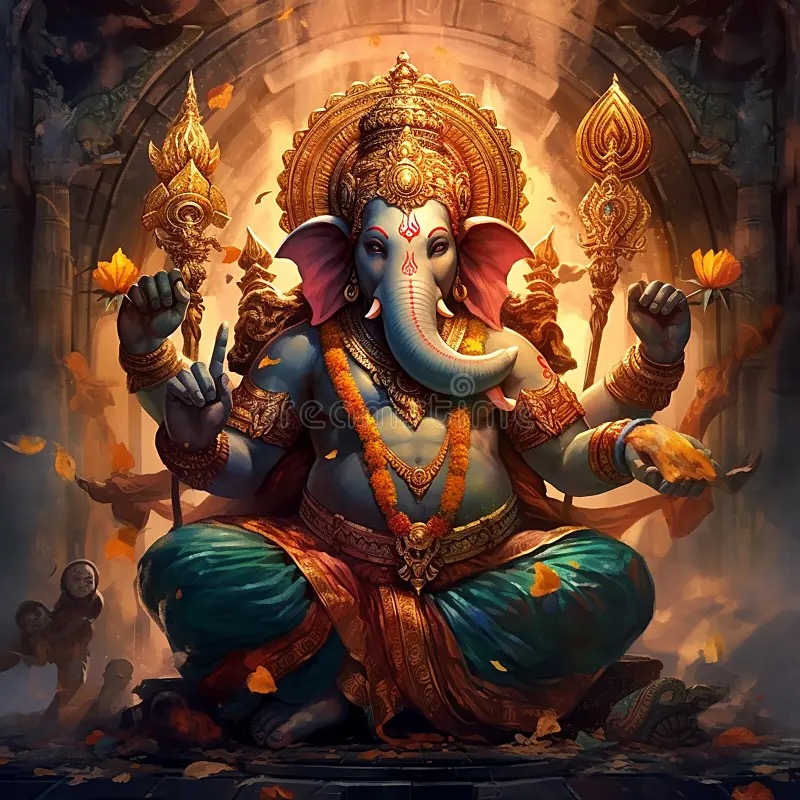
In our journey of looking at Ganesha’s form, we have seen how his hands lay out a path of action. But what is the nature of the consciousness that offers this path? What is the character of the divine, not just in what it does, but in what it is? The Ganapati Atharvashirsha offers us a profound portrait, an anatomy of grace, that takes us from the most personal qualities of interaction to the most absolute, cosmic truths.
It all begins with how this divine presence engages with us, founded on a bedrock of profound receptivity.
The Foundation: A Presence that Hears and Holds
Before any action, there is being. The first two qualities we explore are about a presence that is infinitely open.
First, the Śūrpakarṇakaṁ—the ears like winnowing fans. This is not mere hearing; it is the sacred art of Deep Listening. It is a listening that sets aside its own identity to truly merge with the one who speaks. It is a presence that has such a profound willingness to understand that it separates the essential truth (the grain) from the noise of ego and pain (the chaff). In this egoless listening, it is Truth itself that hears.
Paired with this is the Lambodaram, the great belly. This symbolizes an infinite Tolerance. It is the divine capacity to absorb and digest all the dualities of life—our joys and our sorrows, our successes and our failures, our love and our anger. It is a compassionate space that can hold the entire universe of our experiences without judgment, remaining in perfect, unperturbed peace. It is a presence that can hold us completely.
The Spirit: The Passionate Engagement of ‘Rakta’
But this presence is not just a silent, passive witness. It is passionately engaged with the world. This is the secret of the three “Rakta” attributes, which paint a picture of a divinity that is alive with the color of love, service, and sacrifice.
- This consciousness is Raktagandhā’nuliptāṅgam—anointed with the paste of red, passionate sandalwood. Like sandalwood, it willingly wears itself out in selfless service, grinding itself down to offer the cooling, healing fragrance of grace to the world.
- It is Rakta puṣpaiḥ supūjitam—worshipped with red flowers. It inspires and honors the highest form of devotion: the ultimate sacrifice. The “red flower” is the lifeblood of the heart, offered in pure love by those who serve a higher cause.
- And it is Rakta vāsasam—clothed in red garments. The very fabric of its being is love. It is enveloped in a garment of passionate affection (
rakta) that creates a bond (sahavāsa) between the divine and the devotee, and unites all beings in a cohesive, loving whole.
The Ultimate Nature: The Final Truths
From these qualities of being and engagement, the text then pulls back the final veil to reveal the absolute, unchanging nature of this divine reality.
- First, we learn its core motivation: Bhaktānukampinaṁ devam. It is a God whose fundamental nature is Compassion for its devotees. It is not an indifferent cosmic force, but a benevolent consciousness that is intrinsically kind.
- Next, its status: Jagatkāraṇamacyutam. This compassionate being is also the Infallible Cause of the Universe. It is the unshakeable (
acyutam) source (kāraṇam) from which all worlds (jagat) emerge. - Then, its timeline: Āvirbhūtaṁ ca sr̥ṣṭyādau. This cause is not a recent event. It is Eternal, having “manifested at the very beginning of creation,” existing before time itself.
- And finally, its ultimate reality: Prakr̥teḥ puruṣātparam. This eternal, compassionate cause is utterly Transcendent. It is beyond the duality of Prakriti (Nature) and Purusha (Spirit) because it is the single source from which both arise. It cannot be contained within any category or concept.
Thus, the dhyanam gives us a complete anatomy of grace. It introduces us to a divinity that is personal enough to listen deeply and hold us with infinite tolerance. It shows us a spirit that is passionately engaged in service, sacrifice, and love. And finally, it reveals that this intimate, loving presence is simultaneously the eternal, infallible, and transcendent cause of all existence. It is both a compassionate friend and the absolute, supreme reality.
रक्तं लंबोदरं शूर्पकर्णकं रक्तवाससम्।
रक्तगंधाऽनुलिप्तांगं रक्तपुष्पै: सुपुजितम्।।
भक्तानुकंपिनं देवं जगत्कारणमच्युतम्।
आविर्भूतं च सृष्टयादौ प्रकृते पुरुषात्परम्।
एवं ध्यायति यो नित्यं स योगी योगिनां वर:।।9।।
 Reinvent The Self!