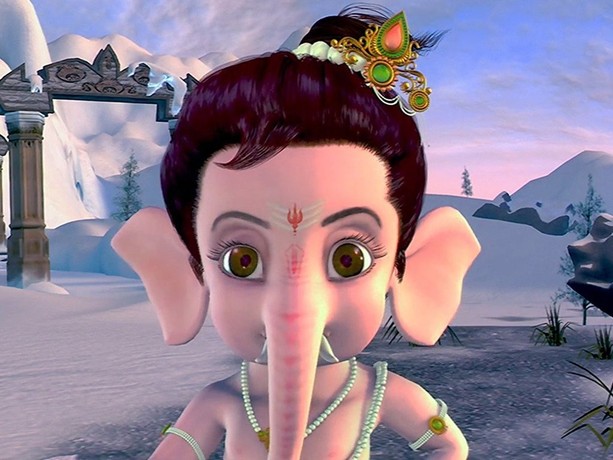
We have seen just another interpretation of Ganesha from the internal lens. It’s time to see how this blog sees Ganesha from the external lens.
We’ve walked a path together, decoding the form of Ganesha as a roadmap for the individual soul’s journey to liberation. But what if the map has more than one destination? What if the same symbols that guide the self also guide the society? We often place spirituality in the sanctum and governance in the public square, as if they are two different worlds. But the ancient seers saw them as one, believing the macrocosm of the state reflects the microcosm of the soul.
This leads to a fascinating thought: Can we read Ganesha’s form not just as a guide to self-realization, but as a blueprint for ideal governance, for Rāja Dharma? The answer, I believe, is a resounding yes. The same four hands that show us the path to Mokṣa also lay out the framework for creating Rāma Rājya.
The Domain and The Law: Pāśa and Aṅkuśa
Let’s look again at the first two hands. The Pāśa, the noose, which we saw as the web of personal karma and attachment, can be viewed on a grander scale. It is the State itself—the vast, interconnected society of people, a complex web of challenges, relationships, and aspirations. Not only people, but the resources in general, like rivers, roads, mountains, cities, etc. This is the domain, the public sphere, that a righteous ruler must hold and care for. Pasa also means bondage or suffering. In general it reflects the suffering of the people in the State.
How does a ruler bring order to this complex State? With the Aṅkuśa, the goad. In this analogy, the Aṅkuśa is not a tool of tyranny, but a symbol for the sharp, precise, and inviolable framework of the Constitution and the Rule of Law. It is the instrument that prevents the elephant of the State from descending into chaos, guiding it with firm and just principles toward progress and prosperity.
The Heart of Governance: Radam and Varadam
Having a domain and a set of laws is standard for any government. But it is the next two hands that elevate this model from mere statecraft to true Dharma. This is where the heart of the philosophy lies.
The Radaṁ, the broken tusk, represents the ethical core of leadership. It is the principle of selfless and unbiased governance, and the profound necessity of sacrifice for the sake of righteousness. A true leader, a true government, must be willing to make painful choices for the greater good. It must sacrifice short-term political gains for long-term stability, or dedicate precious resources to protect the vulnerable. This is the very principle embodied by Lord Rama, who had to make the painful, personal sacrifice of Sita for the sake of his public Dharma as king. The Radam in Ganesha’s hand is a constant reminder that righteous leadership demands sacrifice.
And what is the result of such enlightened governance? What is the ultimate boon, the Varadam, that such a state can grant its people? It is the creation of Rāma Rājya. This is not merely a boon of wealth or power. It is the ultimate societal varada—a nation free from fear, a society rooted in justice, a people secure in their well-being, and a culture that fosters collective bliss. The open hand of Ganesha bestows this state of profound peace and prosperity upon a nation governed by Dharma.
What is Mushaka Dhwaja? Mushaka means chaos, in this external lens, the complete absence of law and order. The government’s main responsibility is to restore and maintain the law and order.
A Timeless Blueprint for Leadership
When seen through this lens, the four hands of Ganesha lay out a complete and timeless model for the ideal state:
- The Pāśam: Acknowledge and embrace the responsibility for the entire, complex State.
- The Aṅkuśa: Govern with the firm and just principles of a Constitution and the Rule of Law.
- The Radaṁ: Lead with an ethical core, ready to make Selfless Sacrifices to uphold Dharma.
- The Varadaṁ: The ultimate goal and fruit of this action is a blissful and just society, a Rāma Rājya.
- The Mushaka Dhwajam: the emblem, symbolizes the triumph over lawlessness and the complete dominion over disorderliness.
The image of Ganesha is thus transformed once more. He is not only the guide for the inner yogi but also the ideal for the outer sovereign. He teaches us that the principles that lead to personal liberation are the very same ones that lead to a perfect society. Perhaps the path to a better world doesn’t lie in inventing new political theories, but in rediscovering the timeless wisdom encoded in the sacred, waiting for us to see it not just with our eyes, but with our understanding.
एकदन्तं चतुर्हस्तं पाशमङ्कुशधारिणम् ।
रदं च वरदं हस्तैर्बिभ्राणं मूषकध्वजम् ॥

