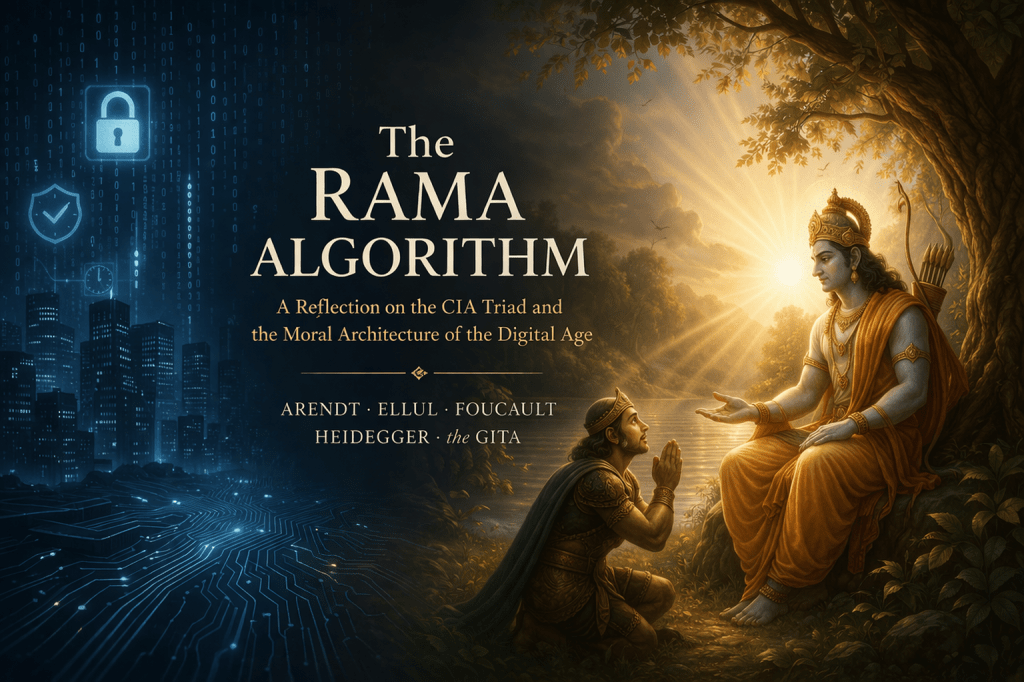
We often say that we live in an algorithmic age. That is true in the obvious sense that software now mediates communication, commerce, logistics, search, entertainment, and increasingly judgment itself. But the phrase conceals a deeper transformation. We are not merely surrounded by technical systems; we are being formed by them. They shape not only what we do, but what appears urgent, desirable, normal, and true.
To describe this condition adequately, technical vocabulary alone is not enough. We need a framework that can think at once about infrastructure, power, moral order, and consciousness. This essay attempts such a framework by bringing together two domains not usually read together: the information-security model of Confidentiality, Integrity, and Availability, and the moral-spiritual language of Dharma.
By the Rama Algorithm, I mean not a literal computational process, but the dharmic order of reality: the lawful relation among truth, right action, consequence, and inner alignment. By the Parallel Government, I mean the modern network of institutions, metrics, platforms, administrative systems, and technical architectures that organizes conduct and increasingly competes for the authority to define reality in practice.
My central claim is simple: the crisis of the digital age is not only that technical systems have become powerful, but that instrumental systems now occupy a place once reserved for moral order. The CIA triad, originally designed to describe trustworthy systems, can be reinterpreted as a way of diagnosing how this displacement occurs.
I. Why the CIA Triad Matters Beyond Security
In information security, the CIA triad is foundational. Confidentiality protects against illegitimate disclosure. Integrity protects against corruption or unauthorized alteration. Availability ensures that systems and data remain accessible when legitimately needed.
Yet because the triad concerns trust, protection, distortion, and access, it can be extended beyond the technical domain. Modern civilization increasingly treats human beings as components inside a socio-technical architecture. If that is so, the same questions arise at a civilizational level:
What is being concealed?
What is being altered?
What is being made accessible, and to whom?
Who defines authorized access?
And what, ultimately, is the asset being secured?
These are not merely technical questions. They are philosophical, political, and spiritual ones.
II. Confidentiality: The Secrecy of Ends
In classical security, confidentiality concerns protection against wrongful disclosure. In contemporary life, however, one of the most striking features of modern power is not only the exposure of persons, but the opacity of systems.
The ends of our systems are rarely stated in their deepest form. They appear under the language of convenience, personalization, productivity, growth, or efficiency. Yet these descriptions are partial. Much contemporary power operates by concealing its real teleology behind procedural neutrality.
Here Foucault remains useful. His analyses of power show that domination does not always appear as overt command. It often works through administration, normalization, surveillance, and self-regulation. What he called governmentality names the production of subjects who govern themselves according to institutional logics they have internalized. Power no longer needs to shout. It works through architecture, habit, workflow, and incentive.
The problem, then, is not simply that corporations keep trade secrets or platforms hide their code. It is that the deeper purpose of the system is veiled. The user thinks the platform serves communication; the employee thinks the firm serves value creation; the citizen thinks the institution serves rational order. Yet beneath those stated aims often lies something more basic: the extraction of attention, the stabilization of behavior, the monetization of predictability, and the expansion of administrative legibility.
Ellul’s critique of technique sharpens the point. Modern societies increasingly subordinate substantive human ends to efficiency itself. Means become autonomous. What begins as instrument gradually reorganizes life around its own imperatives. Under such conditions, the decisive question is no longer whether a system is wise or just, but whether it functions smoothly according to its own logic.
The confidentiality problem of the Parallel Government is therefore not merely hidden information. It is the encryption of purpose. The system’s true ends are diffused across institutions, incentives, abstractions, and layers of distance. Harm proceeds without any single actor fully possessing the whole.
A dharmic vocabulary names this as a crisis of Satya. If truth is not only factual correctness but right disclosure of what is, then a civilization organized by opaque ends becomes structurally vulnerable to Adharma.
III. Integrity: The Alteration of the Human Measure
In security, integrity means that data remains accurate, consistent, and uncorrupted. In moral and political life, the analogous question is: what preserves the integrity of the human person, and what alters it?
At first glance, modern systems appear to value integrity. They emphasize compliance, accountability, auditability, and standardization. But here the deepest inversion occurs. The system often secures its own procedural integrity by quietly undermining human integrity.
Arendt’s reflections on bureaucracy matter here, not because every digital system is totalitarian, but because she identified a durable pattern: large-scale disorder often advances through ordinary function rather than dramatic wickedness. Thoughtlessness, in her sense, is not stupidity but the suspension of judgment under institutional momentum. People continue to perform competently within systems whose ends they no longer examine.
This is why the problem is not always corruption in the crude sense. More often it is redirection. Our honesty becomes loyalty to metrics. Our discipline becomes productivity in service of abstractions we have not morally assessed. Our care for family becomes dependence on structures whose broader effects we would hesitate to endorse if we saw them whole. Our creativity becomes behavioral engineering. Our sincerity becomes fuel.
The information-security metaphor is especially powerful here. The Parallel Government does not merely attack integrity from the outside; it performs a kind of authorized tampering. It modifies the human frame of reference while preserving the appearance of seriousness. One still feels diligent, responsible, and coherent. Yet the object of one’s integrity has changed. The self remains “intact” only in the administrative sense.
Heidegger’s account of enframing (Gestell) deepens this diagnosis. Under modern technological ordering, the world appears as standing-reserve: a stockpile of resources waiting to be ordered, extracted, optimized, and deployed. The danger is not only industrial or ecological, but anthropological. Human beings themselves come to appear as resources. Once that happens, integrity no longer refers primarily to truthfulness of being, but to reliability of function.
Against this, the Gita offers a radically different account of integrity. It does not define the self by performance within the external order alone, but by alignment with svadharma—one’s rightful mode of action within the moral structure of reality. The decisive question is not merely whether one is effective, but whether one acts in accordance with truth, duty, and inner order. One may satisfy institutional integrity while violating dharmic integrity.
The integrity problem of the digital age, then, is not only misinformation or data corruption. It is the slow rewriting of the human measure.
IV. Availability: The Colonization of Attention
If confidentiality concerns concealed ends and integrity concerns altered orientation, availability reveals the most intimate dimension of modern power.
In security, availability means that authorized users can access systems and information when needed. At the civilizational level, however, availability has acquired a different meaning: the expectation that human beings themselves remain continuously accessible.
The worker is reachable after hours.
The user is perpetually notifiable.
The citizen is continuously targetable.
The self is expected to remain interruptible.
This is more than metaphor. It marks a reconfiguration of time, attention, and inwardness. The always-on world converts human consciousness into an infrastructure layer for technical and economic systems. Availability ceases to mean resilience of service and comes to mean permanent extractability of presence.
Ellul again is useful: technique tends toward totality. It does not merely improve functions; it reorganizes the environment around efficiency. Once constant connectivity becomes possible, it becomes expected. Once engagement becomes measurable, interruption becomes profitable. Interior silence starts to look inefficient.
Foucault would likely describe this not as simple coercion but as managed subjectivity. The subject becomes complicit in his own availability. He carries the device, refreshes the feed, interprets responsiveness as responsibility, and confuses constant accessibility with relevance.
Heidegger would see here an intensification of enframing. The human being is gathered into the system not only through labor, but through attention itself. Time is pre-allocated before reflection can intervene.
From a dharmic standpoint, this is devastating because spiritual availability requires the opposite movement: interior receptivity, contemplative distance, and the ability to hear what is not loud, measurable, or urgent. The Gita’s discipline of action is inseparable from a discipline of inward steadiness. One must act, but not be consumed by the turbulence of the field.
The availability crisis of the Parallel Government is therefore not merely overload. It is the colonization of attentional sovereignty.
V. The CIA Triad as Civilizational Inversion
Seen together, the pattern becomes clear.
The Parallel Government produces a distorted form of Confidentiality by concealing its ultimate ends behind technical rationality and procedural language.
It produces a distorted form of Integrity by preserving system coherence while altering the human being’s moral and existential orientation.
It produces a distorted form of Availability by demanding continuous access to human attention, labor, and responsiveness.
This is why the information-security frame is more than metaphor. A civilization may secure its own operational continuity while compromising the deeper security of the person.
The irony is profound: systems built to maximize control, resilience, and predictability may do so precisely by weakening the conditions of human freedom.
VI. AI as the Final Stress Test
Artificial intelligence intensifies all three dimensions.
It deepens the confidentiality problem because opacity of purpose is now joined by opacity of mechanism.
It deepens the integrity problem because predictive systems do not merely observe patterns; they reinforce them. The person is nudged toward becoming more legible to the model that governs him.
It deepens the availability problem because AI extends the reach of system demands into domains once protected by friction: writing, scheduling, evaluation, recommendation, surveillance, even emotional simulation.
Yet AI may also reveal the crisis with unusual clarity. If a machine can anticipate my preferences, imitate my style, and reproduce many of my conditioned reactions, then it exposes how much of what I took to be individuality was already patterned. AI becomes a philosophical stress test. It does not create the emptiness; it makes it harder to ignore.
That is where the essay returns to the Rama Algorithm. If the machine can model the predictable layers of selfhood, then the question of what remains beyond prediction becomes unavoidable. The Gita would frame this not computationally but spiritually: are we established in the deeper seat of action, beyond compulsion and reactivity, or are we only patterned selves mistaking conditioning for freedom?
VII. The Dharmic Reconstruction of the Triad
If the Parallel Government corrupts the CIA triad, the Rama Algorithm restores its depth.
Confidentiality, in dharmic terms, means that the deepest core of the person is not reducible to profile, data exhaust, or behavioral inference. There remains an inwardness systems cannot fully own. This is not secrecy in the bureaucratic sense, but sanctity.
Integrity means more than consistent output. It means inward coherence with truth. A person of integrity is not merely unaltered by unauthorized interference; he is aligned with what is right, even when reward structures encourage compromise.
Availability means not perpetual accessibility to systems, but the ever-present possibility of return to what is real. The spiritual problem is not that truth is unavailable, but that we have become unavailable to it.
This reversal keeps the CIA triad central while restoring its moral seriousness.
VIII. Rama as the Theological Completion of the Triad
A further theological reading is possible. If the Parallel Government corrupts the triad, and Dharma restores its moral meaning, then in the devotional imagination Rama may be seen as its highest personal fulfillment.
Confidentiality, in this register, refers not to institutional secrecy but to the hiddenness of divine action. Rama does not always appear in the ways strategic reason expects. He comes silently, obliquely, unpredictably—sometimes from beyond the visible frame of events. Even the troubling episode of Vali’s death, in which Rama acts from concealment rather than open confrontation, has long forced interpreters to confront a difficult truth: dharmic action is not always reducible to the surface codes by which ordinary human conflict is judged. Rama is “confidential” not because He withholds truth maliciously, but because the full logic of Dharma is not always transparent to finite perception.
Integrity is the least ambiguous dimension of this theological triad. Rama’s fidelity—to truth, vow, duty, and those who take refuge in Him—is one of the tradition’s defining intuitions. His integrity is not merely procedural; it is absolute. He does not simply preserve order; He embodies trustworthiness. Here one may hear an echo of the Gita’s assurance, voiced by Krishna yet resonant across the wider Vaishnava understanding of divine constancy: ananyāś cintayanto māṁ ye janāḥ paryupāsate, teṣāṁ nityābhiyuktānāṁ yogakṣemaṁ vahāmy aham — to those who think of Me alone with single-pointed devotion, I carry what they lack and preserve what they have. Divine integrity is not only consistency, but guardianship.
Availability then reaches its highest meaning. Under the Parallel Government, availability means permanent accessibility to systems of extraction. Under a dharmic and devotional understanding, it means something altogether different: the Divine is never absent. Rama is available with us, for us, and at the deepest level as the sustaining ground of our being. He is not intermittently reachable like a service endpoint that may fail under load. He is omnipresent, inwardly accessible, and what devotional language beautifully calls smaraṇagāmī—the One who comes when remembered. One calls, and He acts; one turns inward, and He is already there.
This theological completion does not replace the philosophical argument; it deepens it. The Parallel Government offers a false triad: hidden ends, corrupted integrity, and compulsive availability. Rama fulfills the triad in its highest form: hidden yet purposeful presence, unbroken trustworthiness, and inexhaustible nearness.
If the modern question is what kind of order secures the human being, the devotional answer is radical: the ultimate security protocol is not merely a principle, but a Presence.
IX. Conclusion: Security for What?
Every security architecture presupposes an asset worth protecting. That is the question with which this essay ends: what, finally, is being secured in our civilization?
If the answer is only continuity of platforms, expansion of markets, optimization of throughput, and stability of behavioral systems, then we may achieve technical sophistication while suffering civilizational disorientation.
But if the asset is the human person rightly understood—truth-capable, morally accountable, inwardly deep, and not exhaustible by data—then confidentiality, integrity, and availability cease to be merely technical objectives. They become names for a deeper struggle over sovereignty.
Arendt reminds us that systems become dangerous when judgment falls asleep.
Ellul reminds us that means become tyrannical when efficiency becomes sacred.
Foucault reminds us that power is most effective when it is internalized.
Heidegger reminds us that technological ordering can reduce beings to resources.
The Gita reminds us that right action depends on alignment with a deeper order than utility.
And Rama, in the theological completion of the argument, reminds us of something further: the deepest security of the self cannot come from systems that merely process us, predict us, and keep us available to their demands. It comes from alignment with that which cannot be exhausted by technique, reduced to metric, or subordinated to administrative logic.
The question, then, is not whether we live under governance. We always do. The question is whether the order that governs us is merely operational, or whether it is also true.
That is why the CIA triad matters here. It is not only a model for defending systems. It is a way of asking whether our civilization still knows how to defend the human being.
And beyond even that, it is a way of asking whether the human being still remembers where ultimate trust belongs.
 Reinvent The Self!
Leave a comment